
September 28, 2026  | By Katrin Bennhold |
Good morning, world. Once a country has nuclear weapons, it suddenly has much more potential to be a danger to the world. At the same time, the world has far fewer options for dealing with that country. It’s unlikely the United States and Israel would have attacked a nuclear-armed Iran, for example.
That’s why North Korea has become such a headache. Its nuclear weapons have protected it from military strikes, making it an example to other nations eyeing bombs of their own. And all efforts to coerce or persuade it to give up its nuclear program have effectively come to nothing; instead, it has steadily built up its arsenal. Today, my colleague Choe Sang-hun writes about why it might be time to try something new with North Korea.
Also:
| Terrorism arrests near U.K. air base A school day in wartime Kyiv A Slovak pop sensation |
 |
| South Korea’s president, Lee Jae Myung, during an interview earlier this month. Chang W. Lee/The New York Times |
Out of options
By Choe Sang-hun
When I sat down with President Lee Jae Myung of South Korea earlier this month, he dropped a bold suggestion that no other major global leader — outside of Beijing and Moscow — has voiced. The world, he said, should lift or ease harsh economic sanctions on North Korea in exchange for halting its nuclear weapons program.
The idea challenges decades of official U.S. policy, which relies on squeezing Pyongyang until it gives up its nukes. Still, Lee pitched this strategy directly to President Trump, who is looking to restart personal diplomacy with the North Korean leader, Kim Jong-un.
Lee’s core argument was simple: What other realistic option does the U.S. actually have?
Consider the facts on the ground.
| Decades of sanctions have failed to stop North Korea from becoming a de facto nuclear-weapon state; instead, they have only hardened its will to expand its arsenal. |
| Pyongyang refuses to negotiate if Washington keeps insisting on immediate denuclearization. |
| China and Russia are now actively helping North Korea flout these penalties.In the meantime, its stockpile of atomic warheads and missiles is growing. |
Lee argues the world must treat denuclearization as a long-term goal but that the immediate priority must be incentivizing North Korea to freeze its current weapons development. Holding onto maximum pressure while demanding total denuclearization is an “idealistic,” all-or-nothing approach that will only aggravate the crisis, he said.
Lee is one of the first global leaders to say it out loud. But the argument he made is one that’s gaining traction: It’s time to try something new with North Korea.
Sanctions versus denuclearization
The U.S. sanctions against North Korea are nearly as old as their troubled relationship.
Washington first imposed them in 1950, after entering the Korean War on South Korea’s side. It’s been almost eight decades, but North Korea has yet to buckle under the pressure. Instead, it responded to what it called “American hostility” by conducting six nuclear tests between 2006 and 2017.
Under American leadership, the United Nations tightened the squeeze in 2017, banning major North Korean exports, including coal, textiles and labor.
The added pressure helped bring Kim to talks with Trump. The pair met three times between 2018 and 2019. North Korea wanted sanctions relief; Washington wanted denuclearization. But the talks collapsed over the question of timing. Pyongyang wanted early sanctions relief, while the U.S. was unwilling to give up its strongest leverage.
Kim returned home frustrated. But a strategic opening emerged with the war in Ukraine. Pyongyang supplied troops and weapons to Russia; Russia strengthened its economic and military ties with North Korea. China, wary of losing influence in Pyongyang, expanded its own trade with the Hermit Kingdom.
One of the casualties of these geopolitical shifts has been the effectiveness of international sanctions. Russia and China worked to dissolve a key United Nations monitoring panel, while the expanding trade has supplied North Korea with fresh capital.
North Korea now faces fewer constraints and possesses more resources to advance its nuclear program. It continues to produce plutonium from spent reactor fuel, has added a second uranium-enrichment facility at its main nuclear complex in Yongbyon and expanded another outside Pyongyang. Since 2019, North Korea has also developed and tested a range of nuclear-capable missiles.
Meanwhile, Lee said, “both sides maintain unattainable objectives and do nothing.”
Now what?
Over the past few weeks, I’ve attended several forums where analysts and former negotiators have wrestled with the North Korea puzzle.
Almost no one believes North Korea will give up its nuclear arsenal in one go. Instead, experts envision a long, phased process: freeze the program, then gradually reduce it, until the country is eventually nuclear-free. Along the way, Washington and its allies would offer economic and diplomatic incentives, building toward a permanent peace treaty and, eventually, formal diplomatic ties.
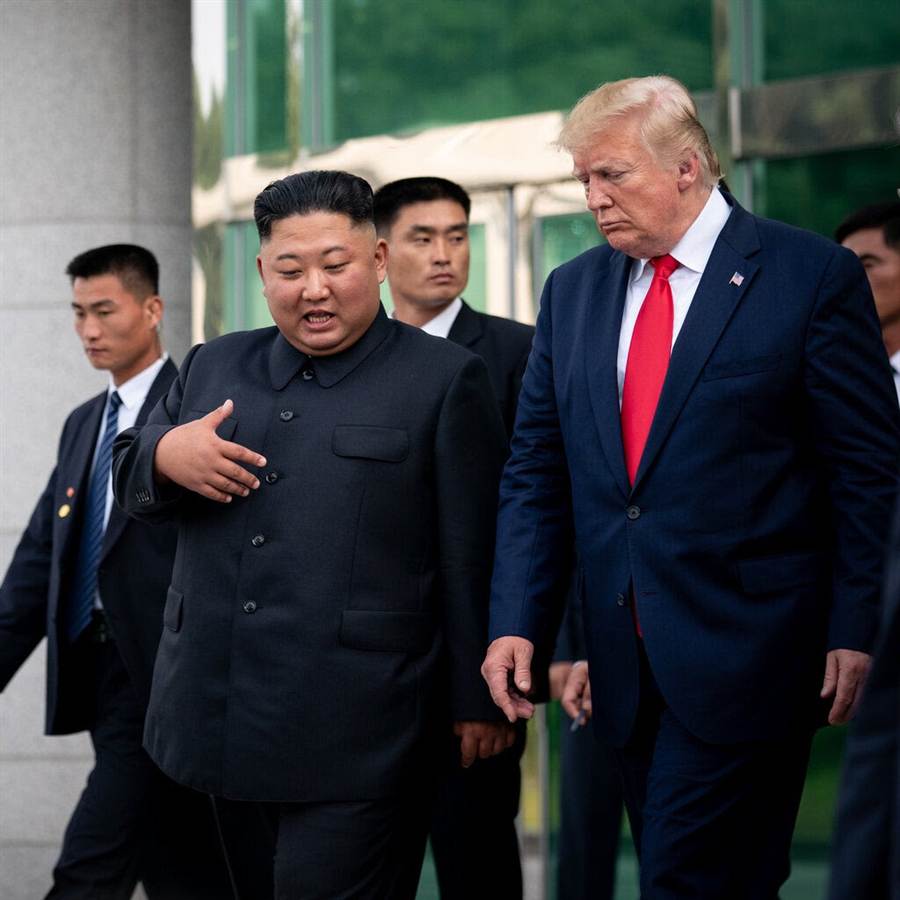
 |
| President Trump and North Korea’s leader, Kim Jong Un, in 2019. Erin Schaff/The New York Times |
But the road ahead is littered with pitfalls. Every previous round of talks — and every short-lived deal, patched together with vague language — has collapsed into recriminations over details like how to verify a freeze. Frustrated American officials have compared negotiating with North Korea to “buying the same horse twice.” North Korean negotiators have likened their U.S. counterparts to “brigands” trying to force them to lower their gun first.
Even if talks between Trump and Kim resume, North Korea would come to the table far stronger than during Trump’s first term. Its arsenal has grown, and it now has China and Russia to lean on if talks collapse. With or without a deal, analysts warn, Pyongyang’s real endgame is getting the world to accept its nuclear weapons as a fait accompli, essentially following the path of India and Pakistan into the nuclear club.
Human rights researchers caution that lifting sanctions would give Kim’s regime more room to exploit forced labor for exports like coal. Others worry Trump will be drawn more to spectacle — a surprise trip to Pyongyang, say — than to the hard work of an actual road map toward denuclearization.
Still, most agree there’s no real alternative other than trying diplomacy again, and soon. Because at this point, North Korea is adding more weapons to its arsenal every year. The price the world will have to pay for a denuclearized North Korea is only going to grow.
| MORE TOP NEWS |
 |
| At the entrance of an air force base in Fairford, England. Justin Tallis/Agence France-Presse — Getty Images |
The British police arrested five men yesterday on suspicion of preparing acts of terrorism after receiving a call about three suspicious vehicles headed toward an air force base used by the U.S. military.
The United States uses the base to deploy some of its largest bombers and has been at the center of controversy this year over its role in the American-Israeli war against Iran.
It is not yet clear whether the episode is connected to the conflict in the Middle East, but investigators are looking into whether there is any link to Iran or Russia. Both have been accused of orchestrating attacks on British soil in the past.
| OTHER NEWS |
| The U.S. ambassador to China said that Trump asked Xi Jinping whether he would like to buy American weapons. The White House later said the U.S. had no plans for such a sale.Two giant pandas, Ping Ping and Fu Shuang, landed in Atlanta, days after Xi said he would send “envoys of friendship” to the U.S.Trump publicly rejected Iran’s latest cease-fire proposal, but the Iranian foreign minister said his country was still awaiting an “official” U.S. response.At least 27 people were killed in two separate shootings in South Africa, near Johannesburg and Cape Town.Aleksandar Vucic, Serbia’s longtime leader, resigned as president, a move that would allow him to keep his grip on power by taking over as prime minister.The Russian and German foreign ministers met for the first time since Russia’s invasion of Ukraine.Our Ukraine correspondent Siobhán O’Grady spent a day at a school in Kyiv where air-raid sirens interrupt classes all day and children must take shelter. Watch her below. |
 |
| Click to watch. The New York Times |
WHAT ELSE IS HAPPENING
| The Mighty Sparrow, known for more than 60 years as the king of calypso, died at 91. He almost single-handedly gave the music of his Trinidadian homeland an electrifying international appeal. |
TOP OF THE WORLD
The most clicked link in your newsletter on Friday was about protests in Spain, spurred by the forced eviction of an 87-year-old woman.
| SPORTS |
Running: The Ethiopian athlete Tigst Assefa won the Berlin marathon, missing a world record run by only 68 seconds.
Football: Manchester City was found guilty of almost all charges relating to breaches of the Premier League’s financial rules. What’s next?
| GROWTH INDUSTRY OF THE DAY |
Catios
The catio — yes, that is a cat patio — is becoming big business. The global market for these covered enclosures designed to allow felines to safely spend time outdoors could grow by roughly $1 billion by 2033.
| MORNING READ |
 |
| Sabrina Santiago for The New York Times |
Is the next pop sensation an ex-ballerina from Slovakia? Meet Adéla, a 22-year-old singer whose star is on the rise. Just a few months ago, she was best known as a contestant on “The Debut: Dream Academy,” a YouTube competition series that resulted in the formation of the girl group Katseye. Viewers who felt she was too exacting and ambitious cast her as the reality show’s villain, voting her off in the first round.
This year, she made her Billboard Hot 100 debut with “Ain’t in LA,” her breakout single about her mother’s dreams of moving to Los Angeles. And “Nicole Kidman,” another song from her new album, was briefly the most-played track on Spotify in the U.S. Read more about her ascent.
| AROUND THE WORLD |
 |
| Samar Hazboun for The New York Times |
An ice cream rivalry in Ramallah
Ramallah, the seat of Palestinian self-government in the West Bank, is home to two dueling ice cream shops. Just a few doors apart, both serve booza — a stretchy, chewy Levantine ice cream — and nearly everyone has picked a favorite.
The West Bank is enduring a severe economic crunch under pressure from the Israeli government. But the ice cream feud, a kind of running joke, has become an aspect of local identity that somehow binds Ramallah together by dividing it. Get a taste.
| RECOMMENDATIONS |
Watch: A grieving widow in Tokyo processes her loss through ballroom dance in the film “Ha-Chan, Shake Your Booty!”
Bewitch: Peruse this “witchy” jewelry collection from Colleen Allen and Alice Waese.
Hunt: Which house in the English countryside would you buy with a $500,000 budget?
Indulge: Here’s how to spend 36 hours in New Orleans.
| RECIPE |
 |
| David Malosh for The New York Times |
In Coahuila, Mexico, salsa de chorizo is not a condiment but a meal in itself, built on the prized local sausage of Múzquiz. Pair it with eggs, toss it with pasta or even layer it into a lasagna.
