
November 18, 2026  | By Katrin Bennhold |
Good morning, world. Tomorrow Anthropic will become the first frontier A.I. lab to go public. The stakes are high. If it goes well, the company could raise as much as $100 billion in the biggest I.P.O. in history. If it goes badly, it could destabilize a market already nervous about an A.I. bubble and still processing the fallout from the Nvidia scandal.
And how well it goes partly depends on whether investors want to bet on a technology that — in the words of Anthropic’s own I.P.O. prospectus — has “extraordinary” potential to solve some of our hardest problems but also carries “catastrophic or existential risks to humanity.” That’s some serious downside risk.
Today, my colleague Dan Barry, in his capacity as a human being, writes about his experience reading a very unusual investment pitch.
Also:
| Ukraine hits a key bridge to Crimea Another Democratic win A weird object floating in space |
 |
| A tech conference in San Francisco in September. Carlos Barria/Reuters |
A human reads the Anthropic I.P.O. filing
By Dan Barry
I looked up from my desk to gaze at the red-orange blanket of fallen leaves just outside my window. I needed the pause, or maybe the distraction, from what I was reading.
The thick document before me looked like any other standard business proposal: a prospectus for an initial public offering with boilerplate language about dividends, compensation and Class A stock. But the more I read, the more it morphed into experimental literature, equal parts business plan, philosophical treatise and sci-fi thriller.
This will be an I.P.O. unlike any other, its language both matter-of-fact and unnerving, its ultimate subject our future. Not futures, as in the stock market, but the future, as in what it might look like and whether we have one.
The prospectus comes from Anthropic, the A.I. lab immersed in the technologies rapidly transforming the human experience. It will offer shares to the public for the first time tomorrow, and this document, recently filed with the Securities and Exchange Commission, lays out its blueprint for potential investors to decide whether to bet on the future of civilization.
I cannot give you odds on this existential gamble.
‘Geniuses in a data center’
In seeking the considerable capital needed for chips, data centers and electricity, the company — with an estimated valuation of more than $1 trillion — begins its pitch by dangling the possibility that A.I. could “solve problems that have resisted generations of human effort.”
It asks us to imagine its A.I. models as “a country of geniuses in a data center,” working in concert to improve our quality of life. Helping to cure disease. Connecting the underserved to medical expertise. Increasing economic productivity. Improving government services.
You’d have to be a robot not to … let me rephrase: You’d have to be a toaster oven not to want an end to cancer.
Anthropic is a public benefit corporation dedicated to balancing social responsibility with profit. Its seven founders have championed a measured approach to developing what the prospectus calls “the most transformative technology in human history.” It encourages developers to compete on safety and security, “rather than rushing to release increasingly powerful models without adequate safeguards.”
In discussing a particularly advanced form of A.I. that Anthropic expects to match or surpass human capability and become widely available, the document says, “If Powerful A.I. is directed at solving humanity’s hardest problems and the risks are managed responsibly, the potential is extraordinary.”
If.
If we work together to ensure the safe and responsible growth of machine intelligence, the prospectus seems to be saying, what a wonderful world this will be (notwithstanding an economic disruption “greater in magnitude” than any other technical advancement in history). If not, then economic upheaval may be the least of our worries.
Keep in mind, dear potential investor, “To build A.I. is to harness cognition itself, and anything so powerful can be used for ill as well as good.”
 |
| Dario Amodei, Anthropic’s co-founder and chief executive. Kent Nishimura/Agence France-Press, via Getty Images |
A cosmic bet
The foreboding I began to feel intensified as I read. Throughout the document’s 300-plus pages are hair-on-fire sentences delivered in the flat language of business. Phrases such as:
“A.I. can be misused by those who wish to do harm, for example to conduct cyberattacks or to design biological weapons.”
And:
“Authoritarian governments may use A.I. to create high-tech surveillance states, deepen repression and make themselves much more difficult to dislodge.”
Even more unsettling is the acknowledged risk of A.I. becoming so autonomous that humans might lose control: “Our A.I. models may behave in unintended, misaligned or autonomous ways, including by taking harmful actions that no user or third party directed.”
At times, the prospectus evokes a muffled Mayday call struggling to convey calm. Consider this mouthful of a paragraph:
“Concerns have been raised both within our organization and by other researchers, regulators, policymakers and industry participants that sufficiently advanced A.I. systems could, if not developed, deployed and operated with appropriate safeguards, oversight and security measures, pose catastrophic or existential risks to humanity, particularly if such systems were misused, replicated, weaponized or allowed to operate with a high degree of autonomy.”
Catastrophic or existential risks to humanity?
To Anthropic’s credit, it dedicates more than a quarter of its prospectus — 93 pages — to “risk factors,” a rare, perhaps unprecedented, transparency about the potential downsides of a business proposal.
Last year the company’s chief executive, Dario Amodei, put the odds of A.I. leading to the end of civilization from 10 to 25 percent. He has since downplayed the doomsday scenario, arguing in part that the odds drop if governments and the tech industry commit to a more deliberate, safety-first approach.
The Anthropic prospectus is, in the end, an investment proposal in which Amodei and his co-founders each have a stake worth some $18 billion. Such outsize numbers only intensify the sense that a chosen few humans — fallible, like all humans — will decide what comes next, leaving the rest of us to hold our collective breath.
As someone who knows next to nothing about investments, I read the Anthropic prospectus solely out of my vested interest as a human being. But I came away from reading the prospectus with no desire to get in on this cosmic bet.
Instead, I got up from the desk and took my dog for a long walk through another Technicolor autumn day, so familiar and, suddenly, so precious.
| MORE TOP NEWS |
 |
| Samuel Granados/The New York Times; Source: Ukrainian Security Service, via Agence France-Presse — Getty Images |
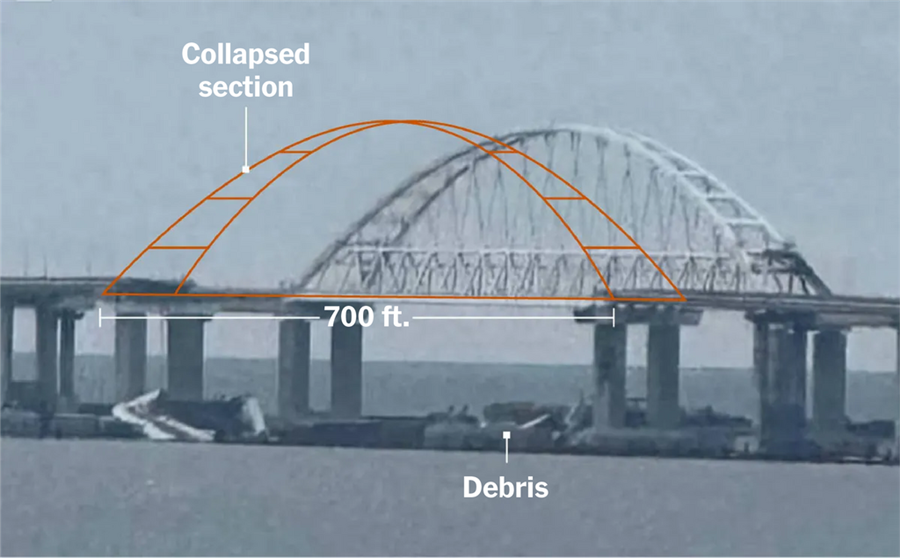
Ukraine hits Russia’s Crimea bridge
After a series of Ukrainian drone and missile attacks, a significant section of the bridge linking the Crimean peninsula to Russia collapsed into the sea yesterday. The damage is a blow to President Vladimir Putin, who presided over its opening in 2018.
The operation required several weeks of destroying nearby air defenses. Previous attacks on the bridge used truck bombs, unmanned naval vessels and covert operatives. Russia has vowed to repair it. See video of the damage.
Related: Leaked files show how Deutsche Bank moved to protect Russian oligarchs it had cultivated as clients.
| OTHER NEWS |
 |
| Doug Mills/The New York Times |
| President Trump met with the Philippine president in Manila before heading to China, where he was expected to cap his whirlwind Asia visit by meeting the Chinese and Russian leaders. Israel’s opposition parties took control of Parliament with the election of a new speaker, ushering in a likely confrontational period of divided government. Jensen Huang said that he was willing to return to Nvidia as chief executive, if the board asked him to do so. The board said it had no intention of doing so. Nvidia yesterday also announced that its sales topped $100 billion for the first time in the third quarter, twice as much as a year earlier. Democrats will hold 56 Senate seats next year — their largest tally in more than a decade — after Mary Peltola was declared the winner in Alaska. Iran’s leaders have hardened their negotiating position with the U.S. since the midterms, seeing Republican losses as a rebuke of Trump’s handling of the war, according to officials. |
| At the U.N. climate talks in Turkey, leaders are backing a plan to expand the reach of electric power, a move that would follow China’s lead. Elon Musk’s companies built a major presence in Texas, but many of his Republican allies there were just voted out. Kirsten Grind, a Times investigative reporter, explains in the video below how the election might affect Musk. |
 |
| Click to watch. The New York Times |
WHAT ELSE IS HAPPENING
| The Suica penguin will soon disappear from Japan’s transit cards, and many people have strong opinions.Christie’s removed a Frida Kahlo painting from auction hours before bidding was to begin. The 1952 work had been publicly reported missing last year from Casa Azul in Mexico City. |
TOP OF THE WORLD
The most clicked link in your newsletter yesterday was about a forensic scientist who said Jeffrey Epstein did not kill himself.
| COSMIC MYSTERY OF THE DAY |
 |
| An artist’s impression of 1998 KY26. M. Kornmesser/ESO; T. Santana-Ros, JAXA/University of Aizu/Kobe University |
Space Object 1998 KY26
In the simplest terms, it’s a boulder orbiting the sun, but it is moving in a way that cannot be explained by gravity alone. Is it a comet, an asteroid or something else entirely? Some scientists think it might actually be a lost Soviet spacecraft — or simply space junk.
We’ve made this link free for you.
| MORNING READ |
 |
| Tatsiana Chypsanava for The New York Times |
Stoats, weasel-like creatures with reddish-brown fur, were introduced to New Zealand from Britain in the late 1870s as a way to control the population of rabbits. But they quickly turned their appetites toward New Zealand’s birds, many of which evolved to be flightless because the islands had no ground-dwelling predators.
The campaign to eradicate stoats has widespread support in New Zealand. Read about an island that’s trying to hunt the last ones.
| AROUND THE WORLD |
 |
| Matt Crockett/Sky UK |
‘Wicked’ goes to Nollywood
By Desiree Ibekwe
Last month, “Saturday Night Live U.K.” reimagined “Wicked” as an early 2000s Nollywood movie: “Nigerian Wicked.” For those unfamiliar with the genre, the sketch might have been a little confusing. For those who were familiar, it was a hilarious blast of nostalgia.
As in the original story, Elphaba is green; Glinda prefers pink. But here they’re styled in the mold of the era’s Nollywood screen sirens and headed to visit the Wizard of LagOz, who is not as he purports to be (he’s broke and sports a fake Rolex).
The plot is not the point. It’s the references to the hallmarks of 2000s Nollywood, including questionable special effects, actors shouting their lines and transparently low production values.
The sketch resonated particularly with British Nigerian audiences, many of whom were brought up on these kinds of movies. I watched my fair share, usually in the form of DVDs purchased by my mum from African food shops.
As one of our critics pointed out recently, “S.N.L. U.K.” takes risks and is not afraid to go hyperspecific. The sketch may be a wink at those in the know, but even for those who aren’t, it’s still very funny. You can watch it here.
| RECOMMENDATIONS |
Read: A new biography of Anita Brookner by Hermione Lee pushes back against the notion of the writer and her work as dour and gloomy.
Restore: A couple turned an old stone house in Burgundy into a home. It took a lot of work.
Consider: Should men wear turtlenecks? Our fashion critic answers.
| RECIPE |
 |
| Armando Rafael for The New York Times |
Much more than the sum of its parts, peposo is a Tuscan stew of beef simmered in an entire bottle of red wine, with black pepper and little else. Its origins are humble: Workers building the Duomo in Florence cooked the stew in the kilns used for the cathedral’s tiles.
