
October 28, 2026  | By Katrin Bennhold |
Good morning, world. It was a dramatic homecoming. On Sunday, Venezuela’s most popular politician, María Corina Machado, who had been in exile for nearly a year, slipped across the border and announced she was back in the country.
Machado wants elections in Venezuela. The United States says it does, too, but has not pushed publicly for a date. Today I write about why Machado’s return could lead to a moment of truth — for Venezuela and for the Trump administration.
Also:
| Israel’s high-stakes election Flávio Bolsonaro flees Brazil “Apartment horror” films |
 |
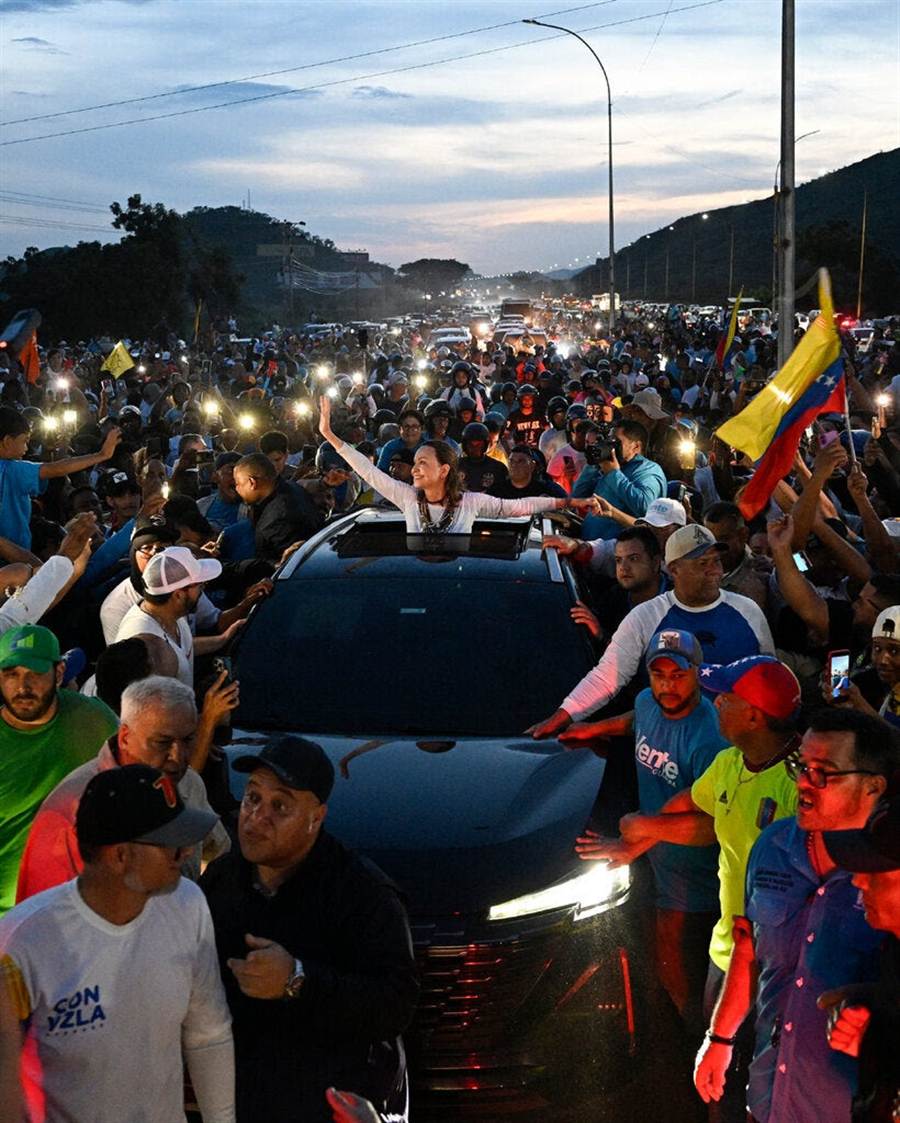
| María Corina Machado in Caracas, Venezuela, on Sunday. Federico Parra/Agence France-Presse — Getty Images |
A dramatic homecoming — but what comes next?
For María Corina Machado, leaving Venezuela was always going to be a gamble.
Under threat from a regime fearful of her popularity, she had spent nearly a year in hiding, changing locations 14 times.
She finally did leave, by boat one night in 2025, to receive the Nobel Peace Prize in Norway. Her attempts to return afterward were repeatedly foiled. The Trump administration, after capturing President Nicolás Maduro, preferred to work with his former deputy.
Then, on Sunday, after nearly a year in exile, Machado surfaced inside Venezuela. At 11:31 a.m. local time, Machado wrote on X: “I am here. With you all.”
Thousands of her followers lined up to cheer her motorcade as it made its way to the capital, Caracas. Some of her supporters said they cried when they heard she was back.
The return of Machado, Venezuela’s most popular politician, now poses a dilemma for the Trump administration. It has promised to work toward elections in Venezuela, while installing as president one of the leading figures in Maduro’s repressive administration. The question: How much does it really care about Venezuelan democracy?
Sidelined by Trump
When the Trump administration toppled Maduro in a surprise overnight raid in early January, Machado might have looked like a ready option to be the country’s next leader.
She had built-in legitimacy with many Venezuelans. A charismatic politician, she rallied millions to vote for her movement in the 2024 presidential election, an election her candidate rightfully won, according to outside observers. Maduro claimed victory anyway.
She’d also gone out of her way to praise Trump, calling him a “champion of freedom,” and even repeating his claims about U.S. election fraud. When she won the Nobel, she dedicated it to him and then later gave him the actual medal.
 |
| Maracay, Venezuela, on Sunday. Gaby Oraa/Reuters |
But in the immediate aftermath of the January raid, it quickly became clear that the Trump administration already had a governing partner in mind, and it wasn’t Machado. It was Maduro’s own vice president, Delcy Rodríguez.
In the months since, Rodríguez has transformed from Trump adversary to pliant partner, and Venezuela has effectively become a modern-day vassal state of the United States, which controls the country’s oil revenues. Trump’s praise for Rodríguez is unstinting. “We have a great situation going over there, with a wonderful president, a wonderful president-elect, Delcy,” he said at a White House event in the spring. “And she is doing a great job.” It was around the same time that Machado visited the White House, and Trump advised her not to return home.
But Machado never gave up. In an interview this month with my colleague Julie Turkewitz, she hinted she’d be back “sooner than you would expect.” We don’t know exactly how she made it in, though we do know that the U.S. did not block her.
The question is whether her return will change anything. In Rodríguez, the U.S. has a leader who does what Washington wants. Would it give that up to support someone it may not control?
Elections by July?
As Julie pointed out, Machado is walking a difficult line. She needs to stay in the good graces of the Trump administration, which calls the shots. She also needs to show her supporters in Venezuela that she is still willing to stand up for them.
Machado told Julie that she would respect any oil deals that have already been agreed to should she come to power.
But she also accused one of the Trump administration’s main business partners, a wealthy man named Alejandro Betancourt, who recently entered into a lucrative deal with the administration to control roughly a fifth of Venezuela’s oil reserves, of “obscene corruption.” Betancourt strongly denies the accusations, and has not been charged with any crimes.
Machado’s track record suggests that she will not back down from her central demand: free and fair elections. And she wants them by July. Were elections held today, she would beat Rodríguez in a landslide, according to a poll this month by Bloomberg News.
Trump’s secretary of state, Marco Rubio, who runs Venezuela from Washington (my colleagues have described him as a de facto viceroy), insists that U.S. support for democracy in Venezuela is sincere, and that he wants it to happen before the end of the administration. Trump himself has been more ambivalent. This summer, he said the country wasn’t ready for elections yet. And on Sunday he greeted the news of Machado’s return with a shrug.
“I don’t know anything about it, but I think she’s a very nice woman,” he said. “She gave me her Nobel Prize, so how can I say anything else? And I hope she’s safe; she’s a very nice woman. But we’re doing really well in Venezuela.”
| MORE TOP NEWS |
Strong turnout in Israel’s election
Israelis voted in the largest numbers in a generation yesterday, in the country’s first election since the Hamas-led attacks on Oct. 7, 2023. Yet, the election did not appear to immediately determine who would lead Israel next.
Exit polls suggested Prime Minister Benjamin Netanyahu’s far-right government was roughly even with a group of opposition parties loosely led by Gadi Eisenkot, a former military chief of staff. (Israel’s exit polls are not considered a precise gauge of the actual results.)
The uncertainty did not stop the leading candidates from making triumphant late-night speeches to their supporters.
Thanks to especially strong turnout by Arab voters — who make up about a fifth of Israel’s population — both sides may need the support of two Arab parties, unless one or more parties defect from one of the main blocs.
Netanyahu has effectively ruled out the possibility of a coalition with the Arab parties, while Eisenkot and his partners have balked at the prospect.
Vote counting is expected to last days, followed by a potentially lengthy effort by the parties to assemble a governing coalition. Follow our live updates.
For more: Netanyahu has long sold himself as the best politician to manage relations with the United States. Watch my colleague Mark Mazzetti explain in the video below how that alliance is now under strain.
 |
| Click to watch. The New York Times |
| OTHER NEWS |
| Flávio Bolsonaro, the presidential candidate defeated in Sunday’s election in Brazil, left for the U.S. a day after the Brazilian police asked him to hand over his passports because he was being investigated in a money-laundering case. South Africa’s president deployed more than 500 soldiers to the city of Durban, a week after a foreign national was beaten to death there during an anti-immigrant protest. The leaders of Finland and Norway made a rare phone call to President Vladimir Putin of Russia in an attempt to end the war in Ukraine. The Trump administration is exploring lifting U.S. sanctions on Russia’s flagship government investment fund. A rare cease-fire, brokered by Melania Trump, began in the Russian-occupied Ukrainian city of Oleshky. A British man was charged with helping Iran’s intelligence service after a security incident at an air base last month. Another man was charged with a separate offense. |
U.S. MIDTERM ELECTIONS
We’re making our U.S. politics coverage free in The New York Times app through the midterm elections.
| California is seeing increased immigration enforcement by federal officers as the Trump administration targets alleged voter fraud ahead of the election. U.S. policy on Israel is at the center of a pivotal Senate race in Michigan, driving anxiety among Jewish and Muslim voters. |
TOP OF THE WORLD
The most clicked link in your newsletter yesterday was about Copenhagen’s new snack.
| ASK OUR CORRESPONDENTS |
U.S. midterm elections are next week. Their outcomes will have global implications. We want to hear from you: Send us your questions about the midterms, and we’ll pick a few for our colleagues to answer.
| CELEBRITY WHISPERER OF THE DAY |
 |
| Kate Warren for The New York Times |
Jonathan Van Meter
The longtime Vogue writer just released an authorized biography of Kim Kardashian. Anna Wintour herself assured Kardashian that Van Meter would be perfect for the project. Oprah Winfrey, Lady Gaga and Jill Biden are among the other famous women who have opened up to him. Read more about how he gets them to talk.
| MORNING READ |
 |
| “Rigor Mortis”, Well Go USA |
Hong Kong is one of the least affordable real estate markets on the planet. Some residents have to live in subdivided accommodation known as “coffin homes,” and even a parking spot can cost more than half a million dollars. This tension has given rise to a subgenre of Hong Kong horror films in which high-density housing is a spooky backdrop for exploring superstitions and socioeconomic anxieties.
In one film, a character’s efforts to save up for an apartment end in a killing spree (that ends up lowering the price of the building’s units). Many of the movies are steeped in Hong Kong folklore, which says that the dead live among us all the time. Read more about the subgenre.
| AROUND THE WORLD |
 |
| Joao Silva/The New York Times |
Celebrating immigrant flavors in anti-migrant South Africa
Sandile Tshabalala, a self-taught South African chef who goes by the name Sanza, created the popular Yeoville Dinner Club, named for the gritty immigrant-rich Johannesburg neighborhood where he used to live. His food borrows from countries including Nigeria, Haiti and Senegal.
At a long table that seats two dozen, he serves family-style dinners that highlight his embrace of immigrants and their cuisine, especially those from other African countries — a notable stance with violence against African immigrants on the rise. Sanza hopes that food can help counter the xenophobia. Read more about his life and work.
| RECOMMENDATIONS |
Watch: In the documentary “Making Marie Antoinette,” the late Eleanor Coppola lovingly recorded the behind the scenes of her daughter Sofia’s film.
Visit: This boozy New York City bookstore crawl is perfect for tourists and locals alike.
Peek: Coco Chanel’s love of lions inspired a new necklace.
Beware: Beleaguered snack-food companies are trying to popularize new “snacking occasions” between meals.
| RECIPE |
 |
| Kelly Marshall for The New York Times |
The Wolof word “rof” here refers to a coarse, peppery paste that is a necessity in Senegalese and Gambian cuisines. Use it to marinate fresh fish, chicken and steak.
