

 |
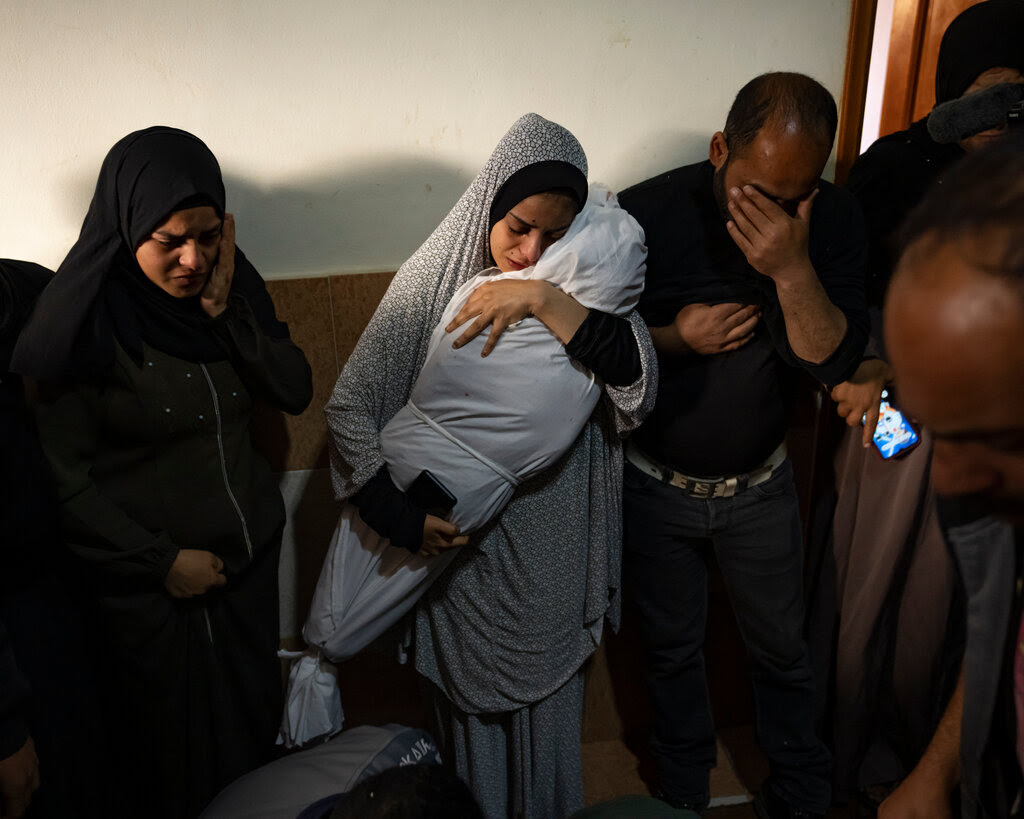
| Mourning relatives killed during strikes in Rafah. Fatima Shbair/Associated Press |
Six months of war in Gaza
It will be six months this Sunday since the Oct. 7 attacks that started the war between Israel and Hamas. More than 32,000 Palestinians have died, people in Gaza are desperate for aid and dozens of Israeli hostages are still being held there.
My colleague Amelia Nierenberg spoke with Patrick Kingsley, our Jerusalem bureau chief, to understand the state of the war.
Amelia: How close are we to a deal, or a meaningful pause in the fighting?
Patrick: We are at an impasse.
Cease-fire negotiations are stuck for several reasons, but in large part because Israel wants to limit the ways in which Hamas could regroup during a temporary truce, whereas Hamas wants the kind of truce that would allow it to reorganize on the ground.
While those talks falter, Gaza is in limbo. Israel plans to invade Rafah, Hamas’s last major stronghold, but has delayed doing so while it tries to gather international support for the operation.
Elsewhere in Gaza, Hamas is largely routed. But there is a chaotic power vacuum because Israel has withdrawn from certain areas without transferring power there to other Palestinian groups, amid disagreements in Israel about who should run a postwar Gaza.
The result is that the war has slowed since the start of the year. But it continues to kill and has left the territory on the verge of what experts say is a looming famine.
Israel and Hamas have fought in the past. Why is this war more devastating than others?
For Palestinians and their supporters, it’s the result of Israel’s abject disregard for civilian life and its willingness to prioritize the eradication of Hamas over the likely collateral costs to human life and civilian property.
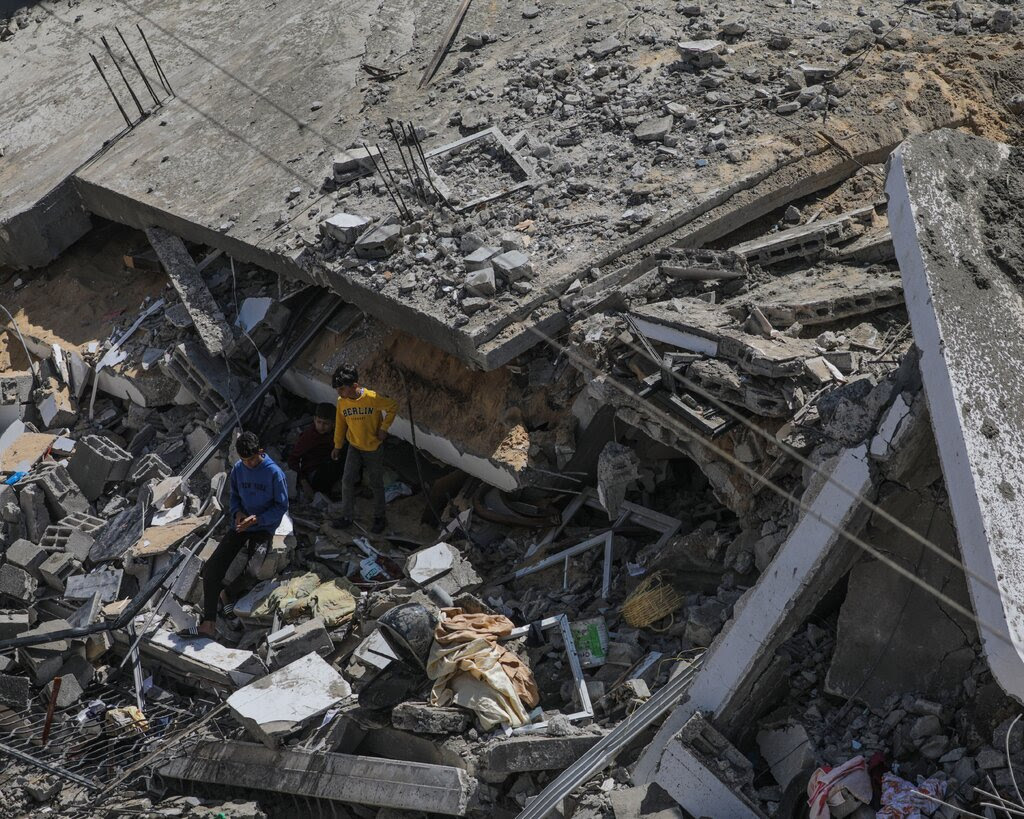 |
| Israeli attacks have leveled much of the Gaza Strip. Mohammed Saber/EPA, via Shutterstock |
To Israel and its supporters, the damage and the death toll is the result of Hamas embedding itself inside civilian areas, in houses and underneath houses in their subterranean tunnel network.
We have seen these completely divergent interpretations in previous Gaza wars. What makes this conflict different is that Israel, deeply traumatized by Hamas’s attack on Oct. 7, is now seeking to destroy Hamas instead of setting it back by a few months, as it tried to do in previous conflicts.
That maximalist goal has led to a longer and much more devastating war.
What do the next six months look like?
A few months ago it felt like we might see some kind of grand deal to end this war and maybe even see some progress in the wider efforts to end the broader Israel-Palestinian conflict.
Now, it seems like the most likely short-term outcome is just more of the same. The negotiations will continue to stutter. Israel will continue to stall on either the Rafah invasion or a power transition in the rest of Gaza. Hamas will continue to hold out in Rafah and try to regroup elsewhere, which will lead Israel to re-enter areas it has already vacated.
All of that may create a kind of slow-burning stalemate. It would not surprise me if we were still stuck in this strange, deadly stasis even on the war’s anniversary.
Latest news:
| Benjamin Netanyahu: Israel’s leader is facing eroding domestic support.President Biden: He called Netanyahu yesterday and told him that future U.S. support “will be determined” by how Israel treated civilians in Gaza. Tthe National Security Council said later that Israel had agreed to open new paths for aid. |
 |
| Iranians breaking their fast in Tehran, near a banner showing a general killed in an Israeli strike in Syria. Arash Khamooshi for The New York Times |
Iran said battles with separatists left 28 dead
Iranian security forces battled simultaneous terrorist attacks in two cities by a militant separatist group that raged for nearly 17 hours. Intense gunfights in the streets resulted in the deaths of 10 security officers and 18 militants, according to the Ministry of Interior.
The gunmen tried to take hostages, and several blew themselves up with explosive vests during the fighting, Iran’s deputy interior minister said. The militants also tried to take over military bases belonging to the Islamic Revolutionary Guards Corps, the Guards said in a statement published in Iranian news media.
Jaish al-Adl, a separatist ethnic Baluch group designated by the U.S. as a terrorist organization, claimed responsibility for the attacks in Sistan and Baluchestan Province, in the southeast. The fighting came during a period of heightened tension after Israeli airstrikes in Damascus, Syria, killed three senior Iranian commanders.
 |
| Laborers from Tajikistan, in Moscow in 2020. Sergey Ponomarev for The New York Times |
A backlash against Tajiks in Russia
The arrest of a group of Tajik citizens accused of carrying out the attack that killed 145 people at a Moscow concert hall last month has led to a crackdown on the Central Asian migrants who prop up Russia’s economy.
The crackdown has exposed one of the main contradictions of wartime Russia, where nationalist fervor promoted by the government has brought xenophobia to new heights even as foreign workers have become an irreplaceable part of the country’s war effort.Continue reading the main story
| MORE TOP NEWS |
 |
| Federico Rios for The New York Times |
| Darién Gap: Sexual assault along the busy migration route is happening at levels rarely seen outside of war zones, aid groups say.NATO: The alliance is looking for a way to show long-term support for Ukraine without granting the country membership.South Korea: Many residents are growing exasperated with the thousands of doctors who walked off the job.Taiwan: The island’s exceptional preparations explain the relatively low number of deaths after a powerful earthquake.Finland: The 12-year-old boy who killed a schoolmate and injured two other students said bullying led to the shooting. |
Politics
| Health: President Biden and Donald Trump, the two oldest people to seek the U.S. presidency, have released less information about their health than many of their predecessors.Kuwait: Kuwaitis voted in parliamentary elections yesterday. Even though the oil-rich emirate is far from a full democracy, it offers a rare alternative to more authoritarian countries in the Middle East.Documents: A federal judge rejected one of Trump’s central efforts to dismiss charges that he mishandled classified documents after leaving office. |
The Week in Culture
| John Barth: The writer, who died this week, ran riot over literary rules and conventions.Nudes: Contemporary artists are breaking away from idealized (usually white and thin) naked forms. |
A Morning Read
 |
| by Fiske Planetarium, University of Colorado Boulder and Desi Collaboration |
Dark energy, the mysterious force that is speeding up the expansion of the cosmos, was assumed to be constant. But new data from astronomers suggest that it may be more changeable.
If dark energy is constant, it could mean that the universe would eventually expand to the point of dissolution. But if the new conclusion is confirmed, dark energy is capable of changing course and pointing the cosmos toward a richer future.
| SPORTS NEWS |
Soccer officials: How much do they get paid per match?
Turkish Super Lig: Explaining Fenerbahce’s vote on whether to quit.
Japanese Grand Prix: A guide to the Suzuka Formula 1 track.
| ARTS AND IDEAS |
 |
| Stephanie Gengotti for The New York Times |
For sale: a Michelangelo drawing (or is it?)
For centuries, a drawing of a man adorned the wall of a villa, in which Michelangelo once lived, overlooking Florence, Italy. Tradition has long held that the image was drawn by a young Michelangelo.
The drawing was removed from the wall and has since been lent for Michelangelo exhibitions around the world. But scholars are not entirely certain that Michelangelo made it, and now that it is going on the market, academic debate could intensify.
| RECOMMENDATIONS |
 |
| Romulo Yanes for The New York Times. Food Stylist: Vivian Lui. |
Cook: This midnight pasta can be ready in minutes.
