
Αθήνα, 13 Νοεμβρίου 2026
JOURNALIST: Foreign Minister, thank you for joining us here. Our last conversation, I think, was in December of last year. A lot has happened since then, so we’ve got a lot to talk about. The biggest thing that everybody in the world is looking towards is at both to Washington, and to see what President Trump is going to do now after our midterm elections. The President yesterday said “We don’t need a deal,” but the fact is that military action—the President also said that we’re essentially over, we’re essentially done, and that any future U.S. military action is highly unlikely. Where do we stand with regard to things? What do you think? How do we get to a true end to the U.S. war in Iran?
G. GERAPETRITIS: Thank you, Matthew. First of all, it’s a wonderful opportunity to discuss with you. It’s always very stimulating to talk to you. We live in challenging times. We keep on saying that we live in challenging times, but the truth is that every single day there is a new thing coming up, and it’s even more challenging than yesterday. And most importantly, the problem is, Matt, I think, what we do today is tomorrow’s precedent. So we need to be very cautious with what we’re doing. We need to be very focused in order to maintain the strategic element of international security architecture that we have made since World War II. Now, when it comes to Iran, I think the situation is very delicate and sensitive. To be totally honest, I do not think that any military action at this moment in this very volatile region could result in a sustainable peace. I think what we should do is to exhaust all possible means in order to achieve a diplomatic solution to this issue. Unfortunately, I have to say that we live in a period where there is an overall awakening in the globe, and we live in an era of the end of illusions.
For example, in Iran, what we see is that geography is turning into a hybrid weapon. The use of the Strait of Hormuz, for example, is totally unacceptable because it hurts not only the freedom of navigation but, essentially, it provides food insecurity, energy insecurity, and there is a global threat, I think. So what we need to do is to try and establish some ground rules about this. What President Trump said was that we need to have a solution that would be (a) sustainable and resilient, and (b) that would have a fair result. You know, President Trump is always trying to have tangible deliverables, and this is something that we all need to address. Sometimes, Matt, I use Greek words to establish the current geopolitical situation. We use as positive elements democracy, dialogue, diplomacy, but we also use Greek words like “chaos” and “catastrophe.” We need to prevent the latter. And in my eyes, what we need to do is to develop a more deliberative approach into this. We need to have inclusivity. We need to involve the Gulf states. We need to have the neighboring states on board. We need to have a diplomatic solution that will secure not only the overall regional security but, above all, the freedom of navigation. We need to understand that freedom of navigation is not about ships and seafarers. Freedom of navigation is about the well-being of the globe.
JOURNALIST:I couldn’t agree more in that. You mentioned freedom of navigation. I think it’s a major issue. In fact, just in the last few days, we’ve seen this playing out with regard to the Turks blocking or trying to block a Greek ship, or a French-flagged ship, I think that’s owned by Greeks, that was going to Cyprus, that was part of the building of the undersea electric cables. Can you talk to us about the challenges that you guys are facing in the East Mediterranean? And, you know, again, your point about the weaponization of geography, what we’re seeing in that part of the world as well.
G. GERAPETRITIS: The truth is that the Mediterranean has become the epicenter of hostility in the last few decades. The fact that the Mediterranean Sea is very rich in hydrocarbons and that there are overlapping claims among all coastal states—there are 21 Mediterranean states—has made the whole situation in the Mediterranean very difficult. What we’re trying to do in Greece is to develop a pattern of extensive connectivity. We have become an energy hub in the Eastern Mediterranean, not only through pipelines and electricity interconnectors but also through the vertical corridor that we are developing alongside with American companies. But also, we have a series of projects in southern Crete concerning the research and hydrocarbon extracts, with Chevron and Exxon. Now, coming to the GSI project, this is a project of fundamental significance, I think, for Europe, because it connects Greece with Cyprus and eventually with the Middle East. This is going to be a very critical factor in order to prevent any kind of over-reliance when it comes to energy. So, it is of critical importance not only for us but also for Europe, for Africa, and for the Middle East. In the past, there were some incidents of interference on the part of Türkiye in this project.
We have made it clear that this project is of European significance, and we are not going to tolerate any kind of intervention in this matter. So, what happens now is that Greece has provided the license to the vessel to research and lay the cable line. The project is progressing. I have to say, Matthew, that the whole of the Mediterranean is abundant with that kind of interconnectors, so there is no point in arguing. I do realize that there are claims from many states, but we have to understand that connectivity is essentially the precondition for prosperity in the future. Unless we have a wide range of connectivity projects, we cannot survive in the future. You see, for example, what happens in Europe. In Europe, we had a tremendous over-reliance on Russia concerning natural gas and petroleum products, and this resulted in a significant recession. We needed to just get rid of that type of over-reliance. We made it partly through the renewable energy sources, but the truth is that we need to develop further connectivity. Connectivity is not about energy. Connectivity is about solidarity among nations and prosperity of people.
JOURNALIST: So, Mr. Foreign Minister, specifically about energy, you mentioned the Chevron and Exxon projects that are happening in Greece. We know those are happening in Cyprus too, with regard to energy and natural gas exploration. I’ve done interviews with both the Greek and Cypriot energy ministers. President Trump shared both of those on his Truth Social, so he is tracking this very closely. President Trump and his administration have been encouraging our European friends and friends around the world to develop their own energy. You guys are leading the way in doing that. The British just came around, so the new administration in the United Kingdom just came around, and they’re now doing natural gas exploration. I was meeting with the British Embassy in Washington before I came over here, and they were very excited to tell that to me. So talk to us about where we’re at with regard to this energy development, and why it’s important when we see the possible instability in the Middle East and things that are happening, of course, in the other parts of Eastern Europe with Russia and Ukraine. Why it’s important that the West develop its own energy sources and not be dependent on anywhere else.
GERAPETRITIS: It’s all about resilience. The truth is what I mentioned before: we are now living in an era of collapse of illusions, to be honest. For example, in Europe, I mentioned that we had the illusion that this type of overreliance on Russia concerning natural gas would last forever. We had the illusion that we could just live on the security guarantees by the United States forever. We thought that peace was a given after World War II in Europe, and we now see that we have a war just inside Europe. So a lot of illusions are collapsing at the moment. This calls for a new strategic narrative, I think, and this narrative should focus, first, on the idea of resilience and, secondly, on the idea of geography as a bridge of friendship. What I mean is that we need to develop a region where resilience should concern, first of all, defense capabilities. We need to start working in our region, and I speak about Europe primarily, we need to develop our deterrence in a much stronger way, because unless you have deterrent mechanisms, you cannot project peace. This is the truth.
And, on the other hand, we need to develop all kinds of connectivity projects in order to develop energy resilience.This is actually what we’re doing now in Europe. We coordinate in an extremely effective manner with the United States when it comes to the vertical corridor and other projects. You mentioned our cooperation with Chevron and Exxon. We are now developing a high-caliber project connecting Greece with Egypt, this is the GREGY project, in order to transfer green energy both ways, from Europe to Africa and vice versa. This is a truly visionary project, in the sense that what we’re trying to do in Greece, but more broadly in Europe as well, is to actually have enough resources to be able to combat any kind of adverse circumstances in the future. And, unfortunately, history tells us that when there are multiple crises, we need to be prepared for the future. And indeed, as has been said, the truth is that in the last few years what we did was to try and emphasize on prediction and projection in geopolitics. This is totally wrong. You cannot project what is going to happen because we do not have anymore the parameters given in order to develop this type of foresight. And what we need to do now is to develop a deliberative attitude, we need to work with other nations, with leaders, in order to develop common values and shared values.
And, on the other hand, what we need to do is to try to turn geography into a bridge of friendship. Greece is in a very, very sensitive region. You know that much. I heard the Deputy Prime Minister, he’s a wise person, he mentioned that some years ago probably everybody would be discussing about the terrible geographic location that we live in, both here and in Greece, because we are not in the best neighborhood ever. But the truth is that the neighborhood should be an asset and not an arena of hostility. This is what we’re trying to do in Greece. This is what Iraqi and Kurdish people are trying to do here. And I think this is going to be the motto for the future: bridges for the nation and bridges for the people. Connectivity should be accompanied with inclusivity. I think those two elements are going to be the key factors for global prosperity in the future.
JOURNALIST: So, Foreign Minister, you mentioned the close ties and work with the United States on a lot of different things, including energy. One of the things I’ve found from talking to folks in both Greece and in the United States—I’ve been to Greece now six times in the last year and a half and have interviewed a number of people, including yourself and the Prime Minister and many other ministers. Later today we’ll talk to the Health Minister and Vice President of the governing party, New Democracy, Adonis Georgiadis here—is that the ties between the two countries have never been stronger. We’re celebrating our 250th anniversary in the United States this year. The two countries have been forever linked from our founding, both countries’ founding. Frankly, our founders in America looked to Athenian democracy to form our constitution and system of government. And then one of the first places that we engaged anywhere in the world was to help the Greeks win independence. But again, I do believe the two countries are closer than ever. I believe that to be true. In fact, I sat down with Secretary Rubio in Washington right when he returned from his incredible address in front of the Acropolis just a few weeks ago, a month or so ago.Talk to us about the ties between the United States and Greece. I do believe they are warmer than ever and only getting warmer.
GERAPETRITIS: I think we are at the heyday of our bilateral relationship. It’s been an outstanding period for the Greek-American relationship, and you can only see this both through the bilateral visits that we have, but also the shared approach in most of the regional and global issues. We had, as you mentioned, Mat, an amazing visit of the Secretary Rubio. I had the honour to welcome him in Athens. We had very constructive and productive talks about what is happening between the two countries, but also globally and regionally. And he gave an outstanding speech in Pnyx, just above Acropolis. I think that signifies the shared values about democracy. If one sees history, they could only say that there is a parallel route between the two countries, the constitution, the American constitution of 1787 was the inspiration for the Greek constitutions, the American Revolution was the inspiration for the Greek Revolution, and, vice versa, the Greek ideas were essentially the key elements within the American Declaration of Independence. I think we are destined to have this kind of deep relationship. And this relationship obviously transcends electoral cycles. The midterm elections are not going to affect in any way this relationship.
We do have a significant number of Greek-American-origin Deputies and Senators now serving. And we have the Greek-American Diaspora, which is very viable, and it is the bridge of friendship. I think what we’re now having is a relationship of mutual respect, and I think this is going to be further cultivated in the near future. There are a lot of things that unite us. Energy is one factor. We have a large number of American investments now operating in Greece, and we’re working hard in order to have some further ties.
JOURNALIST: Foreign Minister, we’re here in Kurdistan, we’re here in Sulaymaniyah, in Iraq. There’s a huge Greek presence at this event here. As I mentioned, there are several other Greeks who are here. Can you tell us about what you guys see here in terms of the opportunity? Why come to Sulaymaniyah? Why come to the Slemani Strategic Forum? What is it about here, in Iraq, in the Middle East more generally, that the Greeks see as an opportunity? Why are you guys putting in the work and coming to places like this? What is it about here that gives you hope for the future?
G. GERAPETRITIS: I will be very modest because I don’t want everyone to come and invest in Sulaymaniyah. I would like first the Greeks to come and invest. So I’m not going to be very open about promoting this idea. The truth is that this place is absolutely fit for large-scale investments because this is an emerging place for investment. I think Iraq, and especially this region, Sulaymaniyah, is now a very fertile region for investments in many sectors. I would only mention, for example, energy, agriculture, tourism. I’m very hopeful that in the very near future we will have a direct flight connection between the region and Athens, and this will further develop people-to-people ties. But above all, I have the feeling that the sustainability and the resilience of the region now largely depends on economic growth. There has been an amazing job done here in Iraq. I hope that there is going to be a very deliberative spirit when it comes to the talks concerning full inclusion. And I think this is the perfect place for investors to come here and invest. What I would like to say is that this region has suffered a lot in the past, but this is one of the few resilient civilizations, if one sees history. This region will never, never fall in decay. It’s going to be always in the spotlight. And I am very hopeful that in the very near future, Iraq and Iraqi Kurdistan will be developing as one of the key destinations for investors globally.
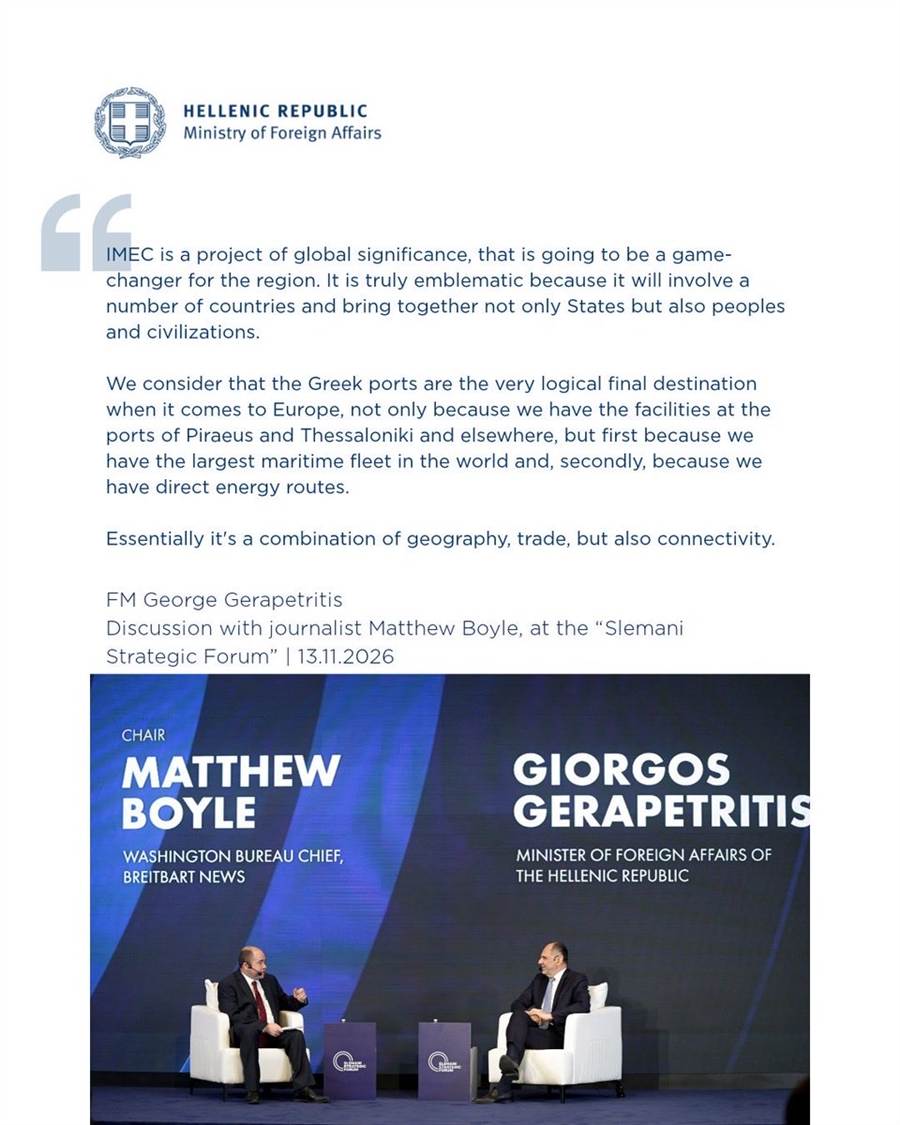
JOURNALIST: And the last thing I want to ask you here, Mr. Foreign Minister, is just about what you mentioned, the long history here. We look at the long history of a place like Greece. I always look to these ancient civilizations as places that we can learn a lot from in the United States. And we talked a lot about the geopolitics of these various Corridors. Whether it’s the Vertical Corridor – we didn’t talk about this in this conversation, but we have in previous ones – about the IMEC Corridor to connect the Far East with the Far West. Talk to us about the geopolitical importance of this region, about the Eastern Mediterranean. And again, we’re talking about geopolitics, geography being important. Talk to us about that.
G. GERAPETRITIS: IMEC is a project of global significance, and I think this is going to be a game-changer for the region, but also more broadly, because the truth is that now, with what we are suffering with the partial closure of the Strait of Hormuz and Bab al-Mandab and what is happening in the Red Sea, we need to find alternative routes, not only when it comes to the actual transport of products, but also for electricity, for data, for telecommunications, eventually for models to connect people. And I think the IMEC project is truly emblematic because it will involve a number of countries. It will bring together not only States but also peoples and civilizations. It will develop people-to-people ties. It will further develop the people’s mobility in the broader region. For us in Greece, we consider that the Greek ports are the very logical final destination when it comes to Europe and the getaway to Europe, because not only do we have the facilities at the ports of Piraeus and Thessaloniki and elsewhere, but first because we have the largest maritime fleet in the world. As you probably know, we almost possess 20% of the global maritime fleet and more than 60% of the European maritime fleet. And secondly, because we have direct energy routes. When you actually directed towards Greece, essentially you can just move through our connectivity projects to Eastern-European States, to Central-European States, to North-Africa. So essentially it’s a combination of geography, trade, but also connectivity.
JOURNALIST: Thank you, Mr. Foreign Minister.
G. GERAPETRITIS: It was wonderful. Thank you so much.
