
November 11, 2026  | By Katrin Bennhold |
Good morning, world. It didn’t take long after last week’s midterm losses for the Trump administration to begin publicly fighting over the war in Iran.
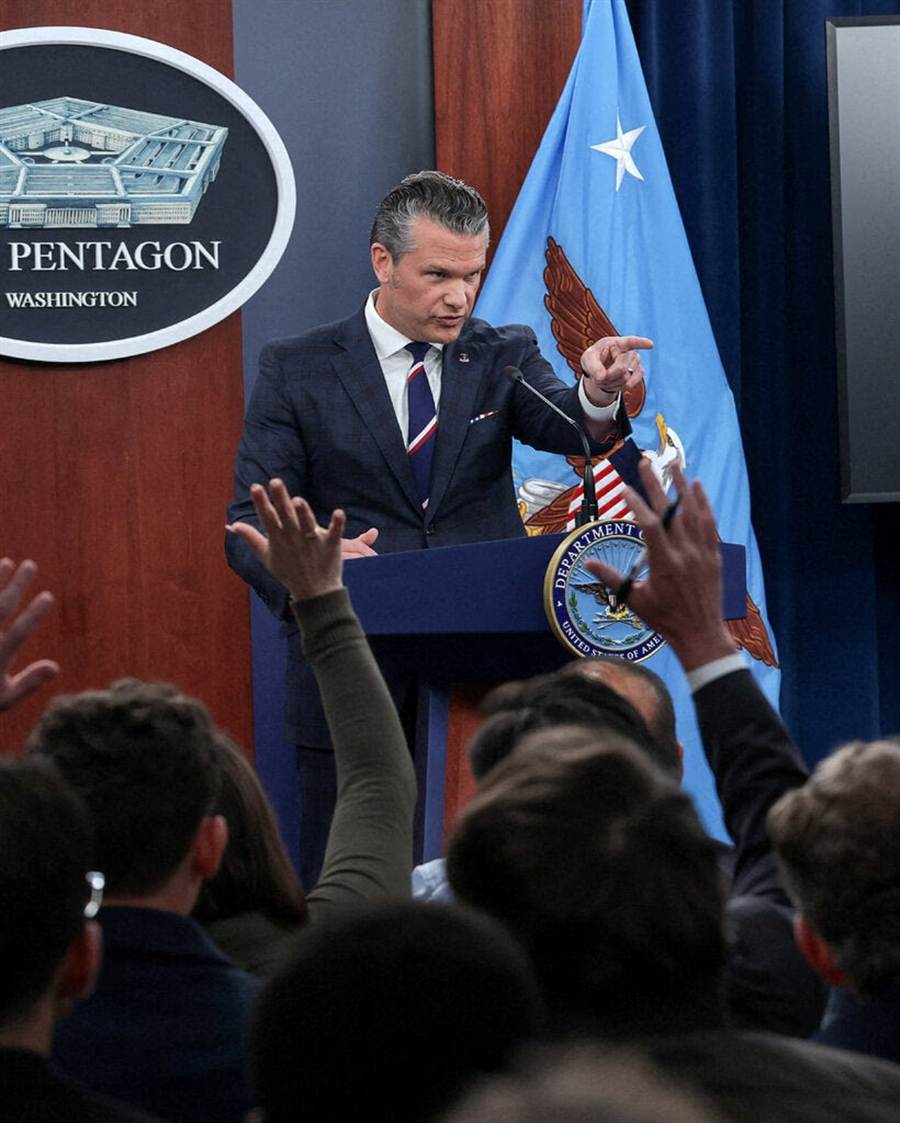
Divisions are now out in the open. “The reason we lost is the war,” Vice President JD Vance declared. Defense Secretary Pete Hegseth, in contrast, posted a defiant video defending the war. He also had to defend himself from a now-shelved effort — led by a Republican congressman with Democratic support — to impeach him. (More on that below.)
We’re seeing a formidable U.S. military buildup in the Middle East — a third aircraft carrier is expected to arrive soon. Fighter jets, long-range bombers, warships and 50,000 troops are all on standby.
So what does this all mean for the war? Today, my colleagues David Sanger and Eric Schmitt outline four potential scenarios.
Also:
| Russia’s bravest newspaper shuts down The Nvidia spy scandal The honest truth about cranberries |
 |
| In Washington last week. Doug Mills/The New York Times |
No easy choices
By David E. Sanger and Eric Schmitt
The public split last week between Vice President JD Vance and Defense Secretary Pete Hegseth over the war with Iran is now fueling an urgent question: How does the U.S. get out of the conflict?
The debate inside the administration has hardly been a secret since the war started more than eight months ago. Vance privately expressed skepticism; Hegseth was among the most gung-ho.
Now, President Trump must decide where he will come down as he weighs whether to launch a renewed attack.
On Monday, he said that the war was “effectively over” (an assertion Iran swiftly denounced as “fake news”). But he also said the U.S. was “locked and loaded” should circumstances change.
At the core of the problem, according to people engaged in the debate, is a fundamental issue: Trump and his aides still cannot agree on what they are trying to accomplish.
 |
| The U.S. aircraft carrier Theodore Roosevelt in Singapore on Saturday. 2026 Planet Labs PBC, via Reuters |
Here are some of the U.S. options under review:
A brief, intense escalation
The most ambitious option that the U.S. and Israeli militaries have developed calls for a short but intensive operation over several days. The targets would probably include Iran’s energy infrastructure, nuclear facilities, and missile and drone arsenals. There are no expectations that a few days of battle will collapse the government; for that, U.S. officials are relying on continued economic pressure.
Trump has often spoken about targeting Pickaxe Mountain, the American name for a deeply buried nuclear site that Iranians call Kooh Kolang. But even the 22,000-pound bomb known as MOAB, the largest nonnuclear weapon in the U.S. arsenal, would probably not destroy an underground site like Pickaxe, which is composed of granite.
The campaign would inflict more damage on Iran’s already degraded missile and drone arsenal, and could perhaps result in concessions in limiting the country’s nuclear program and fully reopening the Strait of Hormuz. But such an approach has not worked before. Iran would strike back at Gulf states, almost certainly driving up energy prices and inflation. Defending the Gulf states would strain the Pentagon’s eroded global supply of missile interceptors.
Pared-back strikes
A shorter, scaled-back version of the first plan would probably take many energy targets off the table, focusing on military and nuclear sites, officials said. The thinking behind this approach is that Iran would be less likely to retaliate by attacking Gulf energy infrastructure.
Trump could claim that the U.S. had inflicted additional damage on Iran’s arsenal, declare victory and begin the exodus from the region. A more limited offensive would also preserve the Pentagon’s stockpile of scarce interceptors.
But administration officials concede that a limited strike would achieve none of the goals Trump set out at the beginning of the war, and would still leave Iran with significant leverage over the Strait of Hormuz.
 |
| Vice President JD Vance at a campaign rally last month. Tierney L. Cross for The New York Times |
Try diplomacy
Before the midterm elections, Vance reached out to Gen. Mohsen Rezaei, the secretary of the Supreme National Security Council and a former commander in chief of the Islamic Revolutionary Guard Corps, suggesting that American and Iranian officials meet soon.
Initially, the proposal seemed well received, and officials from Qatar, Pakistan, Turkey and Saudi Arabia have all been involved in communicating with the Iranians. But in recent days, some American negotiators have turned more pessimistic, according to people familiar with their thinking, fearing that whatever agreement they reach could be undercut back in Tehran by radical hard-liners.
History shows that a diplomatic solution is the only way to have long-term limits on a nation’s nuclear program. But many experts believe Trump would be lucky to get limits akin to those in the Obama-era deal, which Trump withdrew from in 2018.
Muddle along
In this scenario, the U.S. would live with the status quo: an expensive naval blockade that prevents Iran from exporting oil, while U.S. escorts and patrols ensure that 11 to 18 million barrels of non-Iranian oil get through each day. This would effectively allow Trump to avoid making a decision, in the hopes of a longer-term resolution.
He could also seek to negotiate a narrow deal to reopen the Strait of Hormuz, leave sanctions in place and slowly withdraw — letting the Gulf Arabs work out a deal with the Iranians over how the strait is managed.
But such a deal would not address the nuclear or missile issues — much less the nature of the Iranian leadership — that led Trump to go to war in February. And there would be no timeline to the endgame, meaning the conflict could drag on for the remaining years of Trump’s presidency and into that of his successor.
| MORE TOP NEWS |
 |
| Secretary of Defense Pete Hegseth at the Pentagon yesterday. Evelyn Hockstein/Reuters |
A derailed impeachment effort
Republicans in the United States House of Representatives banded together to shelve the effort to impeach Defense Secretary Pete Hegseth.
The House voted to refer the charges to a committee, which would allow Republicans to slow the process indefinitely.
The eight articles of impeachment introduced by a Republican lawmaker, Thomas Massie, involve the war in Iran and other operations. Democrats could still move to impeach Hegseth next year when they assume power, but have so far not indicated whether they will try to do so.
For more: Democrats are preparing to open investigations into Trump, his family and his administration. Michael Gold explains in the video below.
 |
| Click to watch. The New York Times |
| OTHER NEWS |
 |
| Jensen Huang, the Nvidia C.E.O., and Alice Huang at a restaurant in Shanghai. |
| Alice Huang, the woman at the center of Nvidia’s spy scandal, worked with tech titans to obtain essential A.I. chips. Here’s what we know about her. Novaya Gazeta, Russia’s most daring independent newspaper for decades, closed its doors. A Saudi court has sentenced a domestic worker from Kenya to 100 lashes for giving birth outside marriage. Britain’s counterterrorism police said that they had arrested a member of the U.S. Army on suspicion of spying for Russia. A former prime minister of Malaysia, Najib Razak, who was brought down in a corruption scandal, was released from prison to serve the rest of his sentence under house arrest. Support for Indonesia’s president has collapsed after his government failed to contain raging wildfires. The C.I.A. quietly expanded its operations in Mexico last year, a Times investigation found. |
WHAT ELSE IS HAPPENING
 |
| Neil Mockford/GC Images, via Getty Images |
| The British entertainer and best-selling children’s author David Walliams was publicly accused of sexual misconduct. He denies the accusations. Six Pablo Picasso etchings that were stolen from a restaurant on the French Riviera have been found behind toolboxes and a pile of linens in a home in the region. |
TOP OF THE WORLD
The most clicked link in your newsletter yesterday was about a coveted New York City hairstyle.
| SPORTS |
FIFA: The former Arsenal manager Arsene Wenger is being lobbied by key stakeholders to stand against Gianni Infantino in the association’s presidential election.
Football: Manchester United is expected to fire Michael Carrick as head coach after a series of draws and losses.
| NUMBER OF THE DAY |
 |
| Jason Henry for The New York Times |
$1.4 trillion
That’s the top-range valuation that Anthropic is targeting with its blockbuster initial public offering. Yesterday, the maker of the Claude A.I. models set a share price range of $70 to $78, with trading expected to begin on Nasdaq next week. It’s poised to be the largest I.P.O. in history, topping that of Elon Musk’s SpaceX.
| MORNING READ |
 |
| Emin Ozmen for The New York Times |
Turkey is the top importer of plastic waste from Europe. Much of it is recycled, but a lot of it ends up in the environment alongside vast quantities of Turkish trash.
My colleagues visited Adana, the center of Turkey’s recycling industry, and followed the pollution through canals and beaches and saw the flow of plastic runoff all the way to the Mediterranean. Scientists told my colleagues that plastic shredded during the recycling process had washed up as far away as Antalya, 400 kilometers west, where Turkey is hosting COP31, the U.N. climate summit. Read more about how Europe’s trash ends up on Turkey’s beaches.
| AROUND THE WORLD |
 |
| Anthony Cotsifas |
Budapest at night
My colleague Andrew Higgins first visited Hungary’s capital soon after Soviet troops pulled out in 1991. Back then, there was a palpable sense of giddiness over the fall of the Iron Curtain, despite the gloom and decay of a city blighted by more than four decades of Communism.
To see how history and beauty rub against each other now, Andrew set out on a series of walks in neighborhoods crammed with reminders of Budapest’s unsettling but also seductive past. Read his essay.
| RECOMMENDATIONS |
Slay: The cool girls in New York City are wearing jeans from the brand Still Here.
Travel: My colleague in Ho Chi Minh City has a guide to finding a great beach in Vietnam.
Revisit: Chance the Rapper reimagined his Grammy-winning mixtape for the concert stage.
Consider: Cranberries are a must on the Thanksgiving table. But how healthy are they?
We’ve made this link free for you.
| RECIPE |
 |
| Armando Rafael for The New York Times |
Senate Bean Soup has been served to senators and their staff for more than 100 years in the U.S. Senate Dining Room. This stovetop recipe honors the original, with navy beans, ham hocks, butter and onion, but perks it up with carrots and smoked paprika.
