
Good morning, world! When the United States invaded Iraq in 2003, it took pains to stress that toppling its dictator was about spreading democracy, not extracting oil.
President Trump’s messaging since sending troops into Venezuela to topple its autocrat this month has been very different: This is about oil, not democracy. Today, I write about Trump’s open push to claim Venezuela’s vast petroleum reserves — and how that may be easier said than done.
Also:
| Trump heads to Davos Shinzo Abe’s killer is sentenced The Beckhams are fighting |
 |
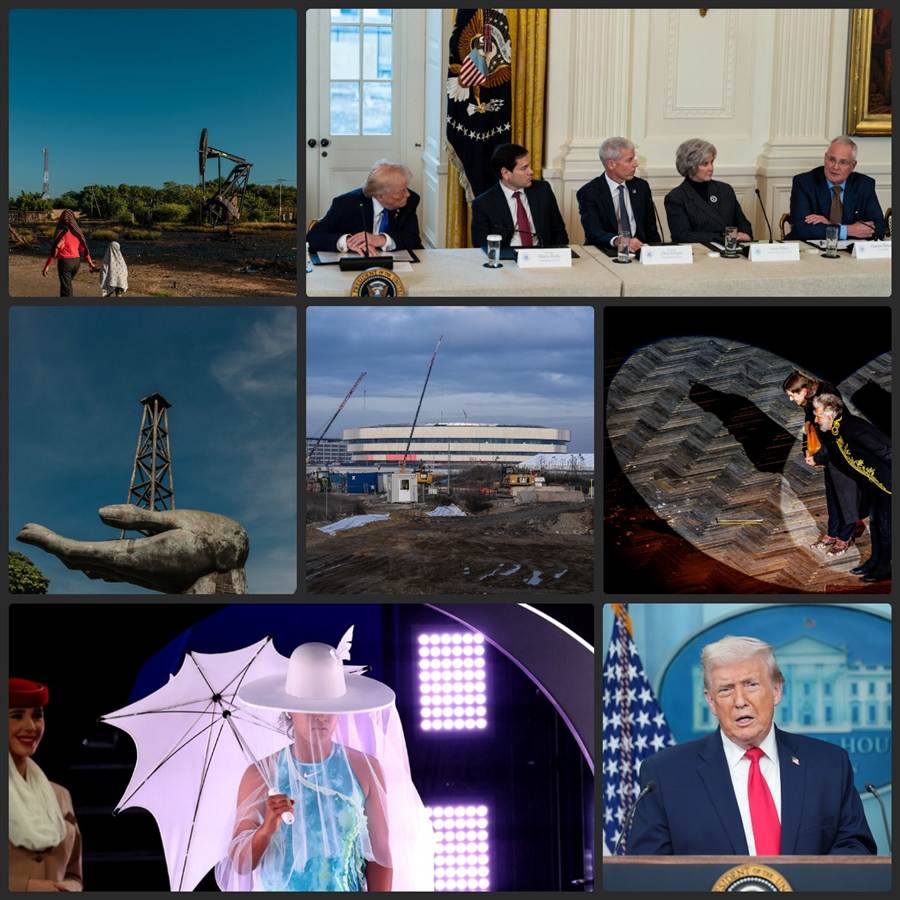
| A statue near Venezuela’s state oil company in Caracas. Adriana Loureiro Fernandez for The New York Times |
A crude awakening
One early sign that things might not go so smoothly for the U.S. in its quest for Venezuelan oil was how American energy companies responded.
In a meeting between oil executives and President Trump this month at the White House, Darren Woods, head of Exxon Mobil, called Venezuela “uninvestable.” Another oil magnate and Trump ally, Harold Hamm, was more diplomatic, but not exactly enthusiastic. Venezuela has “its challenges,” Hamm said.
Trump has made it clear that he wants to move fast. At that meeting, which he called less than a week after U.S. troops captured the Venezuelan president, Nicolás Maduro, Trump told oil executives to “rapidly rebuild” the South American country’s oil industry.
Last week, exclusive reporting by my colleague Anatoly Kurmanaev found that the U.S. has already begun selling 50 million barrels of the Venezuelan oil that had previously been trapped by a partial U.S. blockade.
There are good reasons for the U.S. administration to prioritize speed, Anatoly told me. The Venezuelan economy was days from collapsing. Oil storage was near capacity. The currency was in free fall. Officials had to get that trapped oil out and dollars in as soon as possible.
“It was a race against time,” Anatoly said. “Trump has no interest in a collapsed Venezuela right now.”
In the longer term, Trump has bigger ambitions. He wants what he calls “energy dominance” — enough weight in the global oil market to curb the power of OPEC countries and gain leverage over China. Venezuela is part of that plan.
But in the weeks since the invasion, these longer-term ambitions to gain effective control of Venezuela’s oil industry have “run headlong into reality,” my colleague Anton Troianovski wrote last week.
Trump’s grand plans might take years to come to fruition — if they come to fruition at all.
 |
| Oil and gas executives at the White House this month. Tierney L. Cross/The New York Times |
Slow and expensive
One problem for Trump is that the U.S. doesn’t have a national oil company. Exxon, Chevron and the like are private corporations that will start projects only when they see a good business opportunity. When they look at Venezuela, they don’t like what they see.
The case for investing in Venezuelan oil isn’t straightforward. The country has a lot of oil, but gaining access to it and turning it into a profitable business would take a lot of time and upfront investment, as my colleague Peter Coy writes. That’s the kind of thing that U.S. oil companies, which have recently sought to economize on investments and cut risk, don’t like.
Low oil prices mean the incentive to invest is limited. “Many analysts believe that a vast oversupply of oil is already sloshing around global markets,” Anton wrote.
Another problem: The U.S. may have removed Maduro, and achieved seeming compliance from his successor, for now, but it’s far from clear that it has achieved long-term political stability in Venezuela. A history of political turmoil, which led to the assets of U.S. oil companies being nationalized in the first place, is part of why executives view the country as “uninvestable” today.
And, as some of my colleagues have been reporting, there are signs that cracks have already begun appearing.
 |
| Oil rigs in Cabimas, Venezuela. Adriana Loureiro Fernandez for The New York Times |
‘Zero oil’
For all the discontent many Venezuelans feel toward their government, oil has been an integral part of the country’s opposition to the U.S.
“For the last three decades, they have been fed an ideology of ‘Chavismo,’ with its goal of harnessing oil wealth to transform the country, empower the poor and stand up to the United States and its imperial ambitions,” writes my colleague Maria Abi-Habib.
And so some Venezuelans find it hard to swallow their new status as a country willing to cooperate — and share oil wealth — with the Americans who just invaded them.
“At this point, we should have cut off the oil, we shouldn’t have sold any oil to the United States. Zero oil, zero oil!” one Venezuelan told Maria.
It’s not clear how long the new government will manage to stave off these forces in order to continue cooperation with the United States. Even if it does, other ingredients for instability abound: The country remains filled with paramilitary groups, Colombian guerrillas and gangs.
It’s not the kind of environment that looks tempting to an oil executive watching from Texas. But Trump is also willing to strong-arm them into submission. “I’ll probably be inclined to keep Exxon out,” the president told reporters after the White House meeting. “I didn’t like their response.” Exxon’s stock slipped in the aftermath, though it has since recovered.
| MORE TOP NEWS |
 |
| Trump spoke at the White House yesterday on the one-year anniversary of his second inauguration. Eric Lee for The New York Times |
Greenland tensions rise at Davos
Trump is scheduled to speak at the World Economic Forum today, one day after leaders denounced his threats to take over Greenland. However, Air Force One was forced to turn back with Trump on board after experiencing an electrical issue en route to Davos.
Prime Minister Mark Carney of Canada gave a searing speech about a “rupture” in the world order. President Emmanuel Macron of France said Europe had little regard for “bullies,” after Trump threatened 200 percent tariffs on French wine.
In a series of comments and social media posts ahead of his arrival, Trump mocked European leaders as being weak. His standoff with Europe rattled markets. Greenland’s prime minister would not rule out the possibility of a U.S. attack, even though he said it was “not likely.”
Related: Trump marked the first year of his second term with a one-hour 45-minute meandering speech about his accomplishments and grievances. “I think God is very proud of the job I’ve done,” he said.
| OTHER NEWS |
| A 45-year-old man was sentenced to life in prison for assassinating Shinzo Abe, Japan’s longest serving prime minister, with a homemade gun in 2022.Russian strikes left thousands of apartment buildings in Kyiv without heat in subfreezing temperatures.Our photographer found a wrecked train undercarriage that could identify the cause of the train crash in Spain. Here’s how the collision unfolded, killing at least 42 people.There was another train crash in Spain, this one in the Catalonia area. It killed one person and injured 37 more.Israel seized the headquarters of the U.N. agency for Palestinian refugees in Jerusalem and demolished some of its buildings.Britain approved construction of a Chinese mega-embassy in London despite spying fears.Australia passed tighter gun control laws after a mass shooting at a Hanukkah celebration in Sydney killed over a dozen people.The eldest son of Victoria and David Beckham posted explosive accusations against his parents on Instagram. Here’s what’s going on. |
| SPORTS |
 |
| Martin Keep/Agence France-Presse — Getty Images |
Tennis: Naomi Osaka entered her first Australian Open match in style.
Football: Evaluating each Premier League team’s plans for the January transfer window.
| DAVOS QUOTE OF THE DAY |
“I imagine they will form the dreaded European working group.”
— U.S. Treasury Secretary Scott Bessent, in response to questions about European efforts to block Trump from seizing Greenland.
| MORNING READ |
 |
| Stas Levshin |
When “The Kholops” opened in St. Petersburg in 2024, Russians raced to see the play about 19th century nobles, which is not-so-subtly scathing about Russian life under President Vladimir Putin.
The biggest plot twist: Authorities have not shut it down. Officials seemed to recognize that closing “The Kholops” (the title means “The Serfs”) would create a scandal. Many critics and theatergoers have also theorized that the play has avoided intense scrutiny because most of its judgments arrive indirectly. Read more.
| AROUND THE WORLD |
 |
| Alessandro Grassani for The New York Times |
A new Olympic race: rink building
The Milan-Cortina Olympics are less than three weeks away, but the venue for ice hockey, one of the Winter Games’ premier events, is still a construction site.
More than 1,000 workers are scheduled for round-the-clock shifts until the arena in Milan is completed. The opening ceremony is on Feb. 6, and the head of Milan’s Olympic committee said he was confident that “the arena will be done by Feb. 5.”
The late-stage work has raised anxiety because the National Hockey League has warned that its players, scheduled to participate in the Olympics for the first time in a dozen years, will pull out if the ice is not safe or ready. Read more.
| RECOMMENDATIONS |
Read: “Eating Ashes,” by Brenda Navarro, is a tale of migration, loss and memory.
Care: Here are seven things women should know about heart disease.
Wear: Should you cuff your pants? Our fashion critic has thoughts.
| RECIPE |
 |
| Armando Rafael for The New York Times. Food Stylist: Cyd Raftus McDowell. |
Red Red, a common dish served in Ghana, is a popular stew of beans and peppers. It often starts with soaking and slowly cooking the legumes until tender. This recipe uses canned beans and yields a spice-forward, piquant sauce.
