
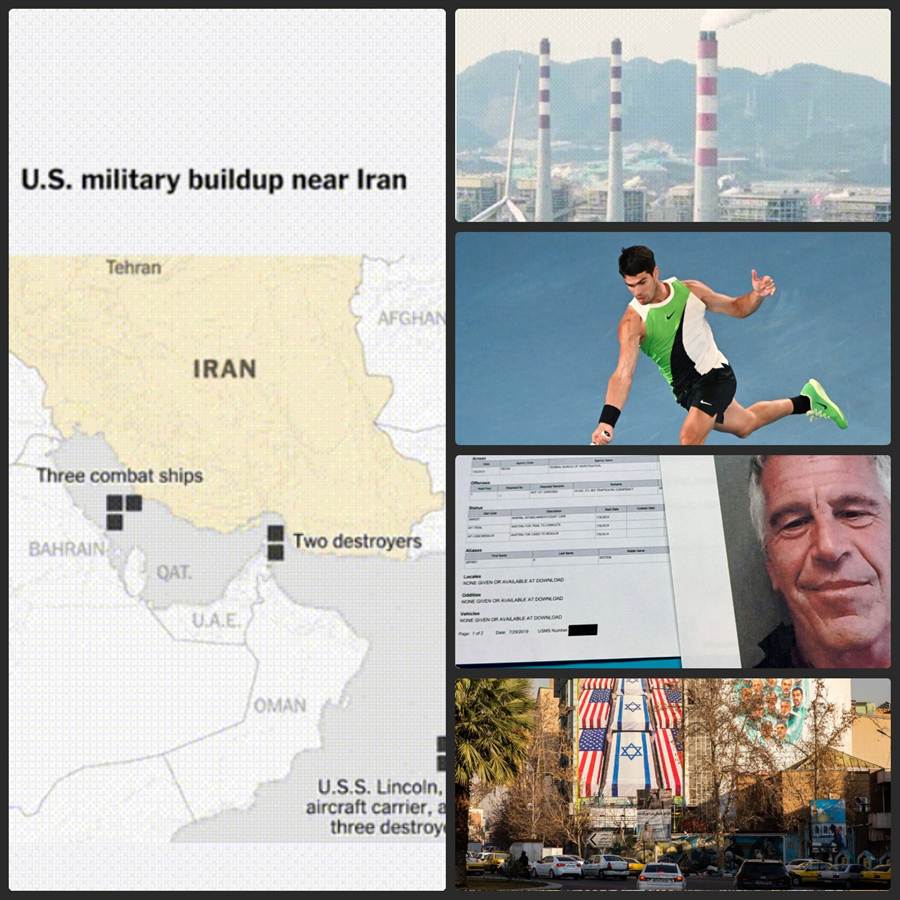
Good morning, world! A huge U.S. military buildup in coastal waters. Repeated threats of military action from the White House. People inside the country hoping President Trump will remove a dictator.
Sound familiar?
Trump’s saber rattling on Iran is reminiscent of the weeks preceding the brazen raid that toppled President Nicolás Maduro of Venezuela last month. But Iran is not Venezuela. Today I write about why bringing down the Iranian leadership would be much harder than ousting the president of Venezuela was — and how it could destabilize the entire Middle East.
Also:
| The men named in the Epstein files A deadly drone strike in Ukraine Hockey, sex and lots of Canada |
Iran is not Venezuela
If you take President Trump at his word, the clock is ticking on military action against Iran.
Trump has effectively given the Iranian authorities an ultimatum. He has demanded that Iran end its nuclear program, stop producing missiles that can reach Israel and cease all support to armed proxies in the region — basically give up all its leverage. It’s a long shot.
And last week, he detailed what would happen if Iran did not comply. “A massive Armada is heading to Iran,” Trump wrote on Truth Social. “Like with Venezuela, it is, ready, willing, and able to rapidly fulfill its mission, with speed and violence, if necessary.”
Trump is actively making a comparison to Venezuela. The United States amassed forces just off Venezuela’s coast as part of a pressure campaign against the country’s leader. When he refused, the U.S. attacked and captured him in a bold overnight raid.
But, as my colleagues report, Iran’s ability to strike Israeli cities and destabilize the wider Middle East makes it a far more dangerous adversary than Venezuela. Which is why, for all his bluster, Trump and his top aides are still weighing whether to make good on the threats of military action.
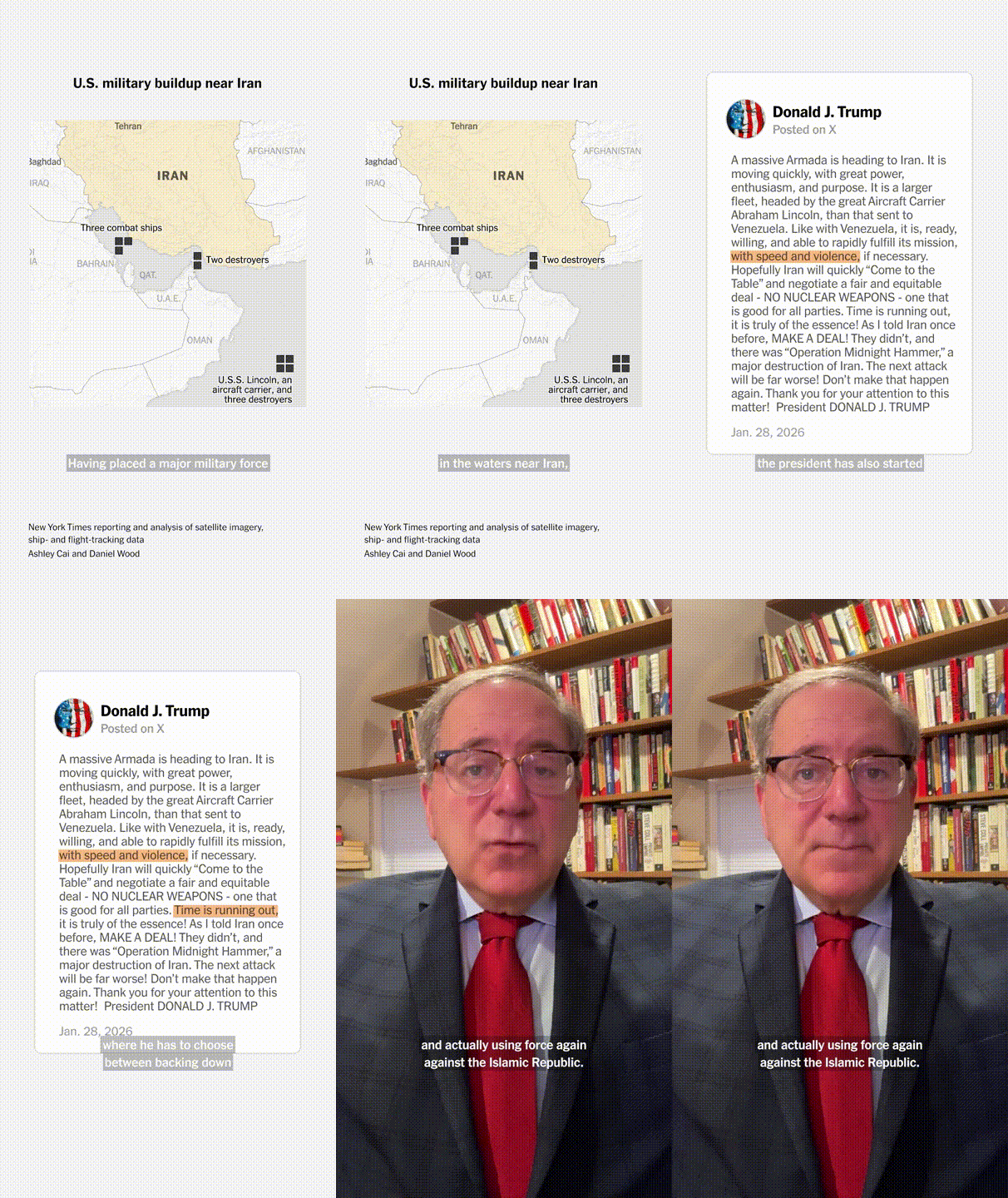
“The president is using Venezuela to try to intimidate the Iranians, but without a clear objective,” my colleague David Sanger in Washington told me. “The playbook is familiar. But the target is very, very different.” (Watch David explain in the video above why Trump is going after Iran now.)
Threatening all-out war
The analogy with Venezuela is tempting.
Iran, like Venezuela, is run by a brutal authoritarian government and has been crippled by years of sanctions. It defines itself in opposition to the United States, relying on U.S. rivals like China and Russia to circumvent trade restrictions.
And it’s weak domestically, as mass protests revealed in January. Dozens of Iranians have told my colleague Erika Solomon, our Iran bureau chief, that they hope Trump will make good on his promise to send help and remove the supreme leader, Ayatollah Ali Khamenei.
But Iran has a lot of capacity to inflict damage in ways that Venezuela does not.
Tehran looks militarily weak at the moment. The Assad regime in Syria has fallen. Other regional allies, like Hamas and Hezbollah, have been decimated. And bombardments by Israel and the U.S. last June damaged Iran’s ballistic missile production lines and buried much of its nuclear stockpile.
But Erika told me that this weakness is part of the reason the Iranian leadership is so determined to strike back. You can read her analysis here.
“This time it’s about survival,” Erika told me. “They have signaled that if the U.S. strikes them, they will do what they can to make this an all-out war in the region.”
 |
| A mural in Tehran on Tuesday. Arash Khamooshi for The New York Times |
Israel on high alert
Shiite militias in Iraq that Iran has long supported have pledged to come to Iran’s aid. These “martyrdom forces” vow to fight to the death and could ignite skirmishes with U.S. forces in Iraq that would significantly destabilize the country, Erika said.
The Houthis in Yemen could also join the fray. In the past, they’ve targeted U.S. ships in the Strait of Hormuz, an important shipping lane for world trade.
But the most immediate threat comes from Iran’s long-range ballistic missiles. They can cover a distance of 2,000 kilometers, exposing the entire Middle East. And Iran has warned that, if attacked, it would strike Israel and U.S. troops in the region.
I spoke to my colleague Ronen Bergman in Tel Aviv. He told me that last June, only a few Iranian missiles made it past Israel’s air defense system.
But after two years of war, Israel is low on interceptors — the missiles that are fired into the atmosphere to take down incoming missiles. And this time, Israeli intelligence agencies told Ronen, an Iranian counterattack could focus on large cities in Israel.
“We’re talking 500, 700, 900 kilograms of explosives,” Ronen said. “They can take out a whole street.”
No clear objective
All this creates a complicated calculus for Trump and raises a bigger question: What does he hope to achieve?
“What is our political and operational objective here?” my colleague David asked. “Is it a change in leadership? Is it making sure that the missile capability cannot reach Israel? Is it finishing the job on the nuclear program? Military action may not help with some of those. When you press the administration, you get a blizzard of answers, but no priorities.”
During protests in Iran last month, Trump seemed to promise he would topple the government. Now that demonstrations have been crushed, the president’s focus is back on Iran’s nuclear program (the one he claimed to have obliterated in June).
Trump is using the threat of strikes to push for a new deal. U.S. officials told David they were skeptical that Tehran would accept Trump’s conditions.
But they also know that any operation against Iran would be a lot more difficult than what the U.S. did in Venezuela. Secretary of State Marco Rubio told the Senate on Wednesday that he imagined it would be “far more complex” to dismantle Iran’s authoritarian government, led by a religious figure with broad regional influence.
My colleagues say they don’t expect imminent strikes as Trump weighs his options. But if we have learned one thing about the U.S. president, it’s that he loves a surprise.
The latest: A deadly explosion that rocked an apartment building in southern Iran and that officials said had most likely been caused by a gas leak spread panic in a country on edge about a potential outside attack.
| MORE TOP NEWS |
The men named in the Epstein files
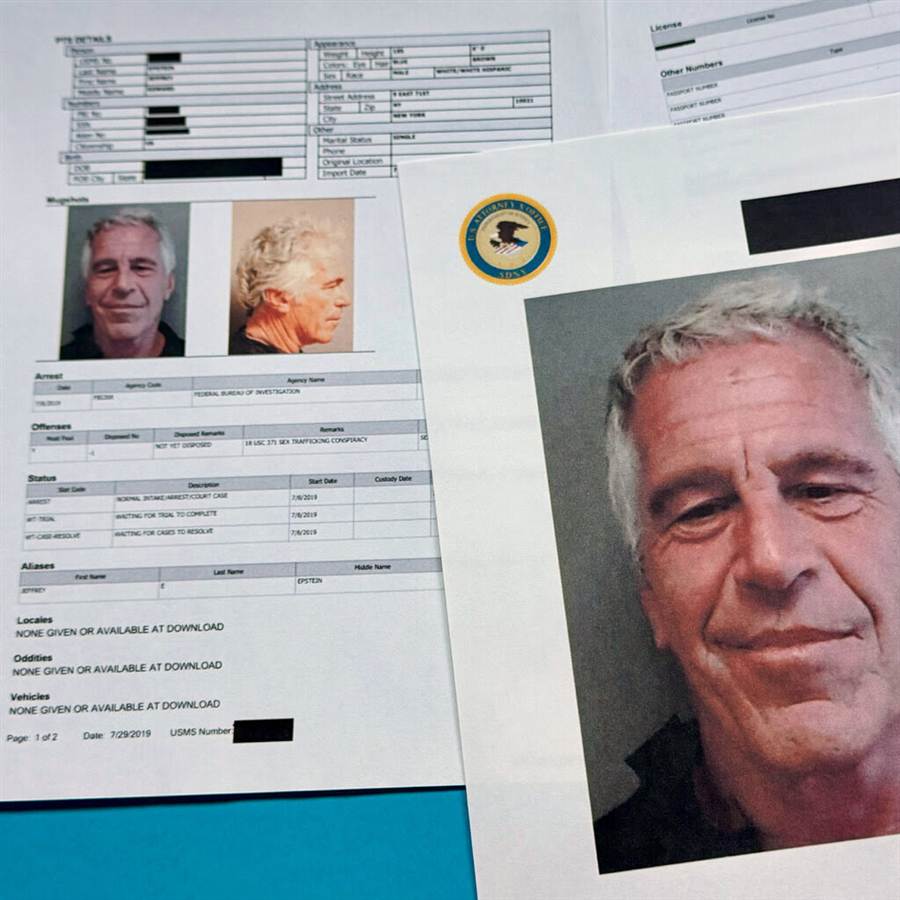
Some of the world’s most powerful men have distanced themselves from Jeffrey Epstein, saying they didn’t know him well. But documents made public over the last several months, including nearly three million pages of records released on Friday, are contradicting the denials.
The documents, and other revelations, show how Epstein’s high-level connections remained even after he was convicted of sex offenses in 2008. Here’s what we learned.
| Elon Musk has denied ever being on Epstein’s island. The documents released on Friday suggested that Musk was, at one point, eager to visit. “What day/night will be the wildest party on your island?” Musk emailed Epstein in November 2012. Here’s more on the powerful men in the Epstein files.Newly released photographs appear to show Andrew Mountbatten-Windsor kneeling over a woman on the ground. On Saturday, Prime Minister Keir Starmer of Britain said he had urged the former prince to testify about his dealings with Epstein before a U.S. congressional committee. |
| OTHER NEWS |
| A Russian drone strike killed 12 miners who had just finished their shift in east-central Ukraine. Representatives from the U.S., Ukraine and Russia are set to hold a second round of talks on ending the war in Ukraine this week.Crowds rallied in dozens of cities across the U.S. to protest the immigration crackdown in Minneapolis. ICE is using facial recognition and other tools to track protesters.A number of international companies including Capgemini, a French tech firm, are facing questions about their work with ICE.Israeli airstrikes in Gaza killed at least 26 people, days before the reopening of the Rafah border crossing that connects the enclave with Egypt.An Oscar-nominated Iranian screenwriter was arrested after signing a statement condemning his government for its crackdown, a human rights group reported.The United Nations says it will run out of money by July if the U.S. and other countries do not pay billions in annual dues.Indonesia lifted a ban on Grok, Elon Musk’s A.I. chatbot, weeks after blocking it for creating sexualized images of real people.Years after a military coup, Myanmar’s government in exile has failed to achieve most of its goals. |
What else is happening
| “Golden” from the movie “KPop Demon Hunters” won the first-ever Grammy for K-pop, and Bad Bunny won album of the year. Here’s what to know about the ceremony.The Melania Trump film, “Melania,” sold $7 million in opening-weekend tickets in the U.S. and Canada, the best start for a documentary in 14 years.The comic actress Catherine O’Hara, who died on Friday, was one of those performers who was simply a delight to see onscreen, our critic writes. |
| SPORTS |
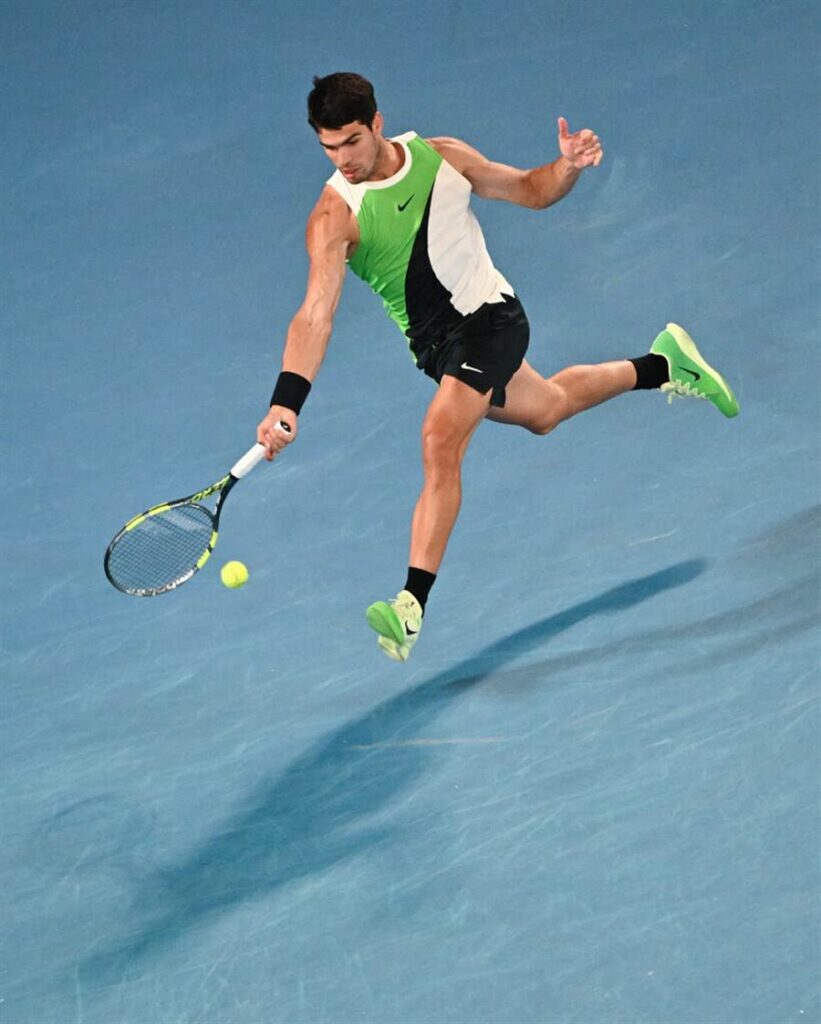
Tennis: Carlos Alcaraz beat Novak Djokovic in the Australian Open final, becoming the youngest winner of the career Grand Slam in history.
Football: Manchester United pulled off a stunning late comeback to beat Fulham.
| TREND OF THE DAY |
House burping
— The German practice of “lüften” — opening windows in your home once or twice a day to eliminate stale air — is gaining traction on social media. The term roughly translates to “airing out.”
| MORNING READ |
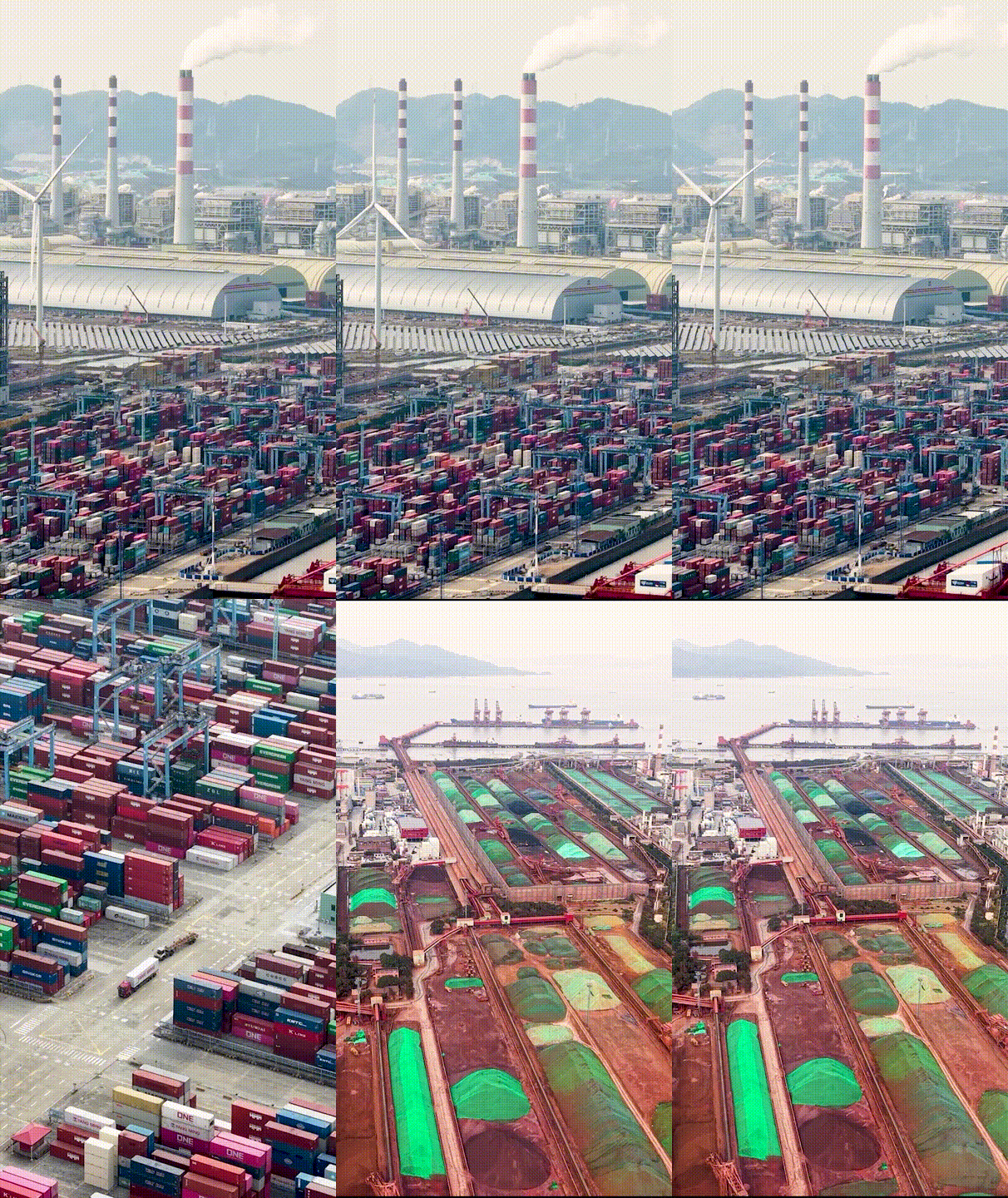
To understand how these are both the best and the worst of times for China’s economy, you just need to look around the city of Ningbo, south of Shanghai. It has the world’s largest port by cargo tonnage and teems with factories making products like household appliances and electric vehicles that show off China’s industrial muscle.
But just up the Yong River, there’s a different picture. Housing prices have collapsed, construction has stalled and the municipal government has cut spending. Sales have plummeted at local businesses and its historic district, with art galleries and bars, has almost no visitors. Here’s why the city’s troubles are worsening, fast.
| AROUND THE WORLD |

Hockey, sex and plenty of Canada
Ottawa — gray, freezing and, yes, a little boring — has become the epicenter of a pop-culture earthquake thanks to “Heated Rivalry,” the steamy series about romance between rival hockey players.
An unexpected red carpet pairing there last week offered an occasion to celebrate the show’s profound Canadian-ness: The lead actor Hudson Williams met a beaming Prime Minister Mark Carney, pulling him into a playful, leg-up embrace. “I greenlit this thing — I stood up to the Americans,” Carney said, tongue in cheek, of how the show was made in and funded by Canada.
Some see the show’s success as a cue for Canada to think bigger about its own stories, at a moment of newfound assertiveness. Read more.
| RECOMMENDATIONS |
Watch: The Colombian film “A Poet” is about a failed artist, but also about when artists fail one another and the world.
Read: Here are 27 new books coming in February.
Travel: Vacationing with a pet can be difficult. Here’s how to make it work.
| RECIPE |

Caldo de pollo is a chicken soup with variations across Latin America. This is a classic Mexican version, featuring a combination of potatoes, carrots and zucchini cooked until creamy and tender.
