

 |
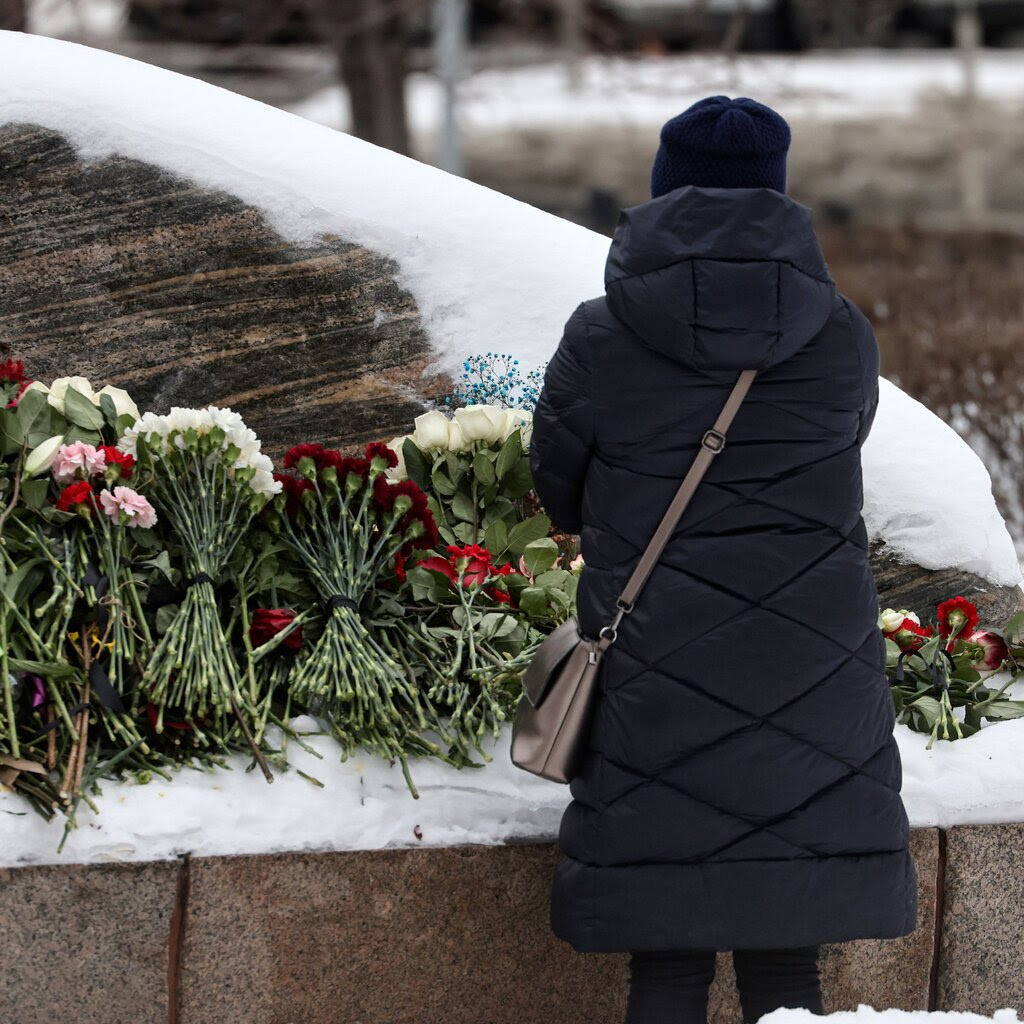
| Laying flowers at a memorial for Aleksei Navalny in Moscow on Saturday. Sergei Ilnitsky/EPA, via Shutterstock |
What Aleksei Navalny’s death means
Aleksei Navalny, Russia’s most prominent opposition leader, died on Friday in a penal colony. He was 47.
Navalny’s body has not been released to his family, and the cause of death remains unclear.
Navalny was the Kremlin’s fiercest critic. He publicly denounced the corruption he saw at the core of President Vladimir Putin’s political party at immense personal cost: He barely survived an attempted poisoning and had been imprisoned since 2021.
His death prompted mourning in Russia — where at least 366 people have been detained for expressing their grief — and left the opposition questioning its future.
Yesterday I spoke with Anton Troianovski, The Times’s Moscow bureau chief, about the response to Navalny’s death and the future of Russia’s opposition.
What kind of reaction are you seeing in Russia? How are people mourning?
All over the country, people are laying flowers at memorials to Soviet repressions. A lot of cities in Russia have these memorials that were generally put up in the 1990s, honoring the victims of the gulag and other repression during the Soviet Union. And it seems that people are kind of automatically gravitating to those places in order to honor Navalny’s memory.
Of course, we’re talking about the minority of people who are brave enough to do that. Human rights groups have reported hundreds of arrests already of people who have gone just to lay flowers. Even doing that is a very dangerous statement in today’s Russia. And at the same time, on state television, which is the main news medium in Russia today, there is pretty much no reporting on what has happened.
What does this mean for the opposition in Russia?
It’s a devastating moment for the opposition in Russia. I don’t think you can say it any other way. Navalny was the hope for people opposed to Vladimir Putin, though Navalny was a controversial figure in some ways. There were people who thought, especially earlier in his political career, that he was kind of too nationalist. He had quite a direct, brusque style that turned some people off.
But no one disputed that he was the main alternative to Vladimir Putin in Russian politics. He was really the only figure of all the various political figures in the last 24 years seeking to challenge Putin. He was the only one who was able to appeal not just to urban liberals in Moscow but really to a much broader cross-section of Russians. He was incredibly adept at using YouTube and social media to penetrate the bubble of propaganda created by state television. And he was able to build a nationwide political network that repeatedly was able to organize mass protests.
What can the opposition do going forward?
Shortly before his death, Navalny endorsed an idea that another exiled opposition figure came up with, which was to say: How about everyone who is opposed to Putin goes to a local polling station at exactly the same time on March 17, the last day of the election? And opposition figures are saying that the time should be noon local time in your city.
So that’s something that it seems the opposition in exile is very much going to be pushing on social media, on YouTube. And opposition figures are thinking that even in the current repressive environment, perhaps this is a relatively safe way to protest because no one says you’re not allowed to go to the polls.
 |
| Ukrainian soldiers firing a howitzer near Avdiivka. Tyler Hicks/The New York Times |
Russia captured Avdiivka
Ukrainian forces withdrew from Avdiivka, a ruined city on the eastern front line, giving Russia its greatest battlefield victory since it captured Bakhmut in May. The retreat comes at a time when Ukraine’s military is outgunned and stretched thin.
Ukrainian soldiers in Avdiivka withstood near-constant bombardment and fought intense battles to break out of Russian attempts to encircle them. More than 900 of the city’s 30,000 inhabitants remained there, mostly surviving underground on food and supplies brought in by aid workers. Their fate is unknown.
What’s next: The terrain around Avdiivka is flat, without large rivers or extensive fortifications, meaning Ukraine will probably have to cede more territory to hold back Russian forces.
Collective anxiety: At the Munich Security Conference, a gathering of Western leaders, many fretted about Putin’s possible next moves and the chance of wavering U.S. support.
 |
| Khan Younis, in southern Gaza, on Sunday. Said Khatib/Agence France-Presse — Getty Images |
Key Gazan hospital declared ‘not functional’
The leader of the W.H.O. said that Nasser Hospital, the largest medical center that was still operational in wartime Gaza, was “not functional anymore” after a weeklong siege by the Israeli military.
There were about 200 patients at the hospital in Khan Younis, with 20 in critical condition who urgently needed to be transferred, the director general of the W.H.O. said on social media.
In Israel: Thousands protested in Tel Aviv in the largest expression of anger against Israel’s prime minister, Benjamin Netanyahu, since the Oct. 7 attacks.Continue reading the main story
| THE LATEST NEWS |
Around the World
 |
| Maansi Srivastava/The New York Times |
| A judge ordered Donald Trump to pay a penalty of nearly $355 million plus interest for conspiring to manipulate his net worth. In total, Trump is expected to have to pay more than $450 million.A senior Pakistani official confessed to helping manipulate the results in the country’s recent election.Thaksin Shinawatra, Thailand’s ousted former prime minister, was released on parole after serving only a fraction of his sentence — in a hospital. |
Royal News
| A college student in the small African country of Eswatini risked his life to protest the country’s absolute monarch. His father is a soldier sworn to protect the king.The Times’s London bureau chief discusses King Charles III’s cancer diagnosis. |
A Morning Read
 |
| Photo Illustration by Alex Merto |
“Natural asset companies” would seek to put a market price on improving ecosystems by using proceeds from public offerings to maintain land. Ideally, investments in the companies would appreciate as environmental quality improved, yielding a return years later.
Such a company does not exist yet, but the idea is gaining traction with some environmentalists and investors.
| SPORTS NEWS |
The Premier League’s most important players: Who contributes the most at all 20 clubs?
Soccer player sentenced for fatal hit-and-run: Ciaran Dickson received six years in prison for killing a teenager in Glasgow.
One tennis player’s remarkable road: Fnu Nidunjianzan’s journey from Tibet to Princeton.
| ARTS AND IDEAS |
 |
| Photograph by Kyoko Hamada. Set design by Suzy Kim |
When eating with your hands is encouraged
In the West, only certain foods and scenarios are exempt from flatware. But in parts of Africa, the Middle East and South and Southeast Asia, eating with the hands is traditional and remains routine for some.
Now, some restaurants in Western countries that serve food from those cultures are asking patrons to drop their forks, wash their hands and dig in.
| RECOMMENDATIONS |
 |
| Matt Taylor-Gross for The New York Times |
Cook: Think of this one-pot chicken and noodles dish as a relay race, with each ingredient handing its flavor off to the next.
