
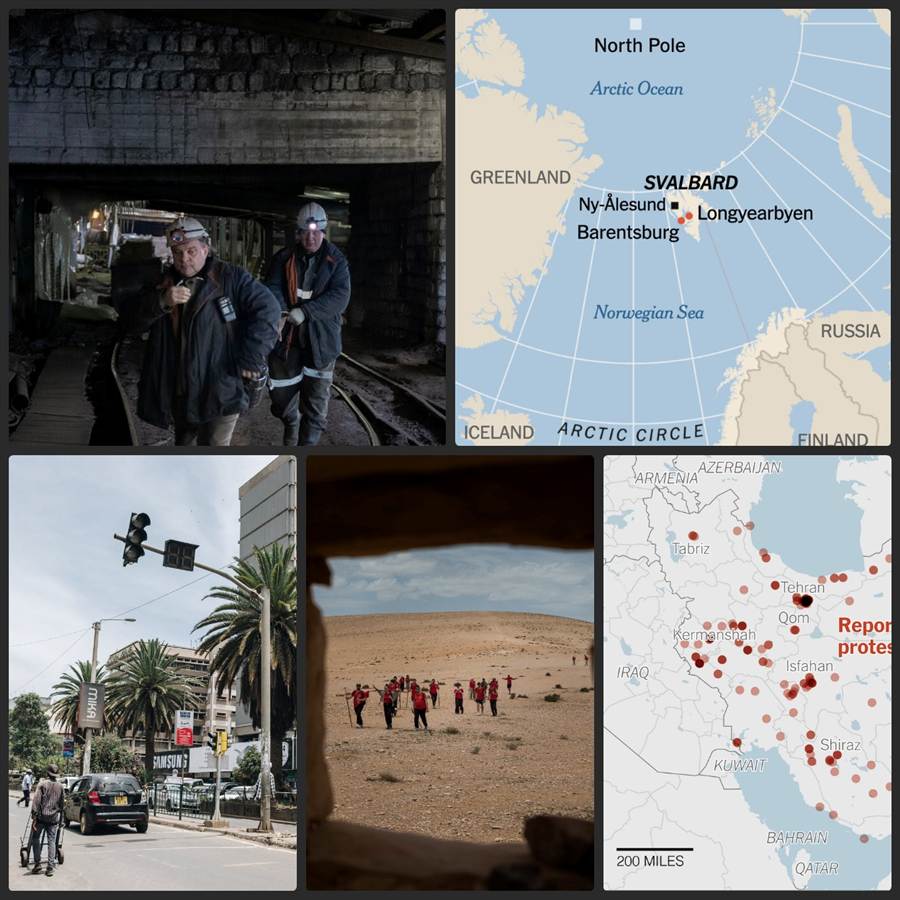
Good morning, world! The U.S. is discussing the future of Greenland today with officials from Denmark and Greenland. They say the island is not for sale; President Trump has made clear he wants to annex it, regardless. To understand how we got here, it’s worth looking more broadly at the quest to control the Arctic.
Home to plenty of minerals and rare-earth elements, the Arctic has long been of strategic interest. But as climate change thins the ice and makes the Arctic and its resources more accessible, the urgency has increased. Today my colleague Jeffrey Gettleman writes about a fight over a different set of Arctic islands — and what it can tell us about Trump’s desire for Greenland.
Also:
| Witness accounts of the Iran crackdown Reporter recommendations from Nairobi |
The battle for the top of the world
By Jeffrey Gettleman
Svalbard was always a special place. But now, as the race for the Arctic heats up, it’s becoming an important one.
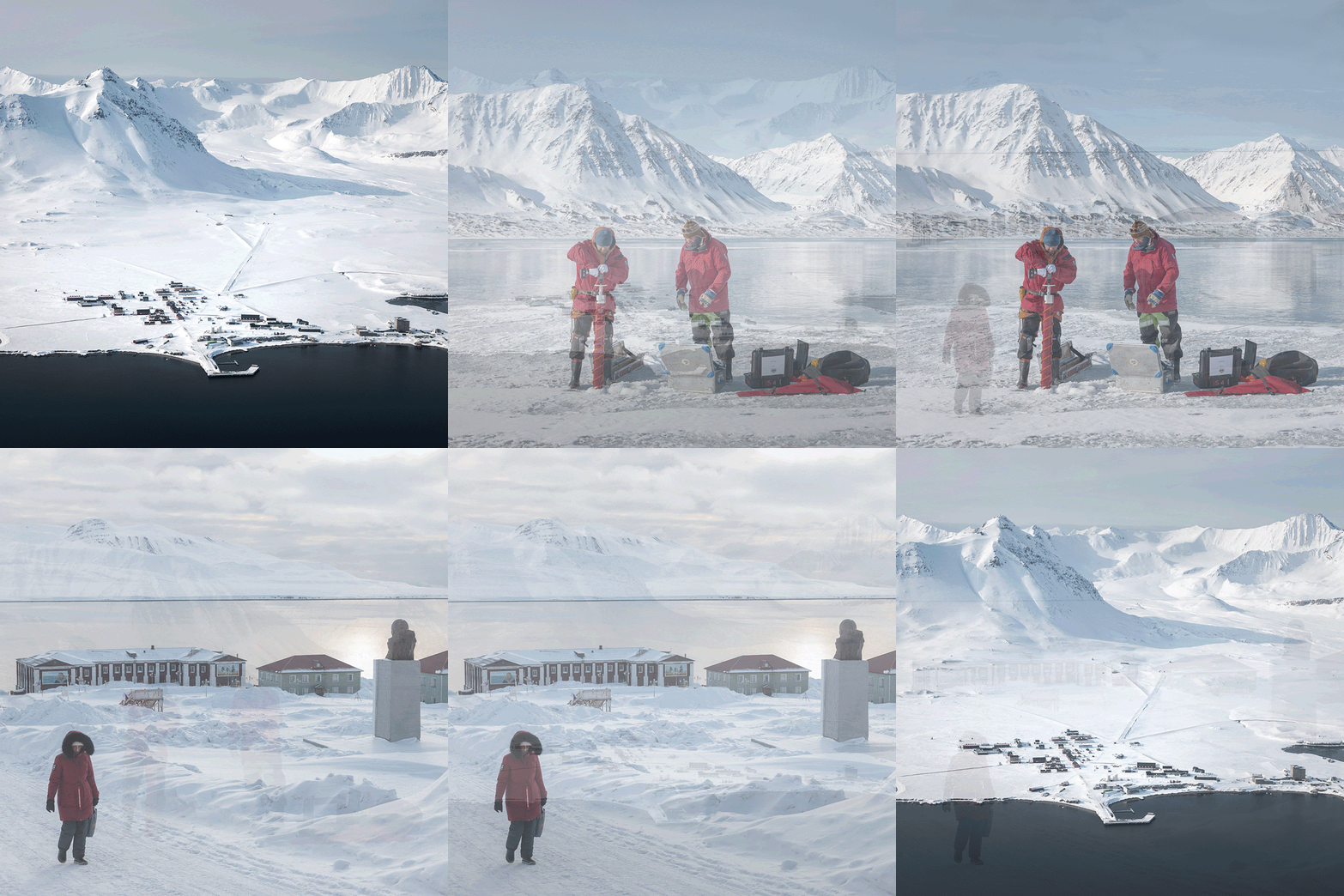
A set of icebound islands near the North Pole, Svalbard is technically part of Norway. But what makes it unique is that it’s governed by a century-old treaty that allows just about anyone from any country to settle there, without needing a visa.
The result is a vibrantly international community, set amid glistening ice fields and gigantic snow dunes. On a recent trip, we zoomed around on snowmobiles meeting Indian climate scientists, Russian coal miners, Norwegian tour guides and two Thai brothers who came here as boys one winter years ago and were confused about what happened to the sun — Svalbard is so far north that the sun doesn’t rise for months.
 |
| The New York Times |
But lately, something has begun to shift. The good old days of international cooperation seem to be ending. Norway is pushing more firmly to assert its sovereignty over Svalbard and fend off foreign influence. In our reporting, we discovered that it’s cracking down on land sales to foreigners, stripping away foreigners’ voting rights, curtailing scientific research and claiming hundreds of miles of Svalbard’s seas. This has angered many countries, including some of its closest allies. All of this is changing the welcoming character of the place, many people told us.
But the Norwegian government says it needs to knuckle down. For too long Svalbard has been seen by other nations as “sort of a free-for-all, and everyone who wants to can come up and do almost whatever they want,” Eivind Vad Petersson, Norway’s state secretary at the Ministry of Foreign Affairs, told us in an interview.
“That’s not the fact,” he added, sharply. “This is Norwegian sovereign territory. So we’re making that a bit clearer.”
Why is Norway, the country synonymous with international diplomacy that hands out the Nobel Peace Prize, suddenly playing tough guy? It connects to some of the same reasons Trump is fixated on seizing Greenland.
Cold, desolate, strategic
Svalbard and Greenland are rapidly becoming entangled in the race for the Arctic. As climate change melts the ice and places at the top of the world become more accessible and livable, the great powers of the world are suddenly interested.
U.S. officials have accused Chinese researchers of conducting illegal military research in Svalbard. The Russians are advancing their own claims to the islands, with language similar to their push to take Ukraine.
Like Greenland, Svalbard has enormous mineral resources. Copper, zinc, cobalt, lithium and rare-earth elements are buried in the ocean floor.
And like Greenland, Svalbard sits in a strategic location along increasingly open Arctic waterways. Their locations near the North Pole also make them an ideal place to track missiles flying across the planet and to download data from satellites.
 |
| A coal mine operated by a Russian company in Svalbard. Emile Ducke for The New York Times |
Something else that these Arctic regions have in common is their unusual territorial status: Greenland was a Danish colony, and now is a Danish overseas territory, still partly controlled by Copenhagen, but geographically distant. (Nuuk, the capital of Greenland, is closer to Washington than it is to Copenhagen.) Svalbard, for its part, is governed by a unique treaty that allows other countries to have the same access there as Norwegians.
Maybe this has something to do with the fact that until recent decades, it was difficult to reach the Arctic and so territorial claims there weren’t firmly established. But in our new era of elbows-out geopolitics, these unusual statuses have become liabilities.
Where great powers meet
Secretary of State Marco Rubio is set to meet today with officials from Denmark and Greenland in a conversation that will be closely watched around the world. The U.S. quest to annex Greenland — either via force, or by purchasing the island — will have repercussions that go far beyond what’s happening in Svalbard. The Greenland issue is becoming a test of how far the United States will go to upend the world order and do whatever it wants, even to its allies.
In Svalbard, the competition for resources and access might not be as intense, but it’s growing.
The Arctic is where several great powers meet — just look at how close Russia, Canada, the United States and Greenland are to one another at the top of the world. The contest is being driven by three factors: a hunger for resources, a rawer moment in geopolitics and climate change. The warmer days are thinning the Arctic ice, and it’s almost as if a whole new region of the world is suddenly emerging. The scramble is on to control it.
Size matters: Greenland is bigger than France, Britain, Spain, Italy and Germany combined. If Trump were to succeed in taking it over, it would be the biggest territorial addition in U.S. history — including Alaska and California. Read more.
The latest: “If we have to choose between the United States and Denmark here and now, we choose Denmark,” Prime Minister Jens-Frederik Nielsen of Greenland, said yesterday in a joint news conference with Prime Minister Mette Frederiksen of Denmark. “We choose NATO, the Kingdom of Denmark and the European Union.”
| MORE TOP NEWS |
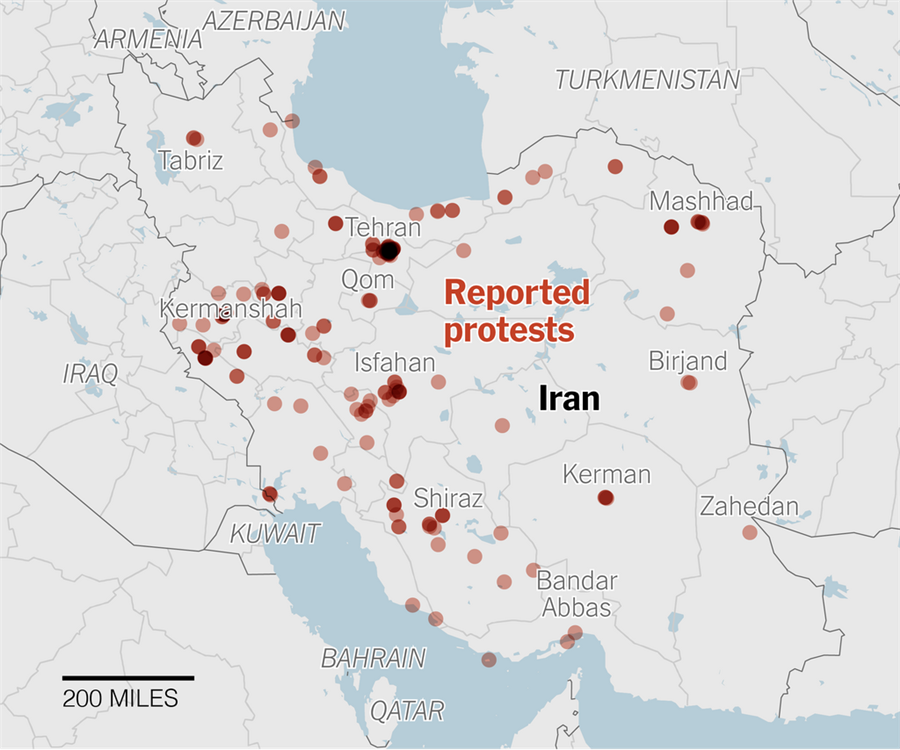
| Note: As of Jan. 8. Shows protests since Dec. 29. Source: Institute for the Study of War and AEI’s Critical Threats Project. Samuel Granados/The New York Times |
Accounts of a deadly crackdown are emerging from Iran
Iranian authorities have imposed a near total communications blackout during large anti-government protests, making it difficult to obtain information. But videos and witness accounts suggest it is one of the deadliest in more than a decade.
As many as 3,000 people are feared dead. Witnesses have described government forces firing on unarmed protesters. “The regime is on a killing spree,” said one protester. Here’s what our reporters have learned.
Trump called on Iranians to keep protesting and warned that those responsible for killing demonstrators would “pay a big price.” “HELP IS ON ITS WAY,” he said on social media. Trump has threatened to intervene militarily in Iran and said the U.S. would impose a 25 percent tariff on countries that do business with Iran.
While the regime may be able to quash these demonstrations, the protests have exposed popular discontent that may be impossible to suppress in the long term. The government “is only buying time until the next round of confrontation between the state and society,” said Ali Vaez, Iran project director for the International Crisis Group, a research institution.
| OTHER NEWS |
| Venezuela’s interim government freed several U.S. citizens from prison, the first known Americans released since the U.S. captured President Nicolás Maduro.China announced the world’s largest ever trade surplus, even adjusting for inflation, despite Trump’s efforts to use tariffs to contain Chinese factories.The U.S. will soon name a committee of Palestinians who will run Gaza. American officials hope that the body will help erode Hamas’s grip on the enclave.Prosecutors are seeking the death penalty for South Korea’s former president, Yoon Suk Yeol, if he is found guilty over his failed attempt to impose martial law.Bill and Hillary Clinton refused to testify in the House’s Jeffrey Epstein investigation, and faced being held in contempt of Congress.Marine Le Pen, France’s far-right leader, appealed an embezzlement conviction that bars her from running for president.U.S. greenhouse gas emissions increased by 2.4 percent in 2025 after two years of decline as demand for electricity surged. |
| SPORTS |
Football: Xabi Alonso’s firing is a reminder that Florentino Pérez rules at Real Madrid.
Tennis: Venus Williams, now 45, lost against a 38-year-old rival in a WTA match.
| WORD OF THE DAY |
Supersucklers
— That’s how researchers refer to sea lions in the Galápagos that continue drinking their mother’s milk years after reaching maturity. (One was found nursing at age 16 — the equivalent in human years of people in their early 60s.) Experts called the behavior “utterly extraordinary” and “an enigma.”
| MORNING READ |

My colleagues traveled to Myanmar last month for a rare look inside one of the compounds where the online fraud industry makes a fortune. Shunda Park opened in 2024 with more than 3,500 workers from nearly 30 countries. Some had been kidnapped. All had become skilled in the art of online swindling, using A.I. and deepfake videos. Every time the scammers bilked someone out of $5,000, they struck a gong. Take a look inside.
Shunda Park was captured in November by a rebel militia that shut down the compound. Watch as my colleague Hanna Beech explains in the video above how the scammers operated.
| AROUND THE WORLD |
 |
| Diego Ibarra Sánchez for The New York Times |
Rediscovering Syria, one hike at a time
Areej Miro came of age during Syria’s 14-year civil war and had seen relatively little of her country. Now that the war is over, she said, “I’m intending to visit every province.”
Miro is part of an adventure group called “Me the Syrian,” which is once again exploring the country. The New York Times followed the group on a trip. As they traveled, dangers from the war never felt far away. Some group members morbidly joked about land mines. Read more.
| REPORTER RECOMMENDATIONS |
Nairobi
 |
| Khadija Farah for The New York Times |
Abdi Latif Dahir recently ended his run as our East Africa correspondent, based in Kenya. He sent us a list of his favorite spots in the capital.
Explore Karura Forest: This forest north of Nairobi is ideal for running, walking, picnicking, cycling, children’s play and spotting monkeys and birds. The forest stands today because the Nobel laureate, Wangari Maathai, led a fierce campaign against the illegal acquisition and development of the forest land. It’s my favorite sanctuary in Nairobi and one of the few places I truly miss.
Check out the bookstores: Nairobi’s literary scene has been steadily growing. There are shops like Soma Nami Books and Prestige Bookshop, but I highly recommend Cheche Bookshop, a Pan-African feminist bookstore. What I love most is their vibrant events program.
Wander downtown: I like to plan meetings in the downtown area. For visitors, I’d recommend signing up for one of the many walking tours of the city center. It’s a gem for architecture, beautifully blending the old and the new. You’ll see buildings from the early 20th century (The McMillan Library, Kipande House and Jamia Mosque), the midcentury period and modern glass structures. I often grab lunch at one of the many nearby restaurants, including those serving excellent Somali cuisine.
| RECIPE |
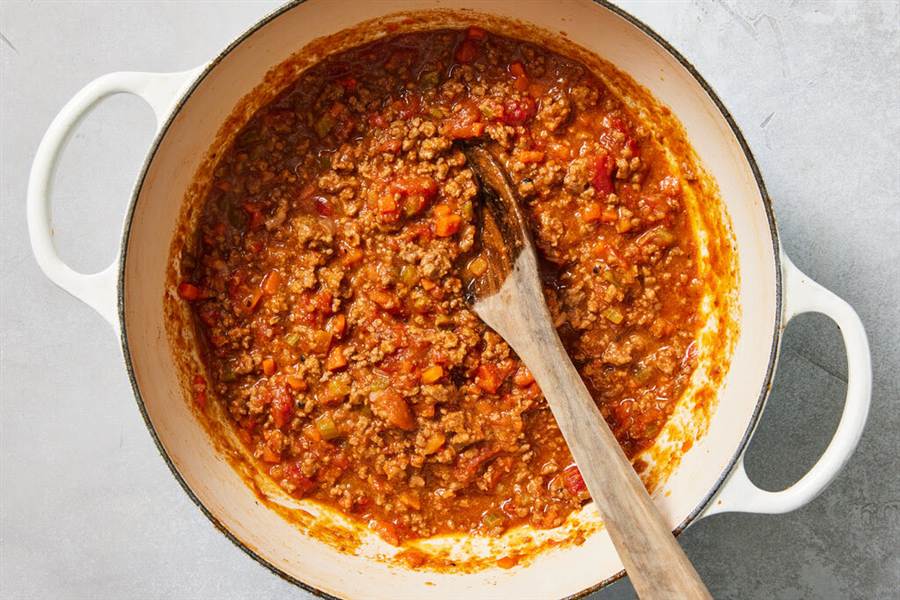
The cookbook author Marcella Hazan changed the way Americans cook Italian food. When The Times asked readers which of her recipes have become staples in their kitchens, many answered with one word: “Bolognese,” the classic sauce. Hazan had a few recipes, but one reader called this “the gold standard.”
