
| July 16, 2026 | By Katrin Bennhold |
Good morning, world. America’s “forever wars” has become shorthand for Iraq and Afghanistan — both long, costly military campaigns that ended having achieved, well, not very much.
Donald Trump was elected partly on a promise to stay away from those kinds of wars. But he may already be entangled in another. Today, my colleague Steven Erlanger, who covers diplomacy, writes about whether the Iran war is the next Iraq or Afghanistan.
Also:
| Ukraine’s defense minister is out Argentina in the World Cup final A very old hiker on a very long hike |

Another American forever war?
By Steven Erlanger
No one starts a war expecting it to last forever.
Yet, American presidents have repeatedly gotten into conflicts that seem as if they could — at least until the next president, or the one after that, decides that the expense and political pain are not worth it, finds a way to declare some sort of victory and goes home.
On Iran, President Trump may have fallen into the same trap.
He campaigned for office vowing to end wars, not start them, and to never get involved in a forever war, let alone one in the Middle East.
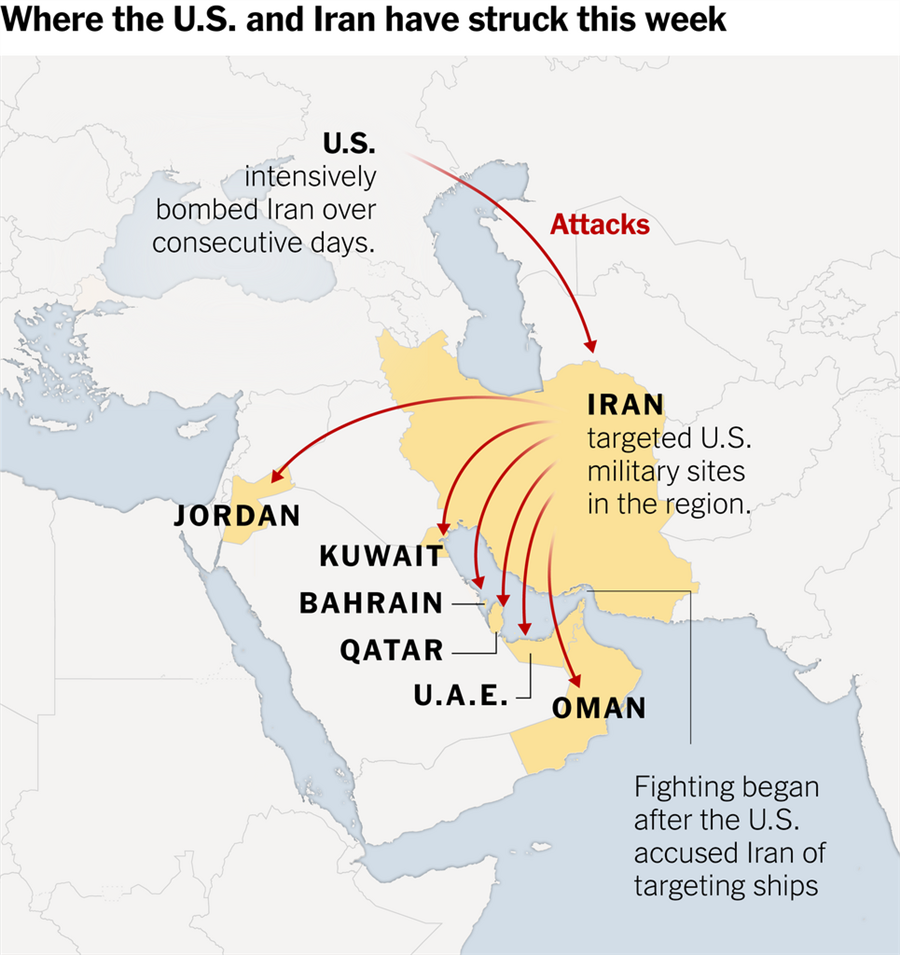
And yet, the war that Israel and the U.S. began shows no signs of ending any time soon. The U.S.-Iran memorandum of understanding, which Trump said “achieves everything we set out to accomplish” less than a month ago, is in tatters. The Strait of Hormuz is — once again — blocked, and both sides are — again — exchanging fire.
Iran has become a low-level conflict, alternating between moments of negotiation and military strikes. Is this the next American forever war?
Powerful military + no strategy
The idea of the forever wars began with Sept. 11 and the “global war on terror,” which pulled the U.S. into long military engagements in Afghanistan and Iraq. Both of those wars, which began by toppling hostile regimes before turning into lengthy and bloody counterinsurgency campaigns, ended either inconclusively or in defeat.
Powerful leaders with powerful militaries are prone to fall into “the short-war fallacy,” said Lawrence Freedman, an emeritus professor of war studies at King’s College London, who wrote an article last year titled “The Age of Forever Wars.”
“They think they can win quickly and not suffer adverse consequences,” he said.
 |
| American soldiers in Afghanistan in 2016. Adam Ferguson for The New York Times |
But even the most sophisticated military forces are not enough if there is no strategy to turn battlefield superiority into lasting political and diplomatic success.
Leaders like Trump in Iran and Vladimir Putin in Ukraine “fail to appreciate the limits of military power and so set objectives that can be achieved, if at all, only through prolonged struggle,” Freedman said.
America’s first gulf war succeeded because President George H.W. Bush had a limited political objective — to drive Saddam Hussein out of Kuwait. That was a lesson lost on his son President George W. Bush in the second gulf war in Iraq, which ended up enhancing Iran’s power in the region. In Afghanistan, the younger Bush drove out the Taliban but then tried in vain to remake the society. When America finally tired of the effort, the Taliban returned.
There is an argument, sometimes made by Trump, that he went to war in Iran to finally end what he considered a 47-year war between the U.S. and Iran, which began with the fall of the Shah of Iran in 1979 and the taking of more than 60 American hostages.
Aaron David Miller, a senior fellow at the Carnegie Endowment for International Peace, said Trump, urged by Israel, had also inserted himself in a parallel forever war — the fundamental one between Israel and Iran, which is also being played out with Iran’s proxies in Lebanon, the Palestinian territories and Yemen.
Trump could have tried to sell the unpopular U.S.-Iran war to his base as a victory of some kind and gone home. Instead, he seems to be doubling down, despite the lack of a clear path to victory. And his promises to keep the Strait of Hormuz open, while Iran insists on maintaining control, could mean a very long American military engagement.
Iran is still different
Still, the war in Iran is different from those in Afghanistan and Iraq, where the U.S. had thousands of troops on the ground for long periods of time.
And unlike in Vietnam, Iraq or Afghanistan, the conflict in Iran can inflict economic pain on the U.S. and the broader global economy, which is a prime reason Tehran has refused to give up control of the strait. That leverage helps explain why the U.S. agreed to the cease-fire that fell apart this week.
But a real negotiated end to the war in Iran still feels far away. Both sides have proved they can’t even stick to a minimal framework agreement that defers all the substantive issues, like ending Iran’s nuclear program, to the future, said Ali Vaez, the Iran project director for the International Crisis Group. If they can’t do that, he added, “that could remove the last barrier between episodic confrontation and a forever war.”
The latest:
| The U.S. and Iran exchanged strikes again, with neither side showing signs of backing down. But Iran’s top negotiator signaled that the door to diplomacy is still open.An Iranian-American woman who was charged in Iran with espionage and barred from leaving for over a year has been released.Iranian cyberattackers tracked the phones of U.S. personnel in the Middle East.A billboard in central Tehran depicts Trump in a coffin. |
| OTHER NEWS |

| Ukraine’s defense minister, Mykhailo Fedorov, in Kyiv last March. Brendan Hoffman for The New York Times |
| The youthful face of Ukraine’s successful drone warfare program, the minister of defense, was ousted after just six months. Meanwhile, that drone arsenal is hitting more Russian ships as Ukraine intensifies its blockade of Crimea.France and Germany want to quit relying on the U.S. and China for key technology like artificial intelligence. The question is how.French lawmakers voted to legalize medically assisted dying for the terminally ill.Almost half of Democrats in the U.S. House voted in favor of a failed bid to end aid to Israel, illustrating a dramatic shift in party sentiment away from backing the Jewish state.Wildfires swept across Ontario, prompting evacuations and sending smoke into the northeastern U.S. |
WHAT ELSE IS HAPPENING
| Joe Biden has written a memoir that addresses his tenure as president and his fateful decision to run for re-election.U.S. Defense Secretary Pete Hegseth plans to screen all service members age 30 and older, including women, for low testosterone.The U.S. will start minting gold $1 Trump coins.Guy Scott, who became the only white president in Africa when he served briefly as Zambia’s leader just over a decade ago, has died at 82. |
TOP OF THE WORLD
The most clicked link in your newsletter yesterday was about why countries in Latin America are rooting for anyone but Argentina at the World Cup.
| WORLD CUP |

The final is set
In a stunning turnaround, Argentina defeated England 2-1, with two late goals, to secure its place in Sunday’s final against Spain. See the highlights.
National trauma: With another loss, England’s years of pain continue.
Revisit: This 3-D view shows how Spain pulled apart France’s defense.
| NUMBER OF THE DAY |

24,204
This is the number of stains on the Bayeux Tapestry, the 11th-century artwork that was transported to Britain from France last week under maximum security. In September, the tapestry, depicting events surrounding William the Conqueror’s invasion of Britain in 1066, will be shown in England for the first time in hundreds of years. More tapestry fun facts: It has 9,646 holes and 30 tears, according to a 2020 report. But still, it’s stunning. See it if you can.
| MORNING READ |

The first commercial feature filmed completely in IMAX, “The Odyssey,” is a three-hour sword-and-sandals epic the likes of which are hardly made anymore, shot in six countries with a cast and crew of thousands.
In an interview, the director Christopher Nolan talked about the many translations of Homer’s monumental poem that he read and of the “nerve-racking” production. “It was a big undertaking, unquestionably,” Nolan said “I don’t think I would have felt ready to take on this film until now.” Read the full interview and our review. It’s a critic’s pick.
| AROUND THE WORLD |

He’s on a 3,500-kilometer hike. And he’s 91.
Dale Sanders once set the record as the oldest person to complete the roughly 3,500-kilometer Appalachian Trail, which runs from Georgia to Maine. That was in 2017, when he was 82. Now, Sanders, known as Grey Beard, is back to reclaim his record by completing the hike within a year.
Though the going feels twice as hard this time around, he’s aiming to cover 19 kilometers a day. “I’m not going to stop unless physically I simply cannot do it anymore,” he said.
“Every mountain I climb,” said one 29-year-old hiker who joined him for a stretch, “I’m like, ‘Dude, you did this?’” Read more and watch a video of Sanders on the trail.
| RECOMMENDATIONS |
Travel: These off-the-beaten-path European hotels are hidden in the mountains and nestled by the sea.
Gawk: Two first-time buyers won an abandoned house at a tax auction. Eight years later, they’re still restoring it.
Rediscover: Mike D is set to release “Thank You,” the first new music from a member of the Beastie Boys in 15 years.
Cope: Varicose veins are hard to ignore. We asked experts when to get them checked out.
| RECIPE |

Ceviche is a perfect light appetizer: refreshing and cooking-free. Citrus — sometimes lemon or bitter orange, but in this case lime — does the “cooking” for you. You’ll find many variations of the dish in coastal Latin America made with different ingredients. This colorful rendition uses scallops and plums.
