
| August 13, 2026 | By Katrin Bennhold |
Good morning, world. Afghanistan has a track record of defeating superpowers. The mujahedeen humbled the Soviet Union in the 1980s, and five years ago the Taliban pushed out the United States.
But can Afghanistan’s rulers overcome the discontent of their own people?
With the country on the verge of another all-out war, this time with Pakistan, that is less than certain. Today, my colleague Elian Peltier explains why all the ingredients for things to spiral out of control are there.
Also:
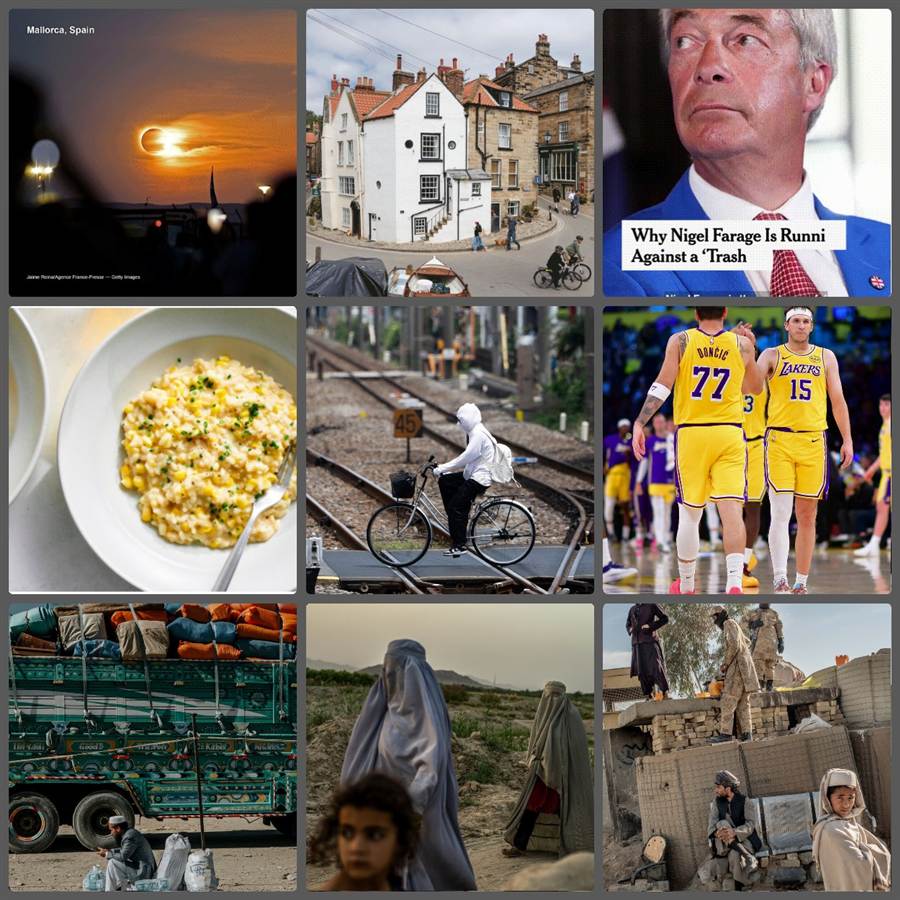
| Farage vs. Binface A settler siege in the West Bank Photos from the eclipse |
 |
| At Afghanistan’s border with Pakistan in December. Tomas Munita for The New York Times |
What five years of Taliban rule looks like
By Elian Peltier
The Taliban took over Afghanistan five years ago this week. They pushed out the world’s most powerful army. Yet the mood among Taliban officials I’ve spoken with and soldiers I’ve bumped into at checkpoints hasn’t exactly been celebratory — more like embattled.
On what could have been a triumphant anniversary for the group, the Taliban find themselves in crisis at home and abroad.
They face a conflict just short of open war with neighboring Pakistan. They’re dealing with fresh waves of attacks from armed groups who want to topple them. Add to that mass unemployment, near-total international isolation and growing domestic discontent, and it all amounts to the most serious threats the Taliban have encountered since their victory in 2021.
It’s too early to tell whether all this will escalate in a way that could threaten the regime’s survival. But it has cracked the thin veneer of security and stability that the Taliban herald as their primary achievement since taking over — and their primary selling point to the world.
 |
| Afghan women in Kandahar in May 2025. Joao Silva/The New York Times |
A tight grip on power — and yet
The Taliban are holding Afghan society in a chokehold that spares no one. Girls and women face restrictions to a degree unseen anywhere else in the world. Religious minorities are witnessing the forced closure of their places of worship. Anyone who voices criticism is repressed.
That grip on power over a country of nearly 45 million people seems immovable. The Taliban collect taxes and are pretty good at it. They are building roads, dams and canals. European countries are desperate to work with them to deport Afghan migrants and asylum seekers. And when someone shuts the door on them, as Pakistan did when it closed its border last year, they open new ones: Afghanistan has increasingly relied on trade with Iran, India and Central Asian states like Uzbekistan.
And yet the signs of trouble that have appeared in recent months are impossible to ignore.
An underequipped Afghan Army waits nervously at the border with Pakistan. Once a sponsor of the Taliban, Pakistan has launched dozens of airstrikes on Afghanistan in recent months; killed 500 civilians since October, according to the United Nations; and threatened to go all in against the Taliban regime, which it accuses of harboring militants who are staging attacks on Pakistani territory.
The mistrust goes both ways: The Taliban have accused Pakistan of supporting the armed groups that have attacked Taliban outposts in Afghanistan’s northeastern province of Badakhshan and are gearing up for a sustained offensive.
Whether, or to what extent, Pakistan is actively supporting anti-Taliban groups is not clear, but suspicions are high enough that a senior Western diplomat with decades of experience working on Afghanistan told me this summer, “This region doesn’t need another proxy war.”
 |
| An Afghan refugee near a border crossing in Pakistan last year. Asim Hafeez for The New York Times |
The picture on the domestic front is also grim. The Taliban are struggling to deal with a cascade of humanitarian and economic crises. Nearly four million Afghans have been forcibly returned from Iran and Pakistan since January 2025 — one of the world’s largest episodes of reverse migration in decades. Aid cuts have plunged millions into deeper food insecurity. And UNESCO says the Taliban have deprived 2.4 million Afghan girls of a secondary education — the equivalent of all school-age girls in New York, Mexico City and Moscow combined, forced to stay home indefinitely.
A society can withstand only so much, even under the tightest of grips. At a rare protest in June, demonstrators chanted “Work, education, freedom,” similar to what their Iranian neighbors chanted in 2022. And the leader of a large religious minority warned the Taliban in May: Don’t squeeze Afghan society too much, or it will explode.
The potential to spiral?
The Taliban know the world wants a stable Afghanistan — one that isn’t a source of refugees, opium or terrorism.
The Taliban claim the country no longer poses a security threat to the region or the West. They say that they have cracked down on the Islamic State, and that they want peaceful relations based on trade and diplomacy, including with the U.S.
All of this may have some truth to it. The Taliban don’t want their various crises to spiral. But it also might not be entirely up to them.
All the ingredients for things to get out of control in Afghanistan again are here, analysts say: Growing animosity toward Pakistan and a vast population of unemployed young Afghans are fertile ground for radicalization, especially as economic opportunities are nearly nonexistent. Under the Taliban, Afghanistan is, once again, a pariah state, with barely any allies.
As a foreign military official in Afghanistan put it, the country is no longer the hub for jihadism that it used to be — but it has everything it needs to become one again.
The past five years have brought some predictability and an end to almost two decades of fighting, which many Afghans have welcomed, despite the immense hardship and repression. But Afghanistan remains shattered, and what always looked like a fragile peace is already at risk.
| MORE TOP NEWS |

Scenes from the eclipse
Skywatchers around Europe turned their gazes upward yesterday to witness a total solar eclipse, the continent’s first in decades. See photos and videos.
TOP OF THE WORLD
The most clicked link in your newsletter yesterday was answers to questions about the eclipse.
| OTHER NEWS |
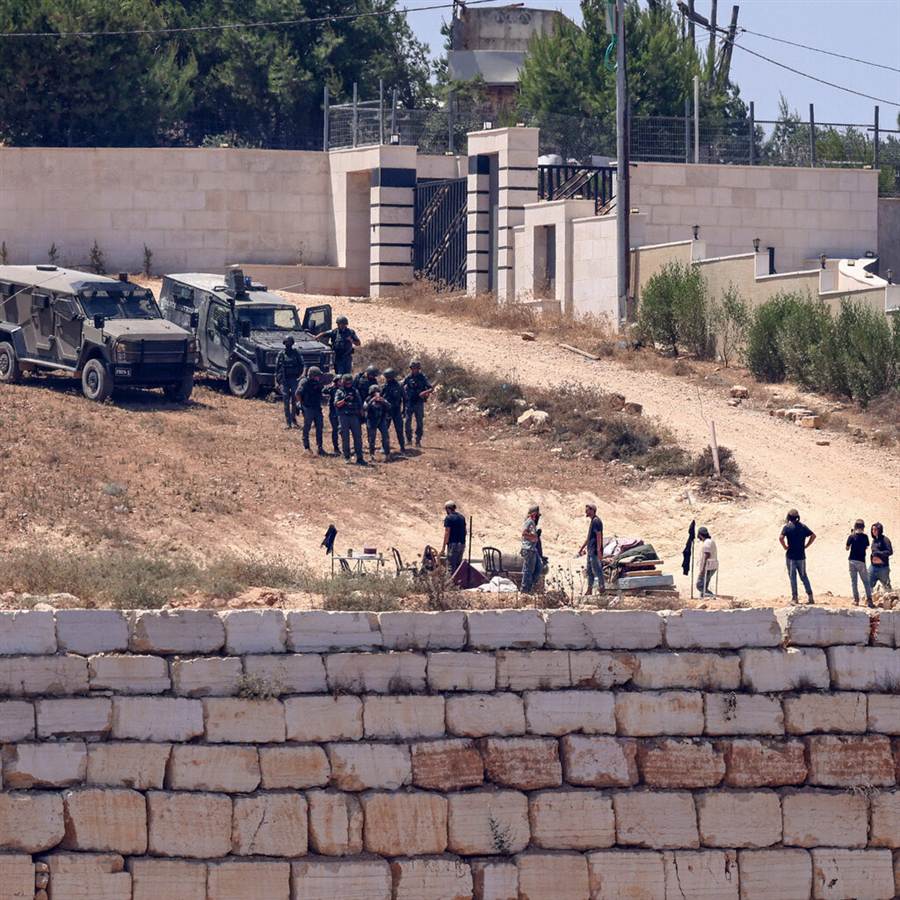
| In the village of Qusra in the occupied West Bank yesterday. Zain Jaafar/Agence France-Presse — Getty Images |
| For days, two Palestinian families have been trapped in their homes in the West Bank by a group of violent Israeli settlers, who set up a tent in the front yard of one of the houses.As Europe braced for the fifth heat wave of the season, many have had enough. Some in Britain mourn the temperate and sometimes rainy English summer.At least 44 people died after a crowded ferry overturned in Zimbabwe’s Lake Kariba.Gulf countries are building or expanding pipelines that can bypass the Strait of Hormuz.Thailand announced a suspension of new gun permits after a mass shooting.Zambia holds a high-stakes election today as President Hakainde Hichilema faces allegations of repression.Zhu Rongji, the former Chinese premier who played a pivotal role in guiding his country toward a market-based economy, died. He was 97.Trump’s tariffs are forcing some Canadian companies to consider moving south. |
WHAT ELSE IS HAPPENING
| Spotify will label A.I.-generated artists and exclude them from its recommendations. |
| SPORTS |

Basketball: The Los Angeles Lakers are being sold in a deal valued at a record-setting $12.5 billion.
Football: Lionel Messi expressed doubts about continuing his career “for much longer” following the death of his father.
| EXPLORATION OF THE DAY |
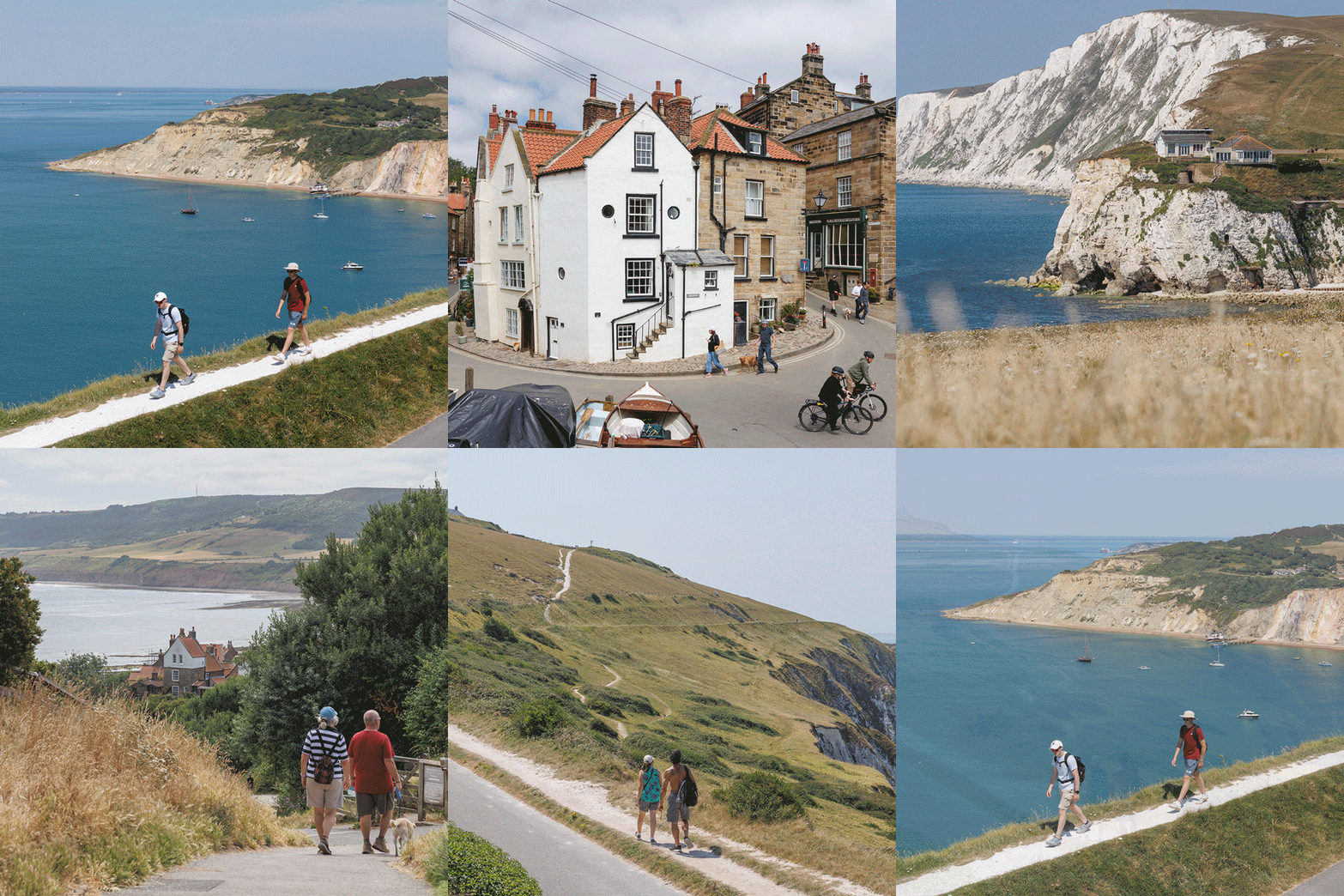
King Charles III England Coast Path
England now has the longest managed coastal footpath in the world: 4,328 kilometers of continuous trails, inaugurated by King Charles III in March. Paul Theroux walked parts of it, including the section by the White Cliffs of Dover, and found that the cliffs give the coast “almost edible beauty — like traversing a wedge of wedding cake, a chunk of ice cream, or a slab of Stilton cheese, depending on the variations of marine sunlight.”
| MORNING READ |

Nigel Farage, leader of the right-wing Reform U.K. party, is expected to win a special election to Parliament in a landslide today. He resigned the seat, in Clacton, last month to force this vote after coming under pressure over his finances.
The major political parties have refused to take part, calling the move a political stunt, but Farage is not without opposition. He’s facing Count Binface, a comedian in a trash can costume. My colleague Amelia Nierenberg sat down with him ahead of the election. “I seem to be his majesty’s opposition,” he said, from behind his bin. “Which is fine.”
Read the interview and click to watch Amelia’s video above.
| AROUND THE WORLD |
 |
| In Tokyo on a hot day last month. Andrew Caballero-Reynolds/Agence France-Presse — Getty Images |
Gadgets that keep you cool
East Asia’s summers are becoming hotter and longer, and “personal cooling” gadgets are everywhere. But they’re not just inexpensive hand-held fans. They also include more sophisticated products.
Here’s a quiz: Which of these is not currently being used in countries like Japan and South Korea? Click for the answer and then read the full story.
We’ve made this link free for you.
| RECOMMENDATIONS |
Read: These novels are about the misdeeds of the ultrawealthy, usually behind well-guarded doors.
Hack: Can using A.I. to monitor flights and hotels help you save money?
Ride: You can see many of America’s most beautiful places on a bike.
Stock: Chefs share ten Japanese pantry staples that you need in your kitchen.
| RECIPE |
 |
| David Malosh for The New York Times |
This creamy corn risotto is pleasingly light, thanks to the airy whipped cream folded in at the end. Making corn stock from scratch adds about 45 minutes of cooking time, most of it unattended, but it really amplifies the corn flavor.
