
November 2, 2026  | By Katrin Bennhold |
Good morning, world. Over the past few weeks, Donald Trump has been negotiating a lot of potential business deals with Vladimir Putin. His administration has discussed lifting sanctions, including on Moscow’s flagship government investment fund; in some cases, that’s already happened.
What’s going on? Some see favoritism toward an autocrat Trump has seemed to admire (and an attempt to lower U.S. fuel prices before midterm elections tomorrow.) The administration argues that it’s all part of a broader effort to end Russia’s war in Ukraine.
For me, as a German, it’s all a bit of a déjà vu. When I was Berlin bureau chief a few years ago, I wrote a lot about Germany’s longstanding policy of trying to influence Russian behavior with business and energy deals. Even after Moscow invaded Crimea, Berlin approved another major gas pipeline. The policy was abandoned only after Russia’s full-scale invasion of Ukraine in 2022.
Today, I write about the lessons of Germany’s failed Russia policy for the Trump administration.
Also:
| Final campaign stops in the U.S. midterms How Binance lost billions Meet a very busy snake catcher |
 |
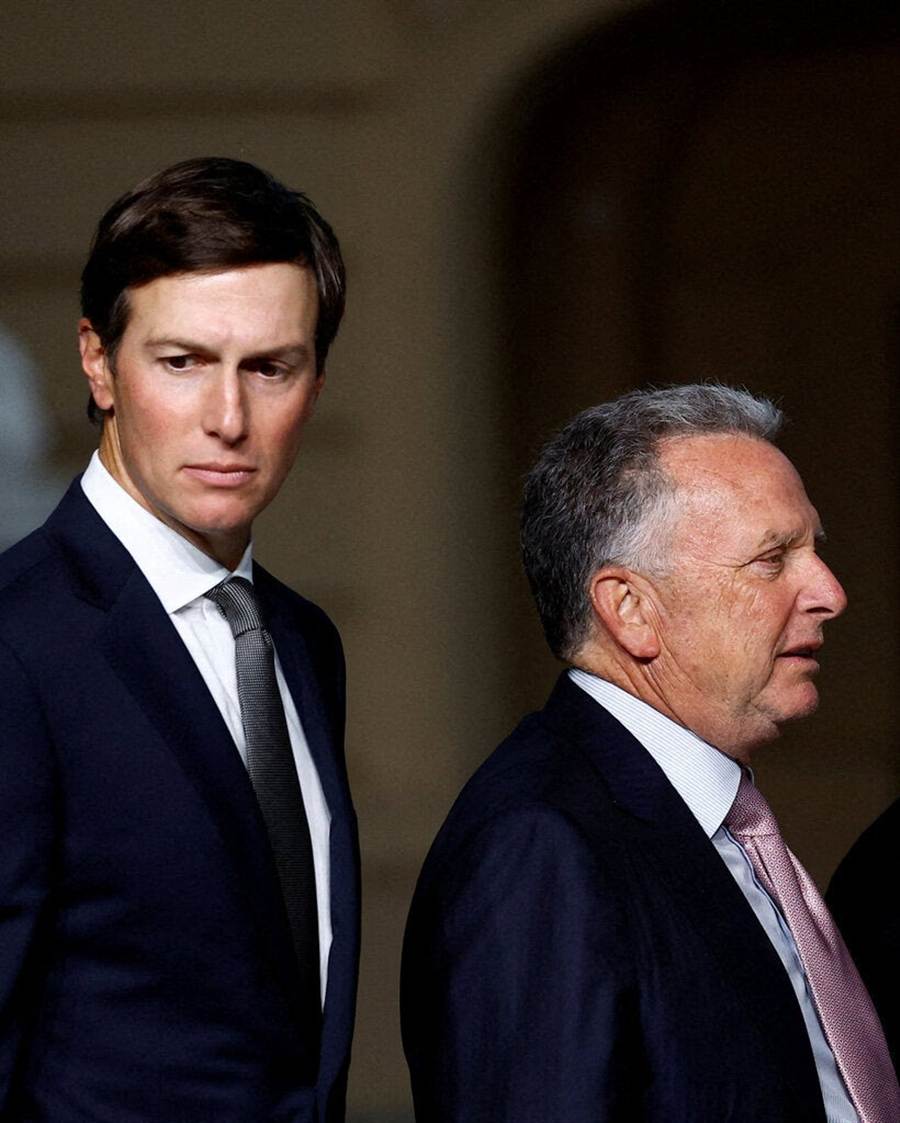
| Jared Kushner and Steve Witkoff in Kyiv, Ukraine, in September. Valentyn Ogirenko/Reuters |
Trump’s Ostpolitik
First, there was the potential Lukoil deal.
Last month, my colleagues reported that the Trump administration wanted a U.S.-led consortium to buy the international assets of one of Russia’s biggest energy companies.
Next, the administration waived some U.S. sanctions to buy Russian diesel and leaned on Europe to resume buying Russian gas. Then we learned that it considered a proposal to buy Russian technology to gain access to and liquefy natural gas in Alaska.
Now, it’s exploring yet another concession: lifting sanctions on Russia’s flagship government investment fund.
Trump wants to end the war in Ukraine. He has repeatedly tried and failed. His latest approach, spearheaded by the two businessmen who are his main negotiators — Steve Witkoff and Jared Kushner, his son-in-law — is aggressively focused on offering Putin economic incentives.
Witkoff and Kushner have argued that the prospect of doing business with the West could persuade the Russian president to compromise in Ukraine.
So far, however, it’s not working. Putin is happily banking all of the concessions while not making any of his own.
The idea of tempering Russia’s behavior with economic incentives isn’t new, nor is it inherently implausible. In fact, it’s the approach Germany took for decades, with, at least for a while, meaningful success.
But it stopped working for Germany for the same reason most experts think it won’t work for the United States now: There are things Russia cares about more than business deals.
 |
| Lukoil is one of Russia’s biggest energy companies. Ramil Sitdikov/Reuters |
Ostpolitik
Until Russia’s full-scale invasion of Ukraine, there was a shared belief in Germany — embraced by a long succession of chancellors, industry leaders and the public — that a Russia bound by trade would have too much at risk to enter into a conflict with Europe. Doing business with Russia, the thinking went, was a win-win: It would make Germany safer and richer.
That policy had its origins in the Cold War, when the West German government ushered in a new policy of engagement with the Soviet Union that became known as Ostpolitik. Ostpolitik was a broad philosophy that included other aspects of the relationship, too — diplomacy, cultural contact. But one of its defining pillars, which only grew in importance over time, became known as “Wandel durch Handel,” or “change through trade.”
I spoke to Liana Fix, who wrote a book about Germany’s evolving Russia policy. Ostpolitik helped build trust between the two sides, particularly during the Cold War, she said. The gas pipelines constructed from the 1970s onward might have made the end of the Cold War more peaceful.
But at the time, gas deals were accompanied by deterrence. “The other piece of it was missiles pointing at Moscow,” Fix said.
That changed after the Cold War. A reunified Germany cut military spending. At the same time, it intensified its business and energy ties with Moscow.
Initially, there was a belief that these ties would help transform post-Soviet Russia into a liberal democracy, Fix told me. But even when Germany’s political establishment became disillusioned with Putin, it still held on to the belief that mutual interdependence would make it too costly for him to step out of line.
It kept believing this after the invasion of Crimea in 2014: Angela Merkel persuaded Barack Obama not to ship arms to Ukraine and instead approved Nord Stream 2. Germany had leverage over Russia, the thinking went, precisely because it was buying so much Russian gas.
The opposite turned out to be true. It was Putin who restricted the flow of gas, in 2021. The next year, he invaded Ukraine.
 |
| Vladimir Putin at the Kremlin last month. Pool photo by Mikhail Metzel |
Lessons from the past
The U.S. does not share Germany’s tortured history or, for that matter, a continent with Russia. And it will never be strategically dependent on Russian gas in the way Germany was until very recently.
But if Trump’s goal is to end the war, one thing the German experience shows is that Putin is motivated by things other than business deals. This has been an incredibly costly war for Russia and Putin has shown that he’s prepared to pay the price.
Not everyone agrees about why Putin invaded Ukraine. Some, like Stephen Walt at Harvard, argue that what incited Putin was the offer of a path toward NATO membership extended to Ukraine in 2008. Walt pointed me to the memo the U.S. ambassador to Moscow at the time, William Burns, sent to Washington that year, warning that “Ukrainian entry into NATO is the brightest of all red lines for the Russian elite (not just Putin).”
“From knuckle-draggers in the dark recesses of the Kremlin to Putin’s sharpest liberal critics, I have yet to find anyone who views Ukraine in NATO as anything other than a direct challenge to Russian interests,” Burns wrote.
Others, like Fix, say that even in the absence of that offer, Putin’s longstanding imperial ambitions in Ukraine mean he most likely would have invaded anyway.
But people with very different views of what is motivating Putin still agree on one thing: business deals won’t be enough to lead him to give up. And worse, they could enable and embolden him.
The later years of Ostpolitik might be better remembered not for the ways Germany influenced Russia, but for the ways Russia influenced Germany. Former Chancellor Gerhard Schröder, a personal friend of Putin’s, earned millions promoting Russian energy interests. (Read my post-invasion interview with Schröder here. It’s a profile of him, but also of Germany’s Russia policy.)
Now it’s the Trump administration that’s talking to Russia about energy deals. The consortium seeking the multibillion-dollar Lukoil deal includes an American investor who is a Trump donor, Middle Eastern business executives with ties to Witkoff and Kushner, and an arm of the U.S. government itself.
| U.S. MIDTERM ELECTIONS |
 |
| Representative Haley Stevens, a Democrat, is endorsing a Republican Senate candidate. Jose Juarez/Associated Press |
Final campaign stops; final polls
Democrats are ahead of Republicans in almost all of the seven battleground states that will determine which party controls the Senate, according to the final set of New York Times/ Siena polls ahead of the midterms.
Trump traveled yesterday to Iowa and Kansas, two conservative states that have turned into Senate battlegrounds for his Republican Party. In Michigan, a Democratic congresswoman endorsed the Republican Senate candidate.
Young men swung to Trump in 2024, but polls show they are now moving away. My colleague Sabrina Tavernise went to Michigan for a closer look at the shift. Watch her video.
 |
| Click to watch. The New York Times |
We’re making our U.S. politics coverage free in The New York Times app through the Nov. 3 election.
| MORE TOP NEWS |
| Binance, the world’s largest crypto exchange, said that it had begun allowing users to withdraw money, three days after it lost $6.3 billion to hackers. Here’s how it happened. Tens of thousands of demonstrators in New Delhi denounced the government’s handling of India’s voter registration lists and demanded the resignation of the chief elections commissioner. If Prime Minister Benjamin Netanyahu gets the green light to form a new government in Israel, he will need to draw on decades of political capital and reckon with old foes. Hundreds of thousands took to the streets in France on Saturday for protests that ended with clashes between demonstrators and the police. |
WHAT ELSE IS HAPPENING
| Heidi Klum dressed as her severed left hand for her Halloween party. See all the other costumes.Joseph Lagu, who led southern Sudan’s war for independence, died at 94. |
TOP OF THE WORLD
The most clicked link in your newsletter on Friday was about Patrick Stewart’s memorable performances.
| SPORTS |
New York City Marathon: Andreas Almgren of Sweden won the men’s race and Sheila Chepkirui of Kenya won the women’s. Here are the highlights. Running the marathon is a sonic experience. Have a listen.
| RISKY BUSINESS OF THE DAY |
 |
| Lauren DeCicca for The New York Times |
Snake catcher
Pinyo Pukpinyo, who works for the Bangkok Fire Department, is also the city’s top snake catcher. On an average shift, he wrangles more than 20 snakes from sewers, flowerpots and toilets, among other places. He does not kill the snakes he catches. Instead, he takes them in. Watch the video.
| MORNING READ |
 |
| Tiananmen Square on May 4, 1989. Peter Turnley/Getty Images |
Nicholas Kristof was in Beijing on the night of the Tiananmen Square massacre, reporting from the streets as Chinese troops moved in on pro-democracy protesters.
In a personal retrospective for our series on 175 years of New York Times eyewitness journalism, he talks about the events of that night and what such extraordinary bravery under state repression taught him about the nature of courage. Read his reflection on the day that changed modern China.
| AROUND THE WORLD |
 |
| Michele Monastra/New Press/IPA Agency, via Shutterstock |
A bloodstained crime opera
Italians can’t get enough of “Romanzo Criminale,” a best-selling novel that has been made into a hit film, a bigger hit TV show and now, an opera.
The gangster story takes place in the 1970s and 1980s, when bombings and murders by far-left and far-right militants terrorized Italy. The opera debuted last month in Florence to eight minutes of curtain calls. Read more about how the opera speaks to a contemporary audience.
| RECOMMENDATIONS |
Watch: Laika’s new triumphant film, “Wildwood,” is an adaptation of Colin Meloy’s fantasy novel.
Read: Were it not for Vincent van Gogh’s sister-in-law, a new biography argues, the artist may never have found fame.
Explore: Check out some of the newer and more helpful features in Google Maps and Apple’s Maps.
Sweeten: Is honey any better for you than table sugar? Take our sugar quiz.
| RECIPE |
 |
| Julia Gartland for The New York Times |
Ukun iyo mallaay or egg and tuna scramble is an umami-forward favorite in many Somali homes, with an ability to feed an entire household cheaply and quickly. The scramble is a great source of protein.
