
October 6, 2026  | By Katrin Bennhold |
Good morning, world. If you’re confused about what happened at a British air base last week, you’re not alone. Five men arrested on suspicion of terrorism and then let go. A prime minister citing “strong indications” that Iran was behind it but not explaining how.
Nobody got hurt, and no damage has been done, as far as we know. But over the weekend, the U.S. military suddenly pulled all of its B-1 bombers from the base. It was a highly unusual move, spurred by the risk of a potential Iranian drone attack, according to U.S. and British officials.
War used to be more or less clearly defined: armies fighting on the battlefield. These days, it takes many hard-to-grasp forms. Today’s newsletter is about one of the newest.
Also:
| Brazil’s rightward shift Remembering Jeffrey Archer South Korea’s art scene |
 |
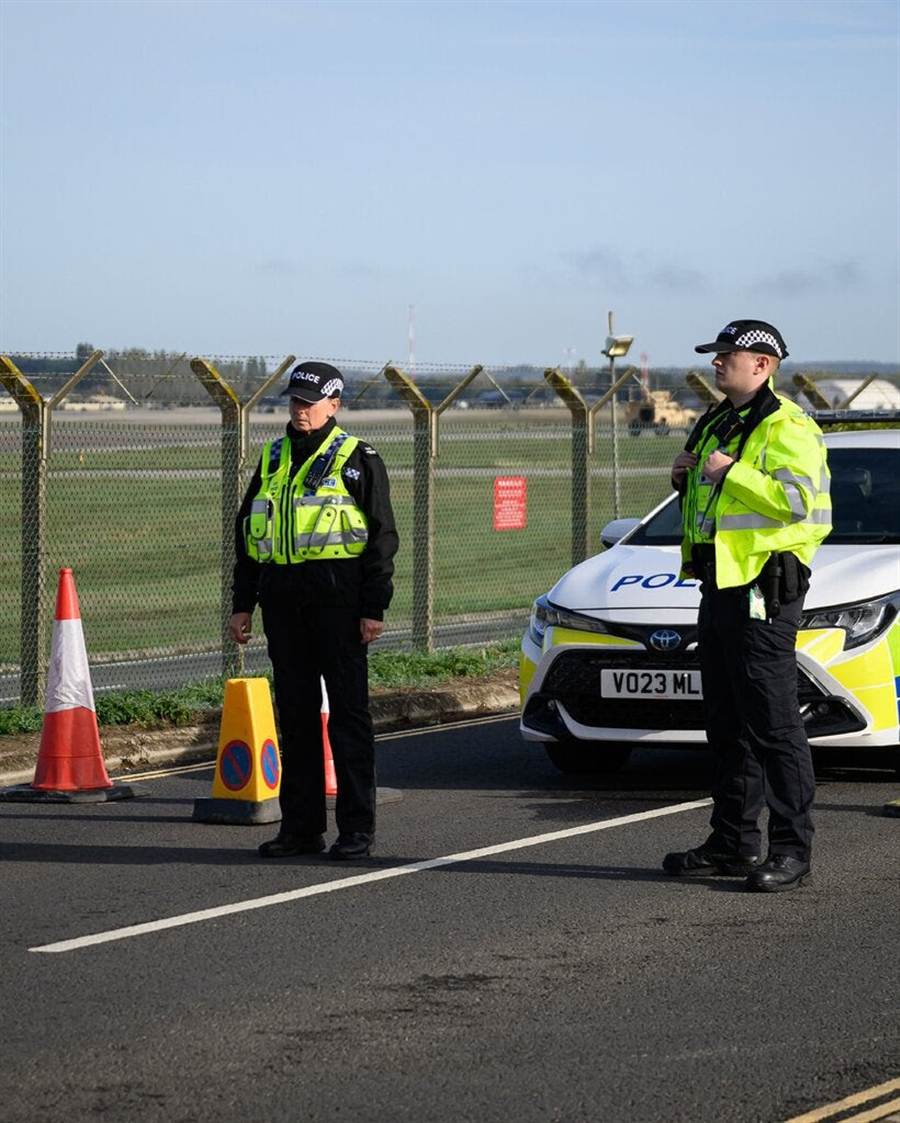
| Near the R.A.F. Fairford military air base in England last week. Leon Neal/Getty Images |
The mysterious story of what didn’t happen at a British air base
At first, it seemed like a terrorist attack on a British air base had been thwarted. Then the story turned stranger.
The five men arrested last week had been traveling in white vans in the middle of the night near a base in southern England that the U.S. has used in its war against Iran. The Islamic Revolutionary Guards Corps had warned over the summer that “any base used to launch attacks on Iranian territory” would be “a legitimate target.” The arrests suggested that threat had materialized.
But the details we’ve learned since then have been confusing. The men in the white vans? Not radicalized ideologues or hardened operators, but “unwitting chumps,” one official said. One of them called emergency services himself; we still don’t know why.
Perhaps most mysterious of all is what the suspected plot was meant to achieve. When the police searched the vans, they found some gasoline but no explosives. The British prime minister, Andy Burnham, said there were “strong indications that Iran played a part.” But as my colleagues recently put it — “a part in what, exactly?”
The men were soon released on bail — not something that tends to happen with suspected terrorists. The whole thing seemed odd, but mostly over, until this weekend, when the U.S. rushed to remove its bombers based on what two U.S. officials called “new threats.” It has since emerged that the withdrawal was because of the risk of an Iranian drone attack, according to U.S. and British officials.
The affair has been both alarming and mystifying. It might also mark a new high point in the ambitions of what analysts call “gig economy hybrid warfare.”
 |
| The New York Times |
Sowing fear
British security officials have warned for years about the dangers of these sorts of plots. Russia pioneered them; Iran has since taken up the mantle.
They involve states recruiting what are known as “disposable agents” or “cutouts,” my colleague Neil MacFarquhar writes. They are often low-level criminals, sometimes teenagers, who don’t know whom they’re working for and agree to take on a task for a fee paid in cryptocurrency.
Since the U.S. began its war in Iran in February, there have been about 20 small-scale arson and bombing attacks against Jewish and American targets in Europe and North America. The authorities and analysts said the incidents all followed a similar model: They were carried out by local criminals or disenfranchised young men hired through anonymous online transactions, with a front organization for Iran’s Revolutionary Guards ultimately claiming responsibility.
The plots don’t have to involve real danger to be disruptive. In the spring, after a warning that the Israeli Embassy in London would be attacked, two jars of a powdered substance were found nearby, setting off a huge police response. The substance turned out to be harmless.
Europeans have been divided about how they should treat these episodes. As terror incidents or crimes? Hiring locals to do this work has the added effect of aggravating local divisions, experts told Neil — turning a story about Iranian proxies attacking a synagogue, for example, into one about an apparent surge of antisemitism in Britain.
But they rarely involve hardened targets, like an air base.
 |
| A U.S. heavy bomber takes off at R.A.F. Fairford on Sunday. David Bown/Getty Images |
Value for money
We still know very little about what was behind the strange events at the base.
Intelligence officials have been particularly intrigued by the decision of one of the arrested men to call the authorities. Was that part of the plan — to distract the police while a broader plot unfolded? Or was it a low-level criminal realizing he’d gotten in over his head and looking for a way out?
But if this is an instance of gig economy warfare, experts told Neil, it represents an escalation in these efforts to use disaffected young people as agents of far-off governments.
States like Iran and Russia do this for multiple reasons. Partly because it ensures distance between the people carrying out the crimes and the state itself, one expert told Neil.
But another reason is that it’s cheap. The term “gig economy warfare” is compelling in part because of the parallels between these actors and, say, underpaid delivery drivers. A 2024 article published by the journal of the British defense think tank RUSI noted some of the prices Russia paid for acts of hybrid war: a few hundred dollars for high-risk activities like arson and assassination, or $53 per person to paint Star of David graffiti around Paris — far less than the cost of an actual operative.
“It appears that just as in other areas of the gig economy,” the article read, “the benefits generally accrue to the employer.”
For more: The possible drone plot against R.A.F. Fairford was part of a complex, multipronged Iranian scheme to strike aircraft and kill some of the several hundred American personnel stationed at the base, according to U.S. and British officials.
| MORE TOP NEWS |
 |
| Porto Alegre, Brazil, on Sunday. Silvio Avila/Agence France-Presse — Getty Images |
Brazil swings to the right
A formidable showing by Flávio Bolsonaro in the first round of Brazil’s presidential election suggests he is well on his way to victory in an Oct. 25 runoff. That would be a dramatic comeback for the Bolsonaro family — Flávio’s father, Jair, a former president, was jailed for a coup attempt after he lost an election — and the biggest win yet for the Latin American right-wing movement, which has won seven presidential elections in a row.
Bolsonaro won 47 percent of the vote — two percentage points more than President Luiz Inácio Lula da Silva, but not enough to clinch a majority. Most of the other candidates, who each drew 1 to 3 percent of the vote, were from right-leaning parties. And right-wing candidates, including three other members of the Bolsonaro family, also made spectacular strides in Brazil’s legislative elections.
Lula still has a narrow path to victory, especially if he can win over some of the 33 million Brazilians who skipped Sunday’s vote. But one analyst called the first-round results from Latin America’s largest democracy “a right-wing tidal wave.”
 |
| Rick Eglinton/Toronto Star, via Getty Images |
Remembering Jeffrey Archer, a novelist whose life rivaled his fiction
Jeffrey Archer, a best-selling British author, politician and one-time jailbird who seesawed between achievement and disgrace, died at 86. He inspired public fascination with headline-grabbing accounts, both fictional and personal, of ambition, self-promotion, misbehavior and scandal.
As a politician — he was deputy head of Margaret Thatcher’s Conservative Party — Archer displayed a barely veiled hunger for the premiership. He once said that politics was his first choice of career, but it was from his 40-plus books that he amassed wealth.
Archer endured many ups and downs, including a perjury conviction in 2001, when he was found guilty of creating false diaries and concocting a story to win a trial over whether he had slept with a prostitute to whom he paid hush money. He spent two years in prison.
| OTHER NEWS |
 |
| Miguel Medina/Agence France-Presse — Getty Images |
| France is bracing for nationwide protests today after union leaders vowed to join students who have spent two weeks blockading schools over subpar conditions.Spain’s prime minister, Pedro Sánchez, called for an early election after months of escalating crises over corruption, migration and housing shortages.Russia tried to tamp down speculation that a worker at a biological research facility in Siberia had died of plague. Here’s what we know.U.S. talks with Russia about ending the war in Ukraine have included a multibillion-dollar oil deal that would benefit executives with ties to the U.S. negotiators, Steve Witkoff and Jared Kushner.In Canada, a separatist party won the provincial election in Quebec, possibly setting the stage for an independence referendum in the next few years.Saudi Arabia attacked the Iranian-backed Houthi militia to help the Yemeni government reclaim strategic territory at the southern tip of the Red Sea.A humanitarian calamity is unfolding in Russian-occupied Oleshky, Ukraine, where there is no food, no safety and no escape.Australian lawmakers questioned an OpenAI executive in a hearing after the company’s A.I. agents breached government websites. |
TOP OF THE WORLD
The most clicked link in your newsletter yesterday was about Tom Ford’s show at Paris Fashion Week.
| DEAFENING BIRDCALL OF THE DAY |
 |
| João Menezes |
The bare-throated bellbird
The dove-sized bird that lives deep in Brazil’s Serra do Mar mountains produces an extremely noisy call to attract female mates — louder than a chain saw or an elephant’s trumpet. Along with another Brazilian species, the red-legged seriema, it has the loudest birdsong ever recorded. (Click here to hear it, but turn down the volume first.)
| MORNING READ |
 |
| Zishaan A. Latif for The New York Times |
Tukaram Mundhe, a top food and drug official in India, has become an unlikely celebrity thanks to his surprise raids of Mumbai restaurants.
No business is safe from Mundhe’s zero-tolerance campaign. His staff has inspected famed establishments like Olympia — where Matt Damon and Tom Holland had tea this summer — as well as street vendors, government cafeterias, high-end restaurants and chains like McDonald’s. Read more about the rock star food inspector.
| AROUND THE WORLD |
 |
| Jun Michael Park for The New York Times |
South Korea takes on high culture
By Jin Yu Young
Over the last decade, South Korea’s films have been lauded globally and its pop stars have won over millions of fans around the world. But can it become a high-culture powerhouse too?
Last month, it felt as if art was all around in Seoul as the city hosted its edition of Frieze, a prestigious art fair. Kiaf, a homegrown fair, featured more than 100 galleries in the city. And elsewhere in the country, the Gwangju Biennale opened for a monthslong exhibition.
I attended Frieze, where I saw the South Korean artist Sun Woo’s painting “Dawn in the Grove.” Another gallery exhibited an angular bronze bust by Suh Yongsun. At the Biennale, a 500-hour sound piece by Sunik Kim called The Light in the Factory remixed songs from South Korea’s pro-democracy protests several decades ago.
K-pop, K-dramas and K-beauty exploded in popularity in part because the South Korean government invested heavily in them as part of a soft power strategy. The government recently said it would invest more in the fine arts, and it pledged a significant increase in state funding for artists.
Could South Korea’s next breakout star be a painter or a sculptor? Perhaps it will be a spiritual successor to Nam June Paik, a pioneering South Korean who is considered by many to be the inventor of video art.
| RECOMMENDATIONS |
Watch: Here are new movies our critics are talking about, including a self-serious satire starring Tom Cruise.
Gawk: What kind of homes can you get now for $100 million or more?
Play: This new video game is like a utopian version of Grand Theft Auto.
Travel: From a tribute to John Coltrane to a night with Michael Douglas, here are 26 fun things happening in New York City this month.
| RECIPE |
 |
| Andrew Bui for The New York Times |
This is a nostalgic, 1980s-crunchy-mom-style vegetarian lasagna, not an Italian purist’s one. In other words, it’s perfect for a weeknight when red sauce, spinach and cottage cheese feel like they might save your life.
