
September 25, 2026  | By Katrin Bennhold |
Good morning, world. A year ago, it felt as if the United Nations was on its last legs. It was running out of money, it seemed increasingly irrelevant and there was concern that Donald Trump would pull the United States out. There was even talk that his Board of Peace could become a sort of alternative, rival U.N.
But this week, as world leaders once again met in New York, there was a new energy. A.I. got its first-ever dedicated Security Council meeting. And Trump, though belligerent as ever, did what you’re meant to do at the U.N.: He engaged in diplomacy. But it’s hard to read the room from outside the building. So I spoke to my colleague Farnaz Fassihi, who has been inside U.N. headquarters all week.
Also:
| Xi at the White House Cambridge’s Arday investigation Deliciously sensual baking |
 |
| António Costa, E.U. president, at the U.N. yesterday. Dave Sanders for The New York Times |
The World Cup of diplomacy
Farnaz, I usually call you up to talk about Iran, but you’re also our U.N. bureau chief and have been covering these annual meetings for a decade. People love to discuss how irrelevant the U.N. has become. How much does the U.N. still matter?
It’s the only forum in the world that brings countries — all 193 of them — together under one roof. They call it the World Cup of diplomacy. Delegations attend bilateral meetings, group meetings, thematic meetings on things like rising ocean levels and food security. These are issues that need a space for discussion, and the U.N. is really the only place that offers that.
What comes out that’s actionable? Very little. But it moves the conversation forward. And there’s value to that if you believe in diplomacy. We’re so used to thinking, “Oh, the U.N. Security Council is so divided; the U.S. and China and Russia can’t agree on anything.” But as one U.N. expert pointed out, when you compare it to the Cold War days, when the U.S. and the Soviet Union were at loggerheads, the U.N. is still doing a lot more today than it was then.
What stood out to you this year?
Definitely artificial intelligence. A.I. went from a marginal issue to a big theme. The Security Council, which always picks what it sees as the most important issue for peace and stability, held a high-profile meeting on A.I., with Sam Altman and Dario Amodei, the bosses of OpenAI and Anthropic, briefing leaders.
For now, several of the countries that have veto power don’t seem very eager to act jointly. The U.S., China and Russia were essentially saying, “You can’t interfere in our sovereign decisions about technology.”
It was also the first time the head of a country actively at war with the U. S. has come to New York and addressed the U.N. How did that go down?
It was remarkable. In Afghanistan and Iraq, the U.S. toppled the governments so quickly that this situation was avoided. During the Vietnam War, Vietnam wasn’t yet a member state, so this was new — and a little surreal. Iran’s president, Masoud Pezeshkian, is getting Secret Service protection from the Americans.
People in Iran are pointing out the irony: Iranians are not safe in their own country, where America may attack and kill them. But in the U.S., they’re protected by the Secret Service and meeting with prime ministers and presidents. For Iran’s government that’s a symbolic win: We survived. We’re still standing.
 |
| President Masoud Pezeshkian of Iran at the U.N on Wednesday. Dave Sanders for The New York Times |
How did Trump handle the situation?
It’s interesting. Last year, Trump just lashed out at countries and insulted the U.N. and people were nervous he’d pull the U.S. — the U.N.’s top funder — out altogether.
This year, from the U.N.’s perspective, at least, his speech was more measured. That might sound surprising, given that he talked about annihilating the Islamic republic and effectively threatened a war crime from the U.N. podium. But he was not threatening the U.N. itself. And in a way, he was doing what people do at the U.N. General Assembly: He used the platform to send a message.
Then, an hour later, we hear the Iranians and Americans have been meeting for two hours on the sidelines. Which is also what people do at U.N.G.A. though not usually after one party has just threatened to annihilate the other.
So, what I’m hearing you say is that the U.N. is still a useful talking shop. But perhaps no longer itself involved in conflict resolution?
The U.N.’s original and core mission was to prevent and mediate conflict, and that piece has slipped away. In Gaza, it had a very minimal role. In the Iran conflict, it’s had no voice. But it’s more than a talking shop. When it comes to humanitarian relief, for example, it’s really the only game in town. The response to floods in Nepal or earthquakes in Colombia and Venezuela, food aid in Gaza and Sudan, would not be possible without the U.N.’s staff, logistics, planes and regional hubs.
The secretary general, António Guterres, is leaving office in December. What should we expect next?
They’re looking for a new secretary general, but for now there’s no clear front runner. At every Security Council briefing I went to this week, they said they want someone who asserts themselves more on conflicts. They feel Guterres has been too passive. They think a new leader, possibly a woman for the first time, could energize the institution.
Dueling speeches: The Palestinian leader Mahmoud Abbas, speaking in a videotaped address, called for a two-state solution while denouncing Israel for what he called a “genocidal” war. Several hours later, Israel’s prime minister, Benjamin Netanyahu, defended Israeli military action across the Middle East in a fiery speech. Dozens of delegates walked out of the hall as he took the podium.
| MORE TOP NEWS |
 |
| At the White House on Thursday night. Doug Mills/The New York Times |
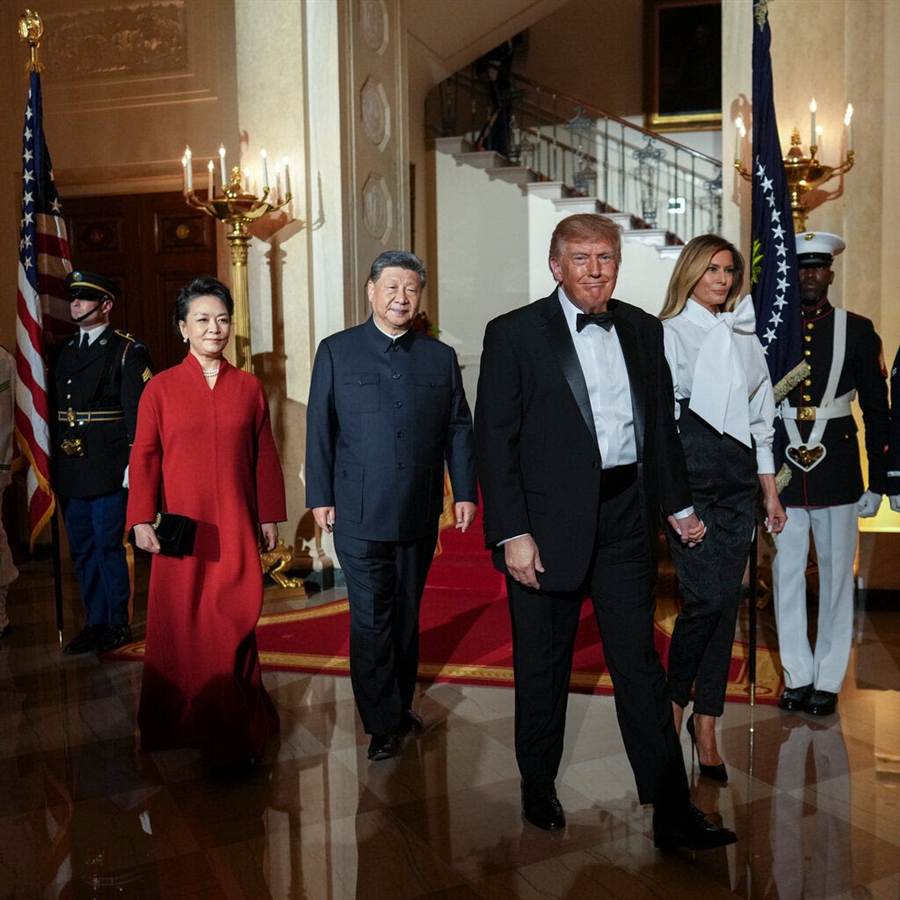
Xi’s White House visit
On his first visit to Washington in a decade, President Xi Jinping was welcomed at the White House. President Trump said yesterday that he had “never gotten along better” with the Chinese leader, during a day of military flyovers, gifts of pandas and lavish ceremonies that masked significant divides. The two leaders did appear to broach pressing issues behind the scenes.
The day was capped with a state dinner. Guests included tech titans including Jeff Bezos, Elon Musk and Sam Altman. On the menu: three courses featuring American ingredients with a subtle Chinese influence.
| OTHER NEWS |
 |
| In Taiz, western Yemen, this month. -/Agence France-Presse — Getty Images |
| The Saudi-led military coalition in Yemen said it shot down six ballistic missiles fired by the Houthi militia at Saudi cities.France will send troops and other military assets to Saudi Arabia to help protect critical energy sites along the Red Sea that have come under fire from the Houthis.Iran’s foreign minister said that Tehran had proposed to Washington a seven-day plan to cease hostilities, reopen the Strait of Hormuz and begin nuclear talks.Cambridge University has abandoned plans to fully investigate its hiring of Jason Arday, the professor who became a flashpoint in debates over diversity, following his abrupt death last month.Journalists from CNN, MS NOW and Politico were allowed back onto the White House grounds after a fight over their access.Demonstrations erupted across Spain after the police in Madrid broke down an 87-year-old woman’s door to evict her.Google is launching an experimental satellite as it works to put A.I. data centers in space.A7, a financial services firm based in Moscow, is at the center of Russia’s efforts to evade global sanctions and buy drone parts for its war in Ukraine. My colleague Aaron Krolik explains in the video below. |
 |
| Click to watch. The New York Times |
WHAT ELSE IS HAPPENING
| Macklemore, the rapper who was kicked off Ed Sheeran’s tour, announced plans for a Free Palestine Tour. |
TOP OF THE WORLD
The most clicked link in your newsletter yesterday was about Lian Yunzhi, the 6-year-old girl who set a Rubik’s Cube record.
| SPORTS |
Football: In a wide-ranging interview, Kylian Mbappé talked about speaking up and revisited his favorite World Cup memories.
| QUOTE OF THE DAY |
 |
| Press Association, via Associated Press Images |
“I like a bit of goo.”
The British food writer Nigella Lawson has joined the new season of “The Great British Bake Off” and she’s on fire. Her sensual love of sumptuous food is spicing up the show’s traditional coziness. She spoke approvingly of a peanut and caramel concoction, and purred, “It looks irresistible, doesn’t it?”
| AROUND THE WORLD |
 |
| Federico Rios for The New York Times Magazine |
An Indigenous world is about to change
As a child, Ben Ryder Howe traveled to Panama, where his father, an anthropologist, was studying the Guna people in the wilderness around the Darién Gap.
For 500 years, the Guna have kept outsiders at a distance, despite their region’s potential as a trade route. Now, though, they’re considering a highway that would run through their land. Ryder Howe went back to Panama to understand why.
| RECIPE |
 |
| Christopher Testani for The New York Times |
Celebrate Chuseok, the Korean mid-autumn festival, with black sesame cake. This simple yet regal cake contains the flavors of songpyeon, the traditional rice cakes, thanks to honey, roasted black sesame seeds and rice flour.
