
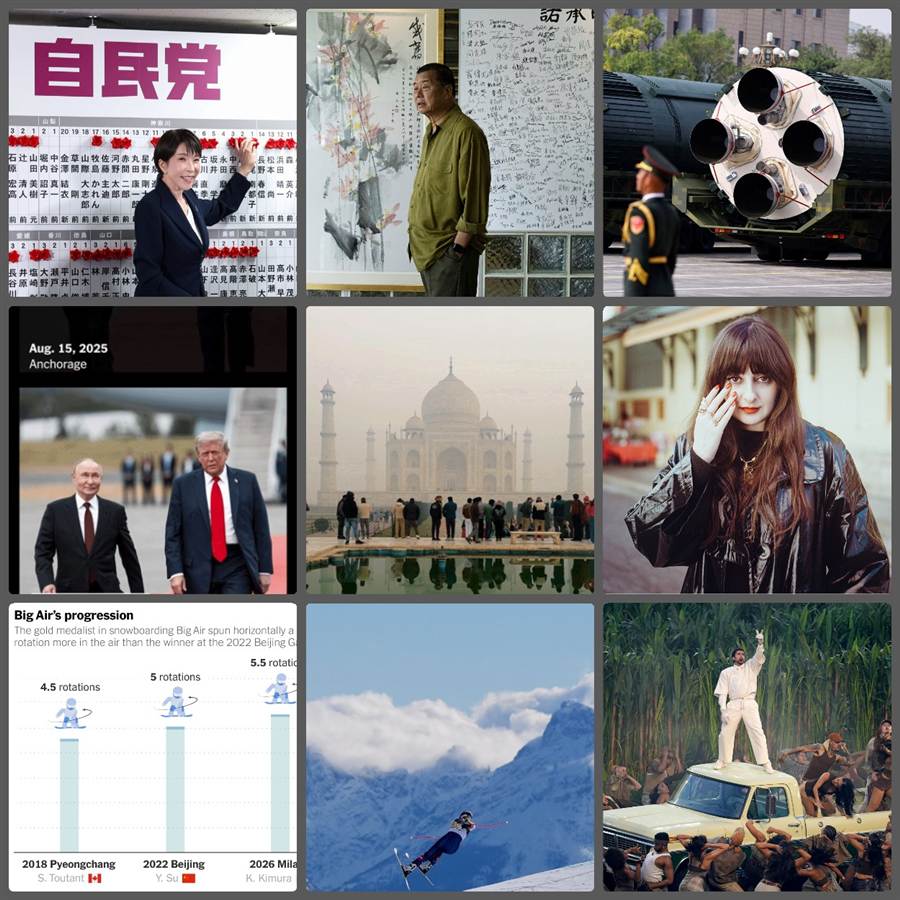
Good morning, world! I grew up in Germany at the tail end of the Cold War. Fears of a nuclear attack were part of my childhood, along with record players and mullets. Since then, when I’ve thought about nuclear proliferation, it has mostly been in the context of countries like North Korea and Iran. I certainly did not see another nuclear arms race coming that included democracies.
But, as my colleagues David Sanger and William Broad write below, nukes are back, with a cascade of consequences for global security.
Also:
| Jimmy Lai sentenced to 20 years A big win for Japan’s leader Bad Bunny’s joyful Super Bowl performance |
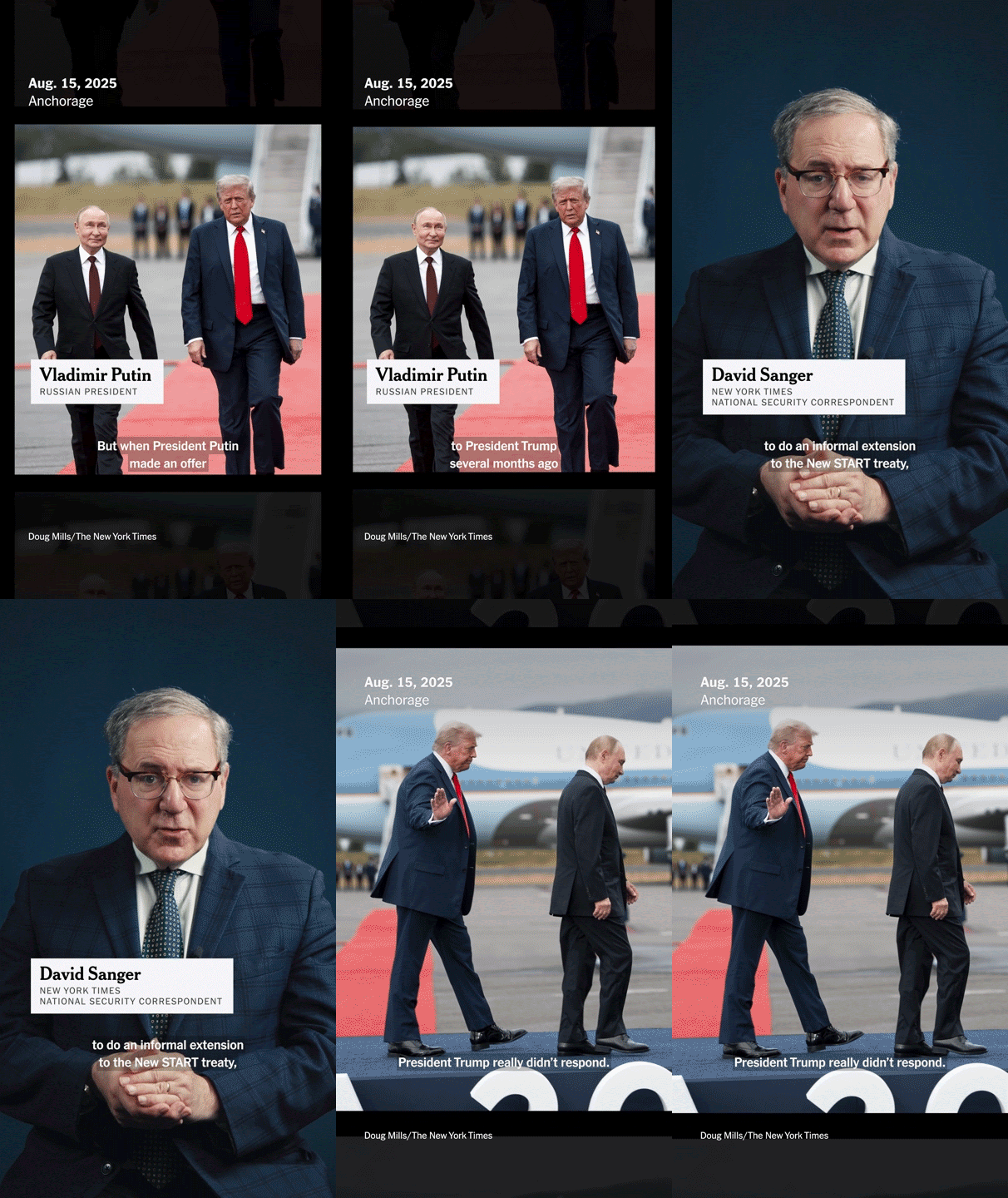
The end of the arms control era
By David E. Sanger and William J. Broad
Last week, the United States and Russia allowed their last nuclear arms control treaty, known as New START, to expire. For the first time since 1972, the superpowers have no limits on the size or structure of their arsenals.
President Trump has said he wants to negotiate a new agreement — “a new, improved, and modernized treaty,” as he described it on social media recently. But he said nothing about freezing American and Russian arsenals at current levels, leaving open the possibility of a renewed arms race.
In fact, the U.S., Russia and China have been preparing for that possibility. And some U.S. allies, uneasy about whether they can count on the U.S. “nuclear umbrella,” have begun talking about establishing their own nuclear forces.
As Vipin Narang and Pranay Vaddi, two of America’s leading nuclear strategists, wrote recently, “Nuclear weapons are back with a vengeance.”
‘No one wants to discuss Swedish nuclear weapons’
It’s “miraculous” that the world has as few nuclear weapon states as it currently does, said Graham Allison, a Harvard political scientist.
“They’re not too hard to make,” J. Robert Oppenheimer said of atomic bombs in 1945. “They’ll be universal if people wish to make them universal.” In 1963, President John F. Kennedy predicted that by 1975 there could be up to 20 nuclear-armed states.
In fact, there are currently just nine: Britain, China, France, India, Israel, North Korea, Pakistan, Russia and the U.S.
A central factor behind this restricted outcome has been the U.S. “nuclear umbrella” — the promise that Washington would come to the defense of allies if they ever came under nuclear attack. This strategy has kept most American allies from building their own nuclear weapons.
But the U.S. strategy is under fire.
Trump often portrays allies as freeloaders, and has cast doubt on whether he would use nuclear weapons to protect them.
The allies have gotten the message. Last year, President Emmanuel Macron of France warned that Europe needed to prepare for America’s retreat. He said he was willing to discuss extending the protection of France’s nuclear arsenal to its European allies.
Poland’s prime minister said his nation had to “reach for opportunities related to nuclear weapons.” And early last month, as Trump’s threats to take over Greenland grew louder, Stockholm’s leading newspaper called for a joint Nordic nuclear arsenal.
“No one wants to discuss Swedish nuclear weapons,” it declared, “but we must.”
Moves and countermoves
Already, there are signs that the Trump administration is planning to break out of the numeric limits of New START in ways that could set off a new arms race. For instance, the U.S. is planning to increase the number of warheads that can be carried by its nuclear-armed submarines.
To Trump administration officials, this planned increase puts foes on notice: If they attempt a nuclear strike, the retaliation could be larger than at any time in years. But there’s a counterargument. America’s deployment of new weapons could fuel an arms race. And U.S. rivals are already making their own moves, including some that would make it impossible for Trump’s “Golden Dome” project to intercept enemy missiles.
In October, President Vladimir Putin of Russia announced a successful test of the Poseidon, an underwater drone meant to cross an ocean, detonate a thermonuclear warhead and raise a radioactive tsunami powerful enough to shatter a coastal city. He also seems to have conducted at least one test launch to prepare for placing a nuclear weapon in space, which might destroy fleets of American satellites.
China is also developing novel weapons: In 2021, it fired a hypersonic missile into orbit that circled the globe before deploying a maneuverable glide vehicle that could deliver a nuclear weapon anywhere on earth. But for the time being, it is the speed with which China’s conventional nuclear forces are growing that has seized experts’ attention.
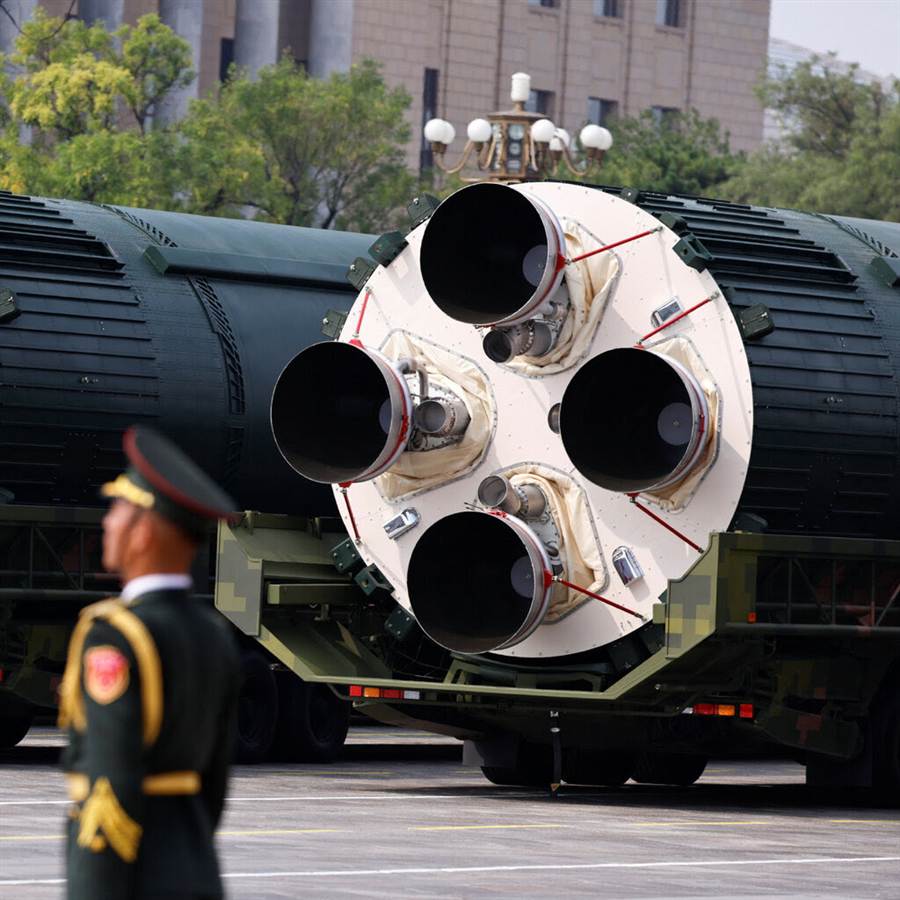
Every effort by the Trump administration to engage China in some kind of discussion of its nuclear capabilities has been shut down by Beijing.
That leaves the U.S. with a choice: It can push ahead with larger arsenals and new, specialized weapons to keep pace with Beijing and Moscow, or negotiate a broader deal of the kind Trump has talked about.
Many among arms control experts agree with elements of Trump’s argument that New START aged poorly. A new, better treaty would cover both new technologies and additional countries — starting with China.
Trump wrote last week he wants to begin such negotiations, but he offered no specifics. The Chinese have little interest in arms control, it seems, until their arsenal is roughly the size of Washington’s and Moscow’s. And so strategists instead see a looming surge in moves and countermoves around the globe that could, eventually, lead to a crisis.
“We’re seeing the end to an era of arms control,” said Erin D. Dumbacher, a senior security fellow at the Council on Foreign Relations.
| MORE TOP NEWS |
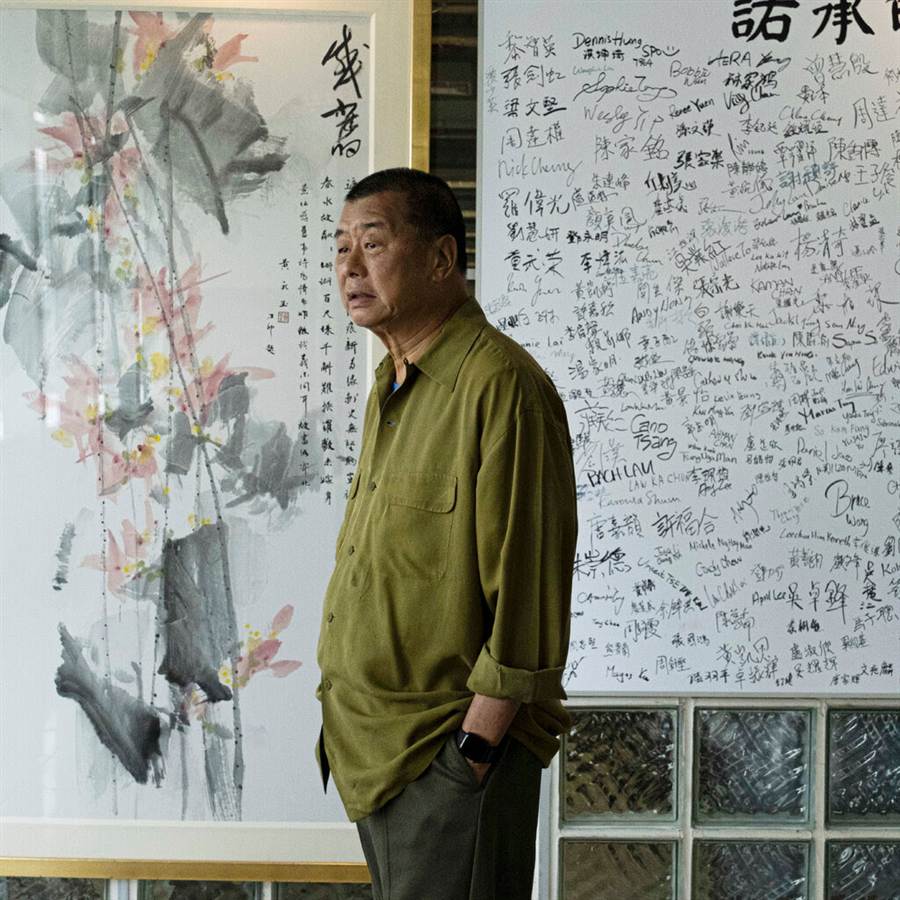
Jimmy Lai sentenced to 20 years in prison
A court in Hong Kong sentenced Jimmy Lai, the media mogul, to 20 years in prison. The ruling is the culmination of Beijing’s yearslong effort to dismantle the influence of a man it blamed for masterminding Hong Kong’s pro-democracy movement.
Lai, 78, was found guilty in December of “conspiracy to collude with foreign forces.” He was also convicted of conspiracy to publish seditious material in Apple Daily, the now-closed pro-democracy newspaper he founded in 1995.
Lai smiled and waved at the public gallery after his sentencing. His sentence is the harshest penalty ever handed down for a national security offense in Hong Kong.
For more: In a city filled with self-made millionaires, Lai’s story of rags to riches stood out. He attributed his ascent to the freedoms of Hong Kong. See his life in photos.
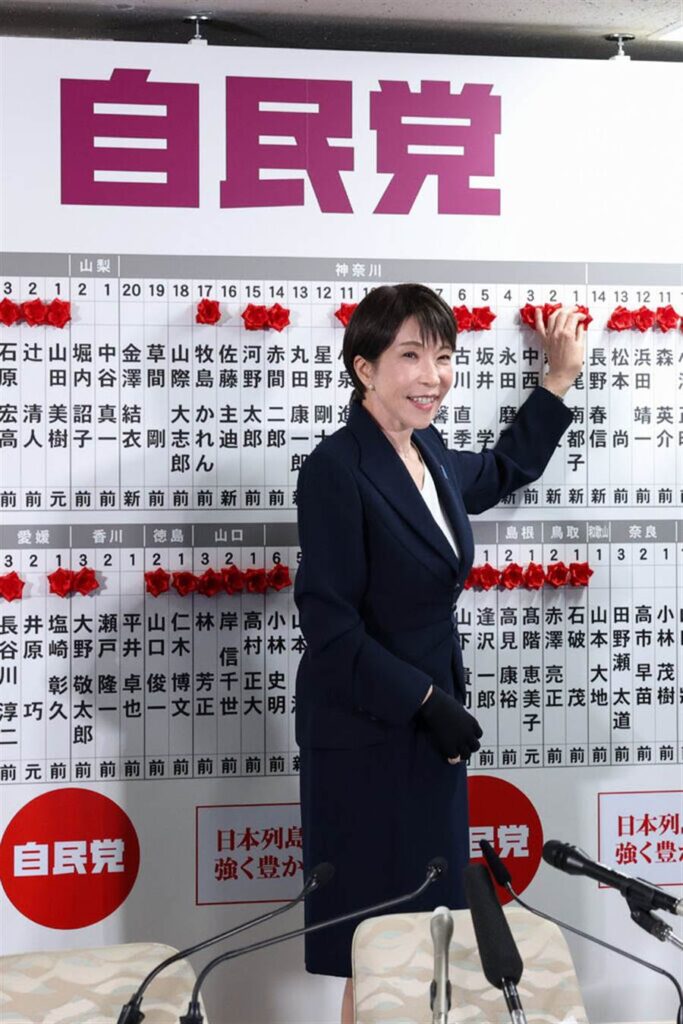
A big win for Japan’s leader
Prime Minister Sanae Takaichi of Japan yesterday secured a resounding mandate from voters for her economic policies and tough stance on immigration and China.
Takaichi’s Liberal Democratic Party won in a landslide, securing a rare supermajority in the House of Representatives, according to results analyzed by NHK, the public broadcaster. With her party now on a stronger footing, Takaichi will face few constraints as she pushes aggressive government spending programs and expansive national security laws.
The decisive victory also shows Beijing that she has the backing of the Japanese public for her hawkish views on China.
| OTHER NEWS |
| The chief of staff to Prime Minister Keir Starmer of Britain resigned over his role in the appointment of Peter Mandelson, a friend of Jeffrey Epstein, as ambassador to the U.S.The Epstein files revealed the scope of Ghislaine Maxwell’s role in supporting the creation of the Clinton Global Initiative, one of Bill Clinton’s signature endeavors.In Thailand, the party seen as the standard-bearer for the conservative-royalist establishment beat a progressive one in a national election.President Volodymyr Zelensky of Ukraine said the Trump administration appeared intent on securing an end to the war by June.Will Lewis, chief executive and publisher of The Washington Post, stepped down days after the paper laid off hundreds of journalists.António José Seguro, a leftist, won a landslide victory in Portugal’s presidential elections, despite a surge of support for the far right.Top of The World: The most clicked link in your newsletter on Friday was about three great documentaries to watch. |
WHAT ELSE IS HAPPENING

| Bad Bunny delivered a love letter to Puerto Rico during his Super Bowl halftime show, where he was joined by Ricky Martin and Lady Gaga. His appearance had become a political flashpoint amid Trump’s immigration crackdown.During his set, Bad Bunny said “God bless America,” then named countries across the Americas while leading a parade of flags.Young Puerto Ricans say he has given voice to the island’s “crisis generation.” |
| WINTER OLYMPICS |

Skiing: Lindsey Vonn was airlifted off course after crashing in the Olympic women’s downhill event. She is in stable condition, the U.S. Ski and Snowboard Team said.
Skating: Italian long track speedskater Francesca Lollobrigida celebrated her 35th birthday by winning her nation’s first gold medal of the Games.
See the medal count here.
| CHART OF THE DAY |
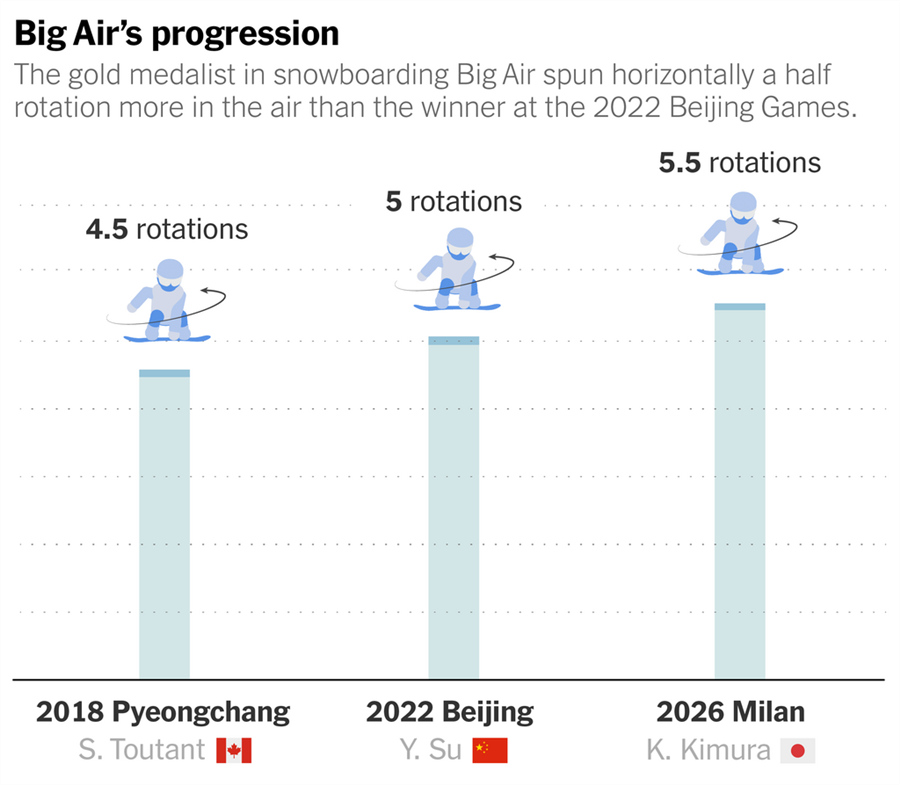
— Big Air snowboarders have improved drastically since the event debuted at the 2018 Olympics. At the Milan-Cortina Games, Kira Kimura of Japan pushed the boundaries. He won gold after executing a switch backside 1980 weddle — five and a half full horizontal rotations.
| MORNING READ |

Hundreds of artworks by the French poet and artist Jean Cocteau were damaged in 2018 when a freakish storm sent seawater crashing through a museum in the French Riviera. Years of careful restoration saved most of them, but the museum remains closed.
Now, Chloë Cassens, the granddaughter of the man who donated the art, wants to reclaim the works, arguing that an agreement to exhibit the Cocteau collection in perpetuity had been violated. It’s an uphill battle. “Even my lawyers have asked, “Girl, are you for serious?’” she said. Read more.
| AROUND THE WORLD |
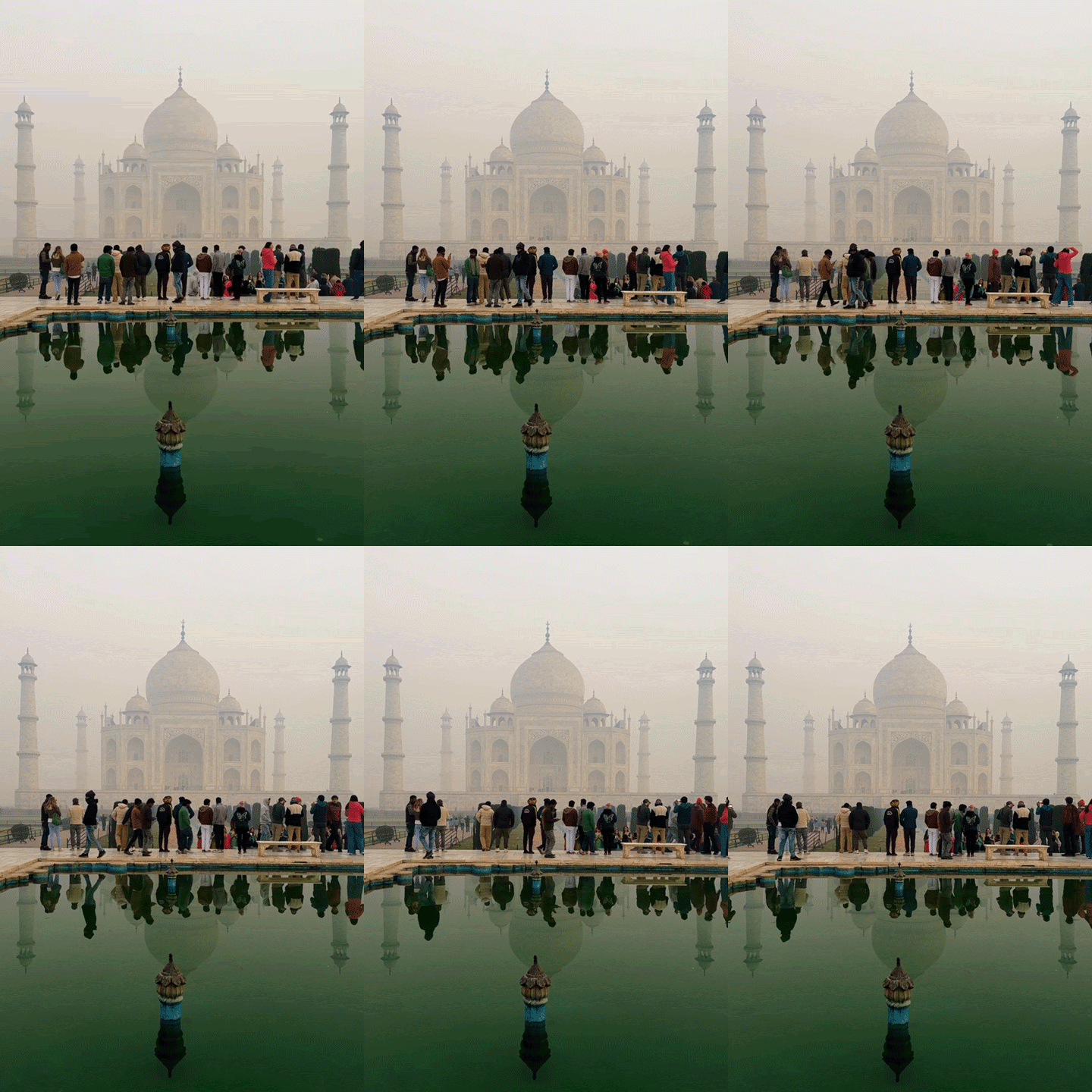
An old conspiracy theory gets new life in India
For years, some pseudo-historians, lawyers and religious believers have pushed a conspiracy theory that the Taj Mahal, which was commissioned by a Muslim leader in the 17th century, is actually a Hindu structure and that its true story has been suppressed.
Now, a new Bollywood film, “The Taj Story,” has put a spotlight on the revisionist claims. Though its writer and director denies an overtly political motive, the story reflects a brand of Hindu nationalism championed by Prime Minister Narendra Modi.
One historian called it “communal poison” intended to divide India, where about 14 percent of the population is Muslim. Read more.
| RECOMMENDATIONS |
Brighten: Light your room like a Swede. (They know a lot about dark winter days.)
Travel: Spend 36 hours in Lagos, Nigeria, with its thriving arts and nightlife scene.
Watch: Carmen Maura shines as a widow forced to sell her childhood home in Morocco in “Calle Málaga.”
| RECIPE |
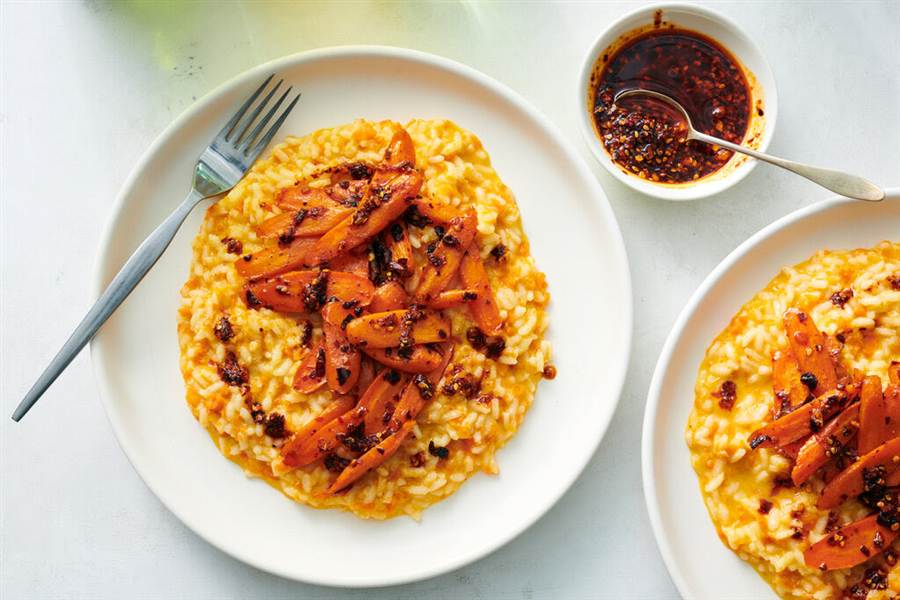
Simple yet surprising, this carrot risotto is a study in contrasts: Luscious, creamy risotto is topped with caramelized carrots that are roasted with spicy chile crisp while you make the rice.
